


I’m lucky. My joints don’t ache, and I can take the stairs without thinking about it. But I have family members for whom that’s not the case, and watching someone wince as they stand up from a chair changes how you think about supplements you’d normally dismiss.
I’ll admit, I’ve tended to roll my eyes at collagen. It’s marketed as some kind of wonder supplement for joints, muscles, hair, skin, nails... the list never ends. But if it can genuinely help people with painful or stiff joints, it deserves a proper hearing, even from a sceptic like me. So this week, I’ve been rummaging through the research.
Osteoarthritis is estimated to affect 300–500 million people worldwide, and those numbers are expected to climb sharply as populations age. For many of you, that’s not a statistic - it’s the aching knee on the stairs, the stiff fingers first thing in the morning, the hip that stops you going out for a walk.
And our treatment options are frustratingly limited. We don’t have anything that reverses the underlying joint damage. That leaves us managing symptoms, mostly with painkillers and anti-inflammatory drugs, which often work well but can carry real costs, like damage to the gastrointestinal tract and kidneys, and an increased risk of cardiovascular disease.
So, does collagen actually help symptoms? Does it protect cartilage? And is it worth the money?
Why might swallowing collagen help your joints?
The logic sounds appealing. Cartilage contains collagen. Osteoarthritis involves cartilage breaking down. So taking extra collagen should help repair it, right?
Not quite. Your digestive system breaks collagen down into its component parts before anything reaches the bloodstream. Whether those fragments then find their way to damaged cartilage and stimulate repair is a different question entirely. Providing raw materials isn’t the same as persuading a damaged joint to rebuild.
That said, there is some biological plausibility. In the lab, certain collagen peptides do encourage cartilage cells to produce more of the proteins that maintain cartilage, while reducing some processes that break it down. Similar effects have been seen in animals. But findings are inconsistent, particularly with human cartilage, and we don’t have convincing evidence that swallowing collagen rebuilds cartilage in people.
Two main formulations are used, with different proposed mechanisms:
Hydrolysed collagen peptides: pre-digested collagen containing amino acids and peptides. Some animal studies suggest these accumulate in cartilage tissue and may influence cartilage-cell metabolism. Typical doses are 5-20 g per day.
Undenatured type II collagen (UC-II): thought to work through the immune system. It’s taken up by immune-cell clusters in the gut called Peyer’s patches, where it may activate T cells that suppress inflammation in joint cartilage. UC-II doses are measured in milligrams.
Both mechanisms remain proposed, not proven. But there’s enough biological plausibility to make the clinical trials worth looking at.
So what happens when researchers give collagen to people?
The pooled evidence initially looks encouraging.
A meta-analysis of 35 studies involving 3,165 participants with joint symptoms found that collagen derivatives had a small-to-moderate effect on pain, equivalent to an 8.5-point decrease on a visual pain scale that went from 0 to 100.
They also found significant improvements in joint function, no clear differences between collagen formulations, and no concerning safety signals. Most studies lasted less than six months, so we can’t say much about longer-term effects.
That 8.5-point drop is a modest improvement on a scale of 0 to 100, but potentially worthwhile if you’re struggling with painful joints. And it’s an average; some people will experience greater relief, others little or none.
A systematic review of 14 randomised controlled trials told a similar story. Most studies found some positive results, typically less pain and better joint function. But doses ranged from 1.2 to 20g per day across studies lasting 12 to 48 weeks, and the researchers felt this wide variation made it hard to generalise results. They were also concerned that about 20% of participants dropped out of some studies, possibly because they weren’t experiencing benefit.
At this point, you might reasonably conclude collagen works. The meta-analyses suggest a modest benefit, and the safety picture looks clean. But when I looked more closely at individual trials, I started getting swatted around the ears by red flags.
How much of that improvement is actually due to collagen?
In a six-month trial, 107 adults with knee osteoarthritis took either undenatured type II collagen or a placebo. Those taking collagen had less pain, less stiffness and better function.
But look at the graph.
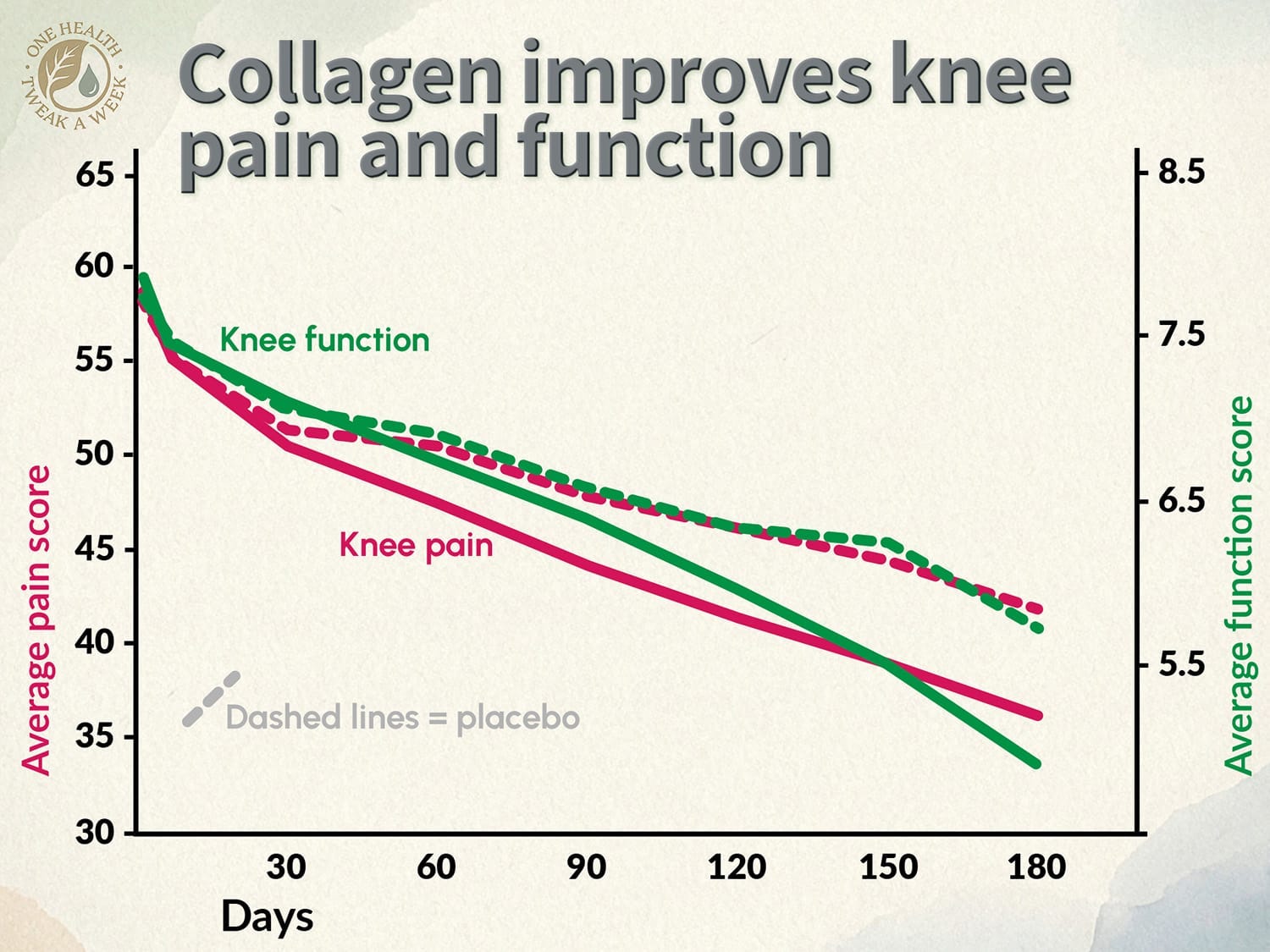
The solid lines show clear overall improvements in knee pain (red) and joint function (green).
But see the dotted lines? Those participants were taking a placebo, yet their pain and function also improved substantially. For the first month, improvements were essentially the same for those taking collagen and those taking a dummy supplement.
We see this regularly in clinical trials, especially when patients are reporting their own symptoms. These participants were seen in clinic monthly, far more attention than most arthritis patients typically receive. They wanted the treatment to work. They may have wanted to please the researchers, even subconsciously. The result was that even those taking nothing found their symptoms improving significantly.
So yes, people taking collagen felt better, but the relevant question is “How much better did they feel than those taking placebo?” The answer is a little, but not nearly as much as the headline numbers suggest.
And whose assessment of pain should count most? In a separate trial, 182 adults with hip or knee pain (but without established osteoarthritis) took collagen peptides or a placebo for 12 weeks. Physician assessments favoured collagen. But when the patients themselves rated their pain, there was mostly no significant difference, apart from some specific activities like climbing stairs, squatting and kneeling.
For a treatment intended to relieve pain, the patient’s experience should carry more weight than the doctor’s assessment. It’s their pain. Yet it was the doctor’s assessment that made the headline results.
How much confidence should we place in the positive trials?
Beyond the placebo challenge, there are broader concerns.
The methodological issues are widespread: small samples, subjective endpoints, considerable protocol variation, and high dropout rates in some studies. A meta-analysis can only be as good as the trials it pulls together.
Then there’s the question of who’s funding the research. Many collagen trials have been financed by companies that manufacture or sell the supplements, and some investigators have commercial relationships with those companies. That doesn’t automatically make findings unreliable; industry-funded research can be excellent. But it means we should examine the evidence carefully rather than accepting the researchers’ conclusions at face value.
In the UC-II trial I described above, two investigators worked for the supplement company and a third was an adviser. They disclosed these relationships, so we can interpret the findings with that in mind.
But when I dug deeper into another trial, the picture was more troubling.
The lead researcher owned the company conducting the study and held collagen-related patents assigned to the manufacturer supplying the supplement being tested. The publication acknowledged that the manufacturer supplied the supplement but didn’t explain who paid for the much greater cost of running the trial.
Public records listed the researcher’s company as both responsible for the trial and a source of funding. Yet the paper claimed that funders had no involvement in designing the study or analysing the results, even though researchers from that company did both.
The study also wasn’t registered publicly until more than three years after it began. Trials are supposed to be registered before they start, partly to create a public record of what was planned, and partly to prevent researchers from publishing only positive results and quietly shelving failures. Registering years later defeats both safeguards.
Despite all these connections, the authors declared no conflicts of interest.
To be clear, the available evidence doesn’t establish that these interests influenced the results. But the incomplete disclosures make it harder to evaluate the findings with confidence. And they underscore why independent confirmation matters.
The two most recent independently funded trials aren’t encouraging:
108 patients with knee osteoarthritis received UC-II or placebo for 24 weeks. No significant differences in pain, stiffness, function, or X-ray appearance.
68 patients took hydrolysed collagen plus UC-II or placebo. Both groups improved, but with no significant difference between them.
Neither trial is large enough to prove collagen is ineffective. But together with the methodological and transparency concerns, they strengthen the case for caution.
Could collagen still protect your joints?
This is one of the most persuasive bits of collagen marketing - not just pain relief, but cartilage protection or repair.
The evidence doesn’t support it. There’s no convincing human evidence that collagen supplementation prevents osteoarthritis, rebuilds cartilage, or slows disease progression. The 2026 trial found no difference in X-ray appearance between collagen and placebo after 24 weeks, though that’s a short window for detecting structural change.
It helps to distinguish two separate questions: “Does my knee feel better?” and “Is the disease progressing more slowly?” A supplement could affect the first without touching the second.
If we rank the claims by the strength of the evidence, there’s uncertain support for modest relief of existing knee symptoms, much less for other joints, and essentially none for preventing arthritis or repairing damaged cartilage.
On a practical note, collagen has an incomplete essential amino acid profile, making it a poor substitute for a quality protein supplement like whey. Don’t assume it’s doing double duty for your muscles while addressing your joints.
So where does this leave us?
Collagen may relieve knee pain and stiffness modestly, but the evidence is more uncertain than the positive headlines suggest. The average additional benefit over placebo appears small, and there’s no convincing case that collagen protects cartilage, prevents arthritis, or helps joints other than the knee.
That said, conventional painkillers and anti-inflammatory drugs carry their own costs with long-term use: gastrointestinal, renal and cardiovascular risks that accumulate over time. Collagen’s short-term safety profile looks reassuring, and the main practical downside is cost.
Speaking of which, a quick scout on Amazon.com shows collagen hydrolysate/peptides powder coming in at around $0.50 to $1 per day for a 10g dose.
For someone with troublesome joint symptoms, a short trial is reasonable. If you feel meaningfully better, that improvement matters to you, even if you can’t know how much is attributable to collagen versus expectation or natural symptom fluctuation.
But continuing indefinitely without noticeable relief, in the hope that collagen is quietly protecting your cartilage, isn’t supported by the evidence.
If I developed troublesome knee pain, I’d be inclined to try collagen for a couple of months. And if it relieved my symptoms as well as my usual painkillers or anti-inflammatories, I’d have little hesitation in making the switch. Collagen appears to have a much better safety profile, and neither treatment has been shown to reverse the underlying joint damage.
As always, your responses are anonymous, but they really help me tailor future content to what’s most helpful to you. Please take a moment to click a button.
HEALTH TWEAK OF THE WEEK
Collagen supplements may offer modest relief from joint pain and stiffness, particularly in knee osteoarthritis, though the evidence is less convincing than the positive headlines suggest. There’s no good evidence that collagen prevents arthritis or repairs cartilage, but a time-limited personal trial is reasonable if your joints are giving you trouble.
1. Don’t take collagen solely to prevent arthritis. No study has shown that collagen supplementation prevents osteoarthritis or protects healthy cartilage. If your joints are comfortable, the evidence doesn’t justify the expense.
2. Consider trying a straightforward hydrolysed collagen supplement if your joints are troublesome. Take around 10g of hydrolysed collagen peptides daily for eight weeks, particularly for knee osteoarthritis. This is a commonly studied dose, not a proven optimum. There’s no convincing evidence that higher doses work better. Eight weeks ought to be enough to determine if it’s helping you. Choose an ordinary product rather than an expensive formulation promising cartilage regeneration.
Before you start, identify the symptoms you most want to improve: walking pain, morning stiffness, difficulty on stairs, whatever matters most to your daily life. Keep other treatments and activities as consistent as reasonably possible, so you can judge the collagen fairly. And don’t count collagen towards your protein needs; its amino acid profile is incomplete compared with whey or other quality protein sources.
3. Decide whether it’s earning its place after eight weeks. If you feel no meaningful improvement, stop. There’s no good reason to continue in the hope of cartilage protection. If you feel substantially better, continuing is reasonable, provided the cost is acceptable and the supplement is well tolerated. You won’t be able to separate collagen’s effect from expectation or natural symptom fluctuation, but relief is still relief. Keep expectations modest for joints other than the knee, where the evidence is thinner.
Hopefully, this has helped you make a bit more sense of the collagen claims. There’s probably something worthwhile here for painful joints, but a lot of the marketing goes well beyond what the evidence supports. At least now you can decide whether it’s worth giving it a go, without being taken in by promises of rebuilding your cartilage.
And we haven’t finished with collagen yet. Apparently, it’s also supposed to give us younger-looking skin, thicker hair and stronger nails. Quite a lot of work for one supplement! We’ll have a closer look at those claims in a future issue.
🎧 Prefer to listen while wondering when standing up from a chair became quite such an undertaking?
🎙️ This week’s One Health Tweak a Week podcast takes a closer look at collagen for joint health. There’s some encouraging evidence that it can relieve pain and stiffness, but the story gets rather more complicated when we examine the trials behind the headlines.
You’ll hear:
Why collagen sounds like a sensible way to repair damaged cartilage, but the biology doesn’t necessarily work that way
What the clinical trials tell us about pain relief and joint function, and why improvements in people taking a placebo are so revealing
Why I became increasingly sceptical as I investigated commercial interests, research funding and some rather questionable disclosures
Why collagen might help painful knees, but there’s little convincing evidence that it prevents arthritis or rebuilds damaged cartilage
How to decide whether collagen is worth trying for eight weeks, which formulation and dose I’d choose, and what it might cost
👉 Good company for your next walk, commute, or while wondering whether the collagen powder in your cupboard has been earning its keep.

(Episodes are free for now. Paid subscribers support the deeper research - and unlock practical tools to help you improve your health without turning it into a second job.)
🧭 Before you go
💬 Have you tried collagen supplements for your joints? Did you notice any improvement in pain or stiffness, or was it money down the drain?
📤 Know someone who’s taking collagen for their joints, or considering giving it a try? Share this week’s article with them. It might help them decide what’s worth paying for and which promises to take with a pinch of salt.
👥 Paid corner – If you’re already taking collagen, or wondering whether to start, drop me a message in our private chat. We can look at the formulation and dose you’re considering, whether you’re paying over the odds, and how to judge whether it’s actually helping.

Until next Saturday – keep those joints moving, and don’t expect a scoop of collagen to perform miracles.
– Ben