
Are You Chasing Super-Berries and Missing the Point of Fruit?
Different fruits bring different strengths - fibre, vitamin C, polyphenols, potassium and more - so the smarter goal is a simple weekly rotation, not a superfood hunt.

Last summer, I noticed that elderberries kept appearing at the top of fruit nutrient rankings: highest in polyphenols and fibre. I have an elderberry bush in the garden.
Naturally, I started eyeing it up with newfound respect.
A little Googling revealed that raw elderberries are toxic. Fine: cook them. I decided to make jam. My first foray into jam-making.
I got distracted, left it on the heat too long, and now own a jar of what is, to all intents and purposes, black set glue. A useful reminder that chasing the “optimal” fruit can lead you somewhere absurd when there’s perfectly good fruit sitting in the bowl.
If you spend any time on health blogs or Instagram, you’ll recognise the underlying anxiety: should you be adding goji berries to your breakfast? What about acai? White mulberries? Is ordinary fruit somehow second best?
The evidence points somewhere far more practical.
You don’t need to find the single best fruit. You need enough fruit, often enough, with enough variety that different fruits can do different jobs. Let me show you why.
Fruit already earns its place
Before we get into rankings, it’s worth remembering how strong the case for fruit already is.
After tracking over 105,000 Americans for 30 years, researchers found that the single food most strongly linked to healthy ageing was fruit.
Not leafy greens. Not oily fish. Fruit. The thing we tend to treat as lunchbox filler or a polite alternative to pudding.
A 2017 meta-analysis added dose precision: people eating around 200g (about 7oz, or two handfuls) of fruit each day had a 15% lower risk of dying from any cause compared to those who ate little or no fruit.
That’s a substantial signal. But here’s the important nuance: there was little extra benefit from eating more than 200g. The relationship plateaus. So “more is always better” doesn’t hold: you’re aiming for a regular, moderate habit, not a heroic daily intake.
Fruit is also linked to lower cardiovascular disease, lower type 2 diabetes risk, lower BMI, and lower dementia risk.
These are observational associations: fruit eaters tend to have other healthy habits, and higher incomes and education levels may play a role. But the consistency of the signal across different populations, different study designs and different outcomes is hard to dismiss.
So: fruit matters. The question isn’t whether to eat it. It’s whether some fruits give you a meaningful edge over others.
Testing the “best fruit” idea
Let’s look at three key nutrients in fruit and see if any single fruit consistently rises to the top.
Fibre
Fibre is one of fruit’s clearest links to long-term health.
Higher dietary fibre intake is associated with lower risk of cardiovascular disease, all-cause mortality, type 2 diabetes, diverticular disease, and some cancers. Trials show modest improvements in blood sugar control, LDL cholesterol, blood pressure, weight, and bowel function. (Sources: 1, 2)
So which fruits deliver it?
Top of the class: elderberries (see previous glue-related misadventure). Raspberries come a very close second, and blackberries aren’t far behind. For a practical, grab-and-go high-fibre option, pears are a top choice.
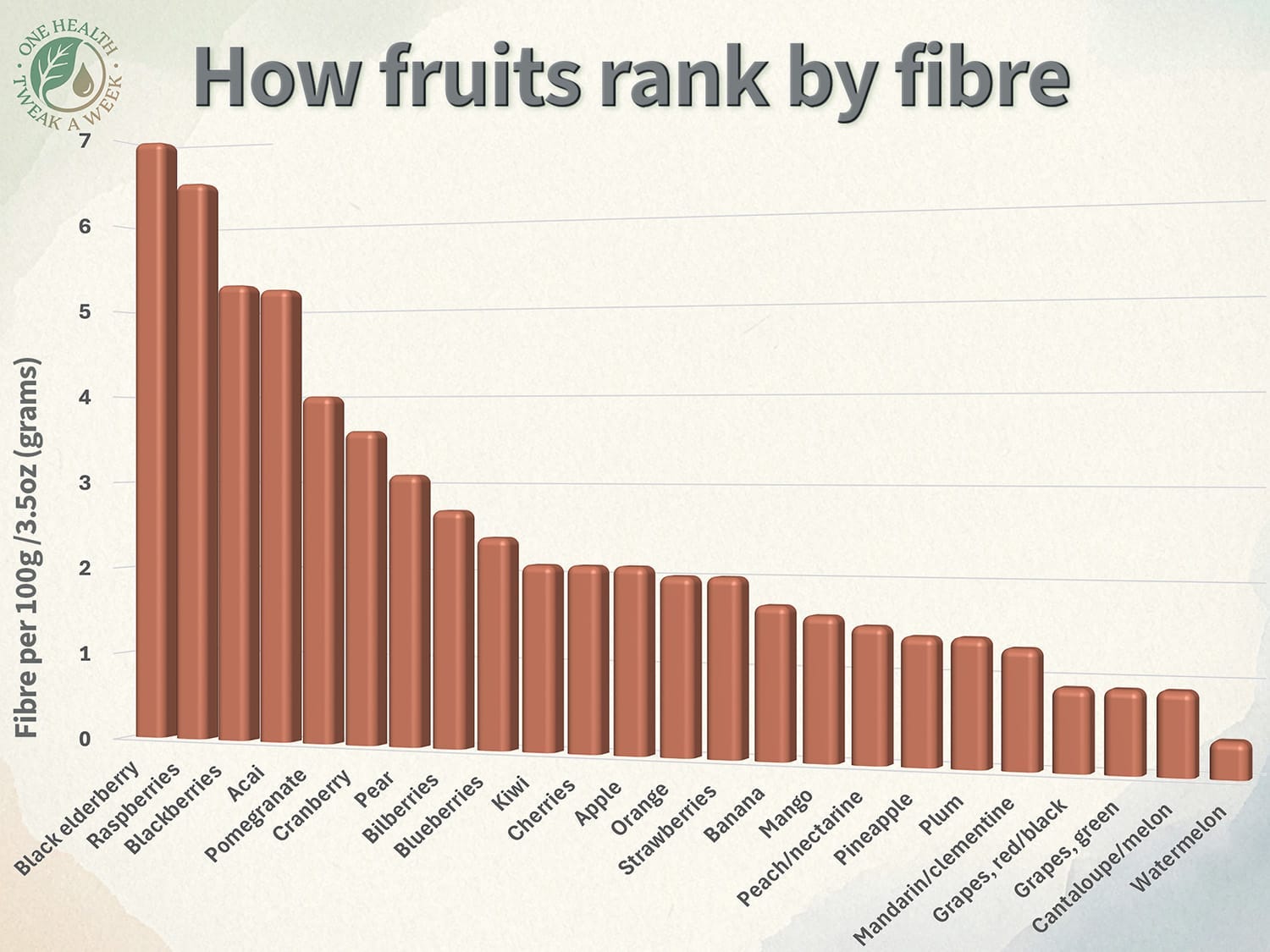
Notice the spread. There’s a real difference between raspberries and, say, watermelon. Fibre content isn’t the same across all fruits: your choice does matter somewhat.
Vitamin C
At school, we learned how scurvy was the scourge of the British Navy during our peak seafaring years of old.
The Scot James Lind conducted one of the first clinical trials aboard HMS Salisbury, proving that oranges and lemons could prevent and treat scurvy. The Royal Navy mandated citrus rations for all sailors, preferring the more readily available limes, which earned British sailors the nickname “Limeys.”
So do you need to suck on a lemon to get your daily vitamin C?
No. Oranges do just fine. But you might be surprised to hear that kiwis and strawberries match oranges, with pineapple not far behind. It’s notable that many of the fruits highest in vitamin C tend to be yellow or orange: oranges, pineapple, cantaloupe, and mango.
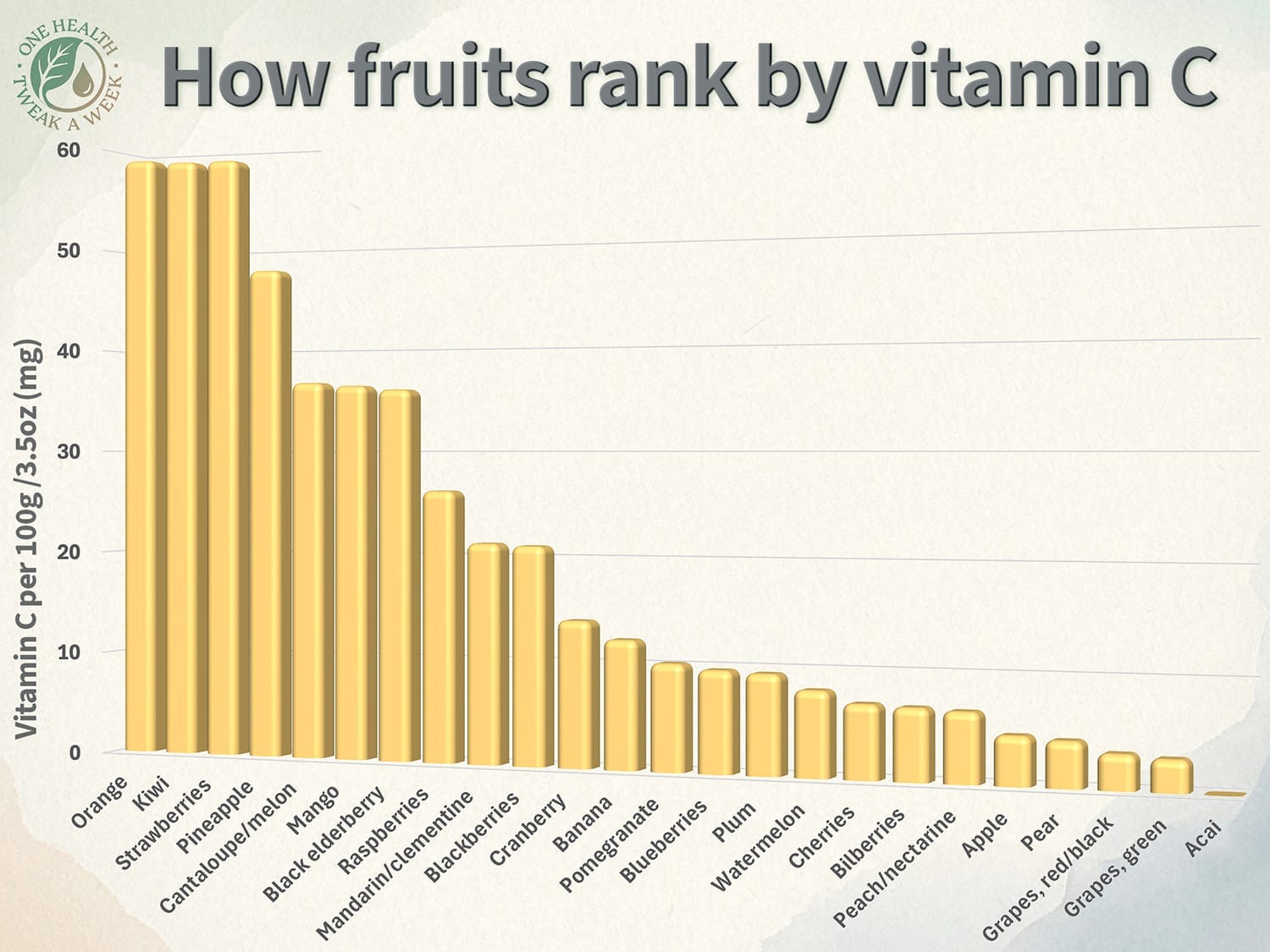
So citrus deserves its reputation, but it doesn’t own vitamin C. The story is already more nuanced than “one fruit wins.”
Polyphenols
Polyphenols are a large family of plant compounds involved in colour, flavour, and plant defence.
In humans, polyphenol-rich foods are linked with better cardiometabolic health, probably through effects on vascular function, inflammation, insulin signalling, blood pressure, and the gut microbiome: not simply by acting as antioxidants.
How big is the signal? In the renowned PREDIMED study of the Mediterranean diet, researchers found that people consuming the most polyphenols had a 37% lower risk of premature death from any cause compared to those who ate the least.
That’s a large association. Now it’s one study, so not proof of causality, but a substantial and plausible signal.
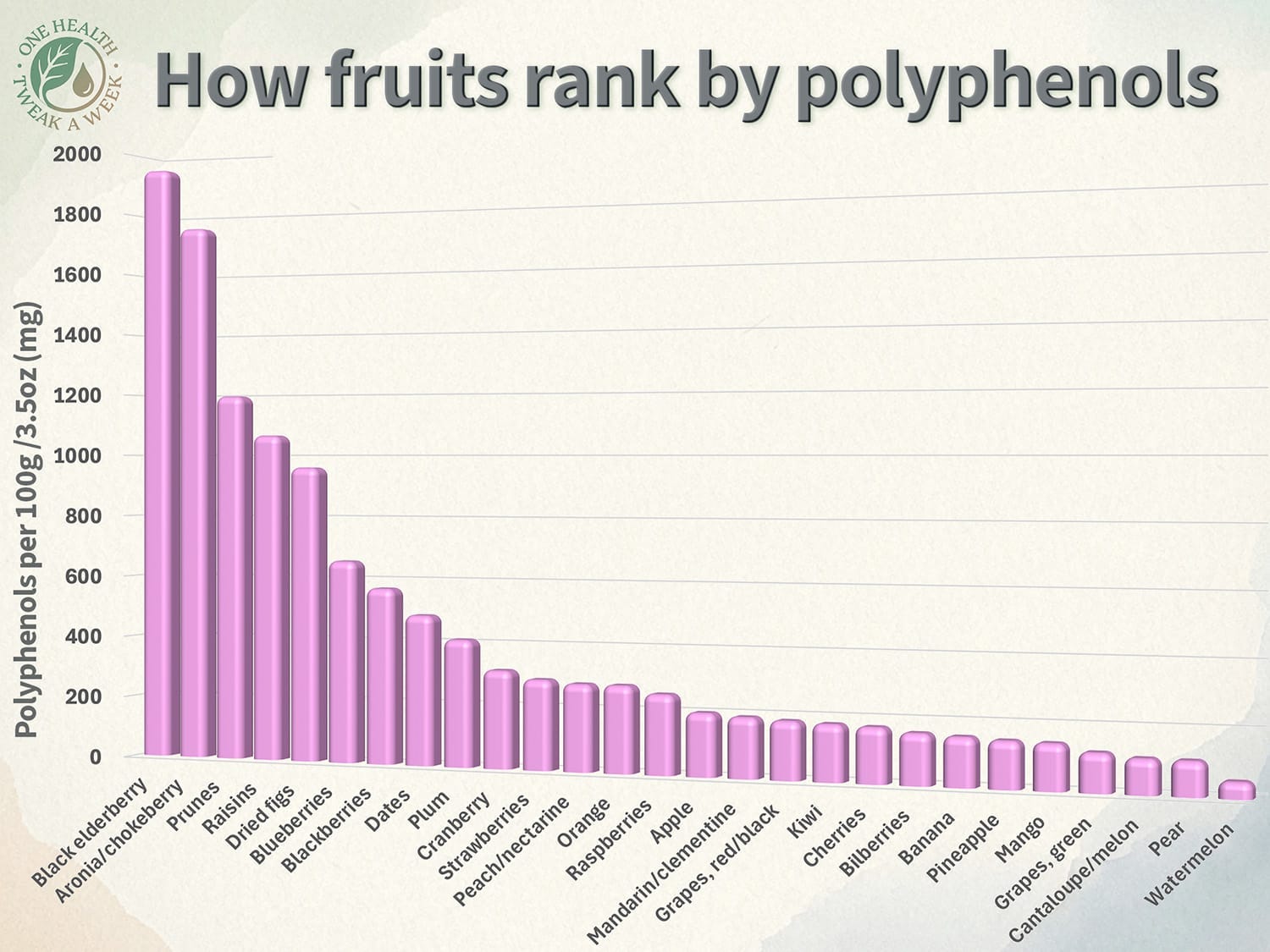
At the top of the list: elderberries and chokeberries (exotic, impractical). Next: prunes, raisins, and figs. For fresh, readily available options, blueberries and blackberries lead the pack. The pattern is striking: fruits highest in polyphenols tend to be dark-coloured. Elderberries, chokeberries, blueberries, blackberries, plums.
A note on dried fruit
You’ll have noticed dried fruits appearing near the top of the polyphenol rankings. They also deliver fibre and minerals. That’s useful.
But before you polish off a whole bag of raisins, it’s worth seeing what happens when you remove the water from fruit: you concentrate the sugar.
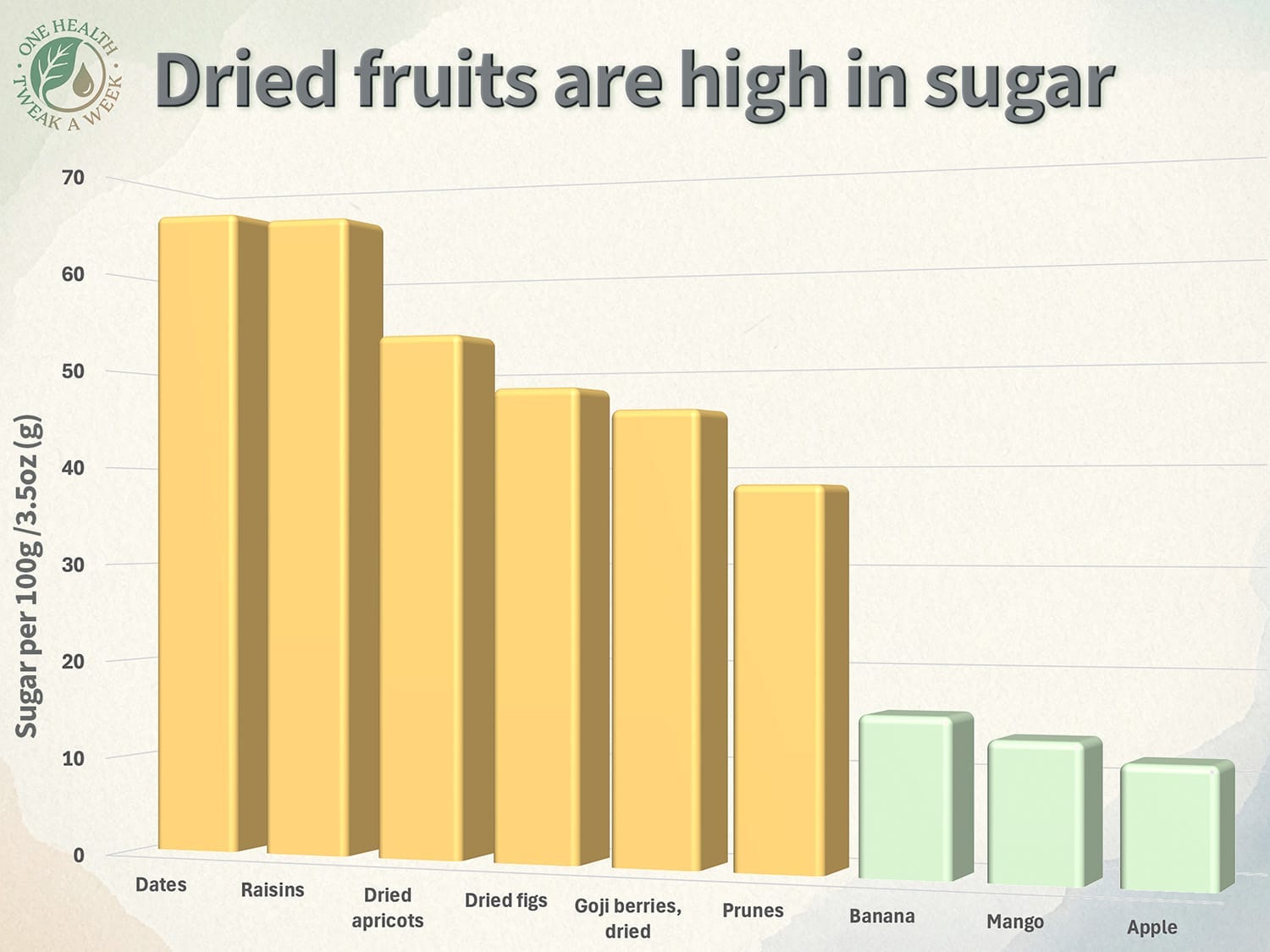
While the sugar in fresh fruit isn’t a cause for concern (it comes packaged with fibre, water, and micronutrients that slow absorption), it’s easy to consume a lot of sugar if you graze from a bag of dried fruit.
Dried fruit works best as a small addition: a spoonful on oats or yoghurt, not an afternoon snack by the handful.
The pattern keeps repeating
We’ve looked at fibre, vitamin C, and polyphenols in detail. We could keep going:
Potassium: banana, kiwi, and cantaloupe lead.
Vitamin A: dried apricots, cantaloupe, mango, prunes, and mandarins top the list.
Lower-calorie options: watermelon, strawberries, cantaloupe, peaches, and blackberries have the fewest calories per serving.
Every time you look at a different nutrient, a different set of fruits rises to the top.
There is no one fruit to rule them all. The idea that you’re somehow missing out by not eating the latest exotic berry is, mostly, marketing.
How fruit learned to catch our eye
There’s one more reason fruit colour matters, and it has nothing to do with Instagram.
For our primate ancestors, sweetness wasn’t a dietary trap as it is in today’s pastry aisle. It was a survival signal.
Sweet usually meant ripe; ripe meant energy, water, and nutrients. A taste for sweetness helped guide early primates towards foods worth eating.
But fruit didn’t just shape our cravings. It may also have helped shape how we see.
Fruit-bearing plants and fruit-eating animals co-evolved in a kind of ancient bargain. Plants developed bright colours and sweet flavours to attract animals who would eat the fruit and scatter the seeds. In turn, day-feeding primates evolved colour vision that made it easier to spot ripe red, orange, and yellow fruit against a green canopy.

So when a mango glows orange, a plum turns purple, or berries deepen from green to red or black, that colour isn’t decorative. It’s part of an old conversation between plants and animals: this is ripe; this is worth your attention.
Not all fruit followed that route. Some fruits were shaped more by nocturnal seed-dispersers like bats, so they tend to be duller in colour but stronger in scent and softness - think bananas and figs.
Either way, the point is the same: fruit variety isn’t just a nutrition chart. It’s an evolutionary story you can pick up, peel, slice, and eat.
What this means for your health
The right question isn’t “which fruit wins?” It’s “am I eating fruit regularly, and am I covering different nutrient jobs across the week?”
Fruit choice does matter: berries bring fibre and polyphenols; citrus and tropical fruits bring vitamin C; bananas and kiwis bring potassium; dark fruits bring polyphenol depth. But the real win isn’t optimising any single slot. It’s covering the spectrum without turning fruit into homework.
Real healthy diets aren’t nutrient league tables. They’re daily habits.
The goal isn’t ranking. It’s coverage.
Two handfuls a day. Multiple colours and families across the week. That’s the practical target: enough variety to let different fruits do their different jobs, without needing a spreadsheet or an Instagram influencer to tell you which berry to buy this month.
As always, your responses are anonymous, but they really help me tailor future content to what’s most helpful to you. Please take a moment to click a button.
HEALTH TWEAK OF THE WEEK
The evidence is clear: eating around 200g (two handfuls) of fruit per day is associated with a 15% lower risk of all-cause mortality, and fruit was the single food most strongly linked with healthy ageing in a 30-year cohort of over 105,000 people.
Since no single fruit dominates across all nutrient categories, the biggest upgrade is variety, not trying to choose one “best” option.
1. Build a weekly fruit spectrum. When you’re at the grocery store, aim for five different colours or fruit families: berries, citrus, apples and pears, stone fruits, grapes, tropical fruit, or melon. We’re talking about eating whole fruit here: fruit juices and smoothies don’t bring the same benefits.
2. Keep the boring winners in rotation. You don’t need exotic berries. Apples, pears, oranges, bananas, berries, kiwis, and grapes are practical, affordable, and collectively cover a wide nutrient spectrum. They’re your backbone.
3. Treat dried fruit as an add-on. A small spoonful of raisins, prunes, or figs on oats, yoghurt, or muesli gives you polyphenols, fibre, and minerals without the sugar load that comes from grazing by the handful.
4. Frozen fruit works just as well. Keep berries, cherries, mango, or pineapple in the freezer so “running out of fruit” doesn’t become the default excuse. Frozen fruit isn’t second best: it’s picked and frozen at peak ripeness, and it’s just as good as fresh. I keep a dedicated freezer drawer stocked, and most evenings dessert is a bowl of (thawed) frozen fruit topped with Greek yogurt.
Years ago, I was more of a pudding person. Now, I can’t imagine going back. Now, most evenings, dessert is a bowl of fruit topped with Greek yoghurt.
That’s the real upgrade here: not chasing the perfect fruit, but making varied fruit so normal that it replaces something less useful.
No elderberry glue required.
🎧 Prefer to listen while washing grapes or rescuing berries from the back of the fridge?
🎙️ This week’s One Health Tweak a Week podcast is about why you don’t need to find the single best fruit - and what to do instead.
You’ll hear:
Why fruit is strongly linked with healthy ageing and lower all-cause mortality
Why the sweet spot seems to be around 200g a day, not heroic quantities
Why different fruits do different jobs: fibre, vitamin C, polyphenols, potassium, colour and more
Why berries, citrus, apples, pears, tropical fruits, melons, dried fruit and frozen fruit each have a place
How to build a realistic weekly fruit spectrum without turning meals into a spreadsheet
👉 Good for your next walk, commute, or figuring out what to do with a pomegranate.

(Episodes are free for now. Paid subscribers support the deeper research - and help me build practical tools that turn good intentions into habits that actually stick.)
🧭 Before you go
💬 Is fruit something you enjoy, something you try to remember to eat, or something you’ve not got around to yet?
📤 Know someone who’s still chasing the “best” fruit, or wondering whether ordinary apples and oranges are somehow second best? Forward this to them.
👥 Paid corner - Want help making fruit work better for your routine, appetite, budget, blood sugar concerns, or gut tolerance? Message me in our private chat, and I’ll help you make it practical.

Until next Saturday - may your fruit bowl look a little less like a holding pen for apples, and a little more like a weekly spectrum.
– Ben
Interesting, Ben. My fridge has an assortment of blueberries, strawberries, and blackberries at all times. Then, grapes, kiwis, and clementines or pixies to snack on.
What an interesting article! Loved it . Useful and distribution worthy