Why Your Best Intentions Get Lost in the Grocery Store
Bakery smells, aisle-end offers and health-halo labels can nudge even sensible shoppers off course. Here’s how to come home with food that supports the week you meant to have.
I’ll be honest: there are times I enjoy a good browse around the grocery store, looking for something new to try, and briefly imagining the exciting meals I might prepare if I bought the jar of fermented chilli paste.
But most weeks, I just want to get in and out before I accidentally buy three different kinds of crackers and artisanal cheese from caves in northern Greece.
The grocery store, however, prefers the first version of me.
That matters because grocery shopping isn’t a rare event. The average American shopper reportedly makes 83 supermarket trips each year, Brits make 130, while French, German and Italian shoppers make about 180. Each trip may feel ordinary, but together they shape the food environment we live in.
And since what we eat day today depends heavily on what’s sitting in our kitchens, those trips are where the real dietary decisions get made. Not at the dinner table. Not while reading a nutrition article. At the grocery store, half-distracted, slightly hungry, with a shopping cart that seems to have a mind of its own.
So this week, I want to look at what happens between the healthy shop we intend to do and the food environment we actually create for the rest of the week - with a little help from the grocery store.
To make that less abstract, let’s follow Helen.
Helen is a midlife woman shopping for herself and her partner. She’s not dieting. She’s not trying to be perfect. She simply wants a reasonably healthy week: fruit in the bowl, yogurt in the fridge, vegetables for dinner, eggs, milk, bread, lunch ingredients, something quick but decent for evening meals, and fewer cookies than last week.
She walks in with a list. A list written on the back of an envelope that also contains half a phone number and a doodle of her cat.
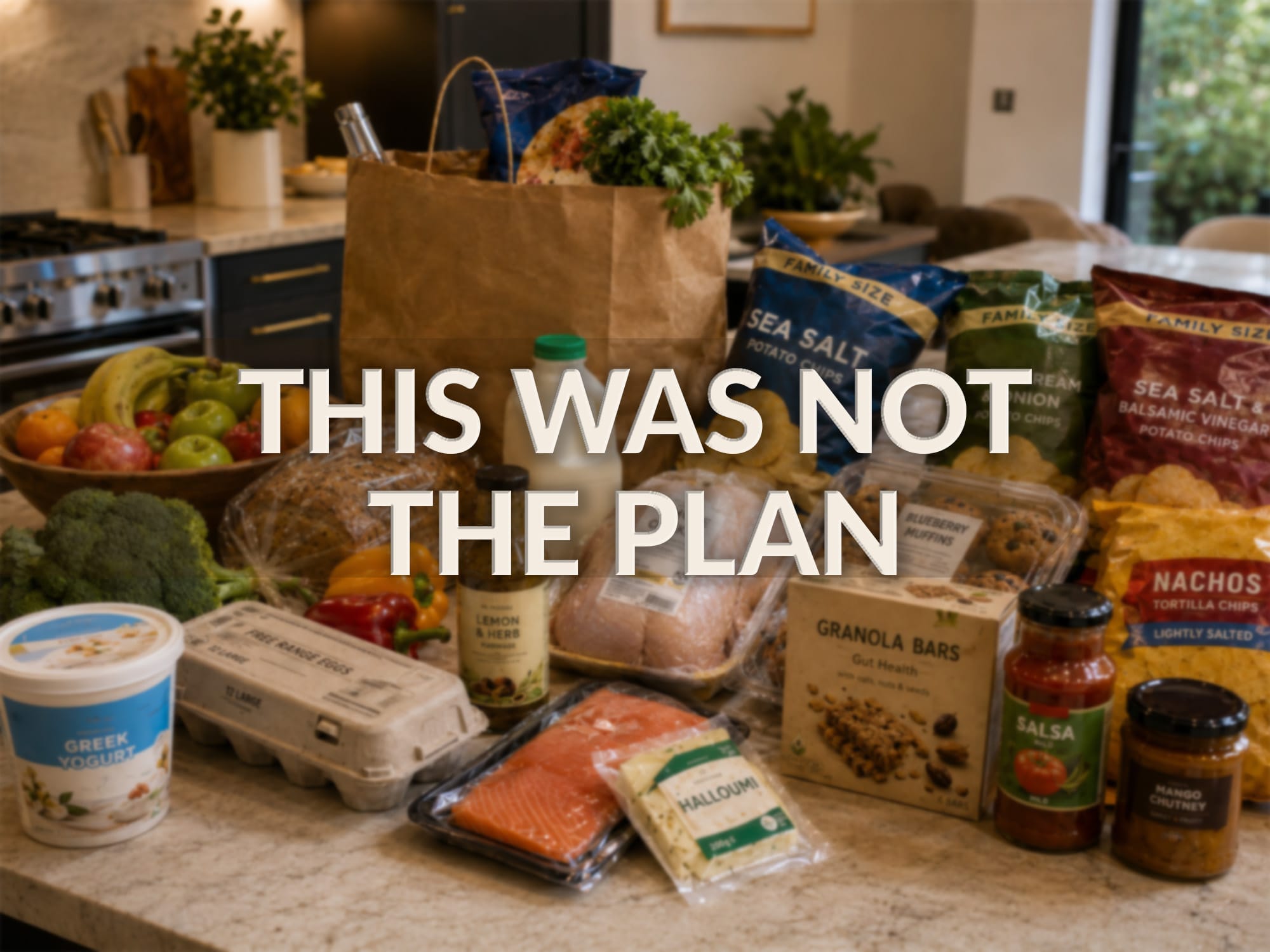
By the time Helen leaves, the healthy shop is still there, plus blueberry muffins (they looked better than cake), three-for-two family bags of potato chips, a “gut health” granola bar, nachos and salsa for a movie night that didn’t exist twenty minutes ago, a seasonal aisle-end treat, and one item she tasted as a free sample.
The healthy shop is still in there. It’s just come home with company.
How did that happen?
The store changes what Helen notices
It starts before Helen has bought anything.
She picks up a shopping cart. It is bigger than her list needs, because carts usually are. A half-empty shopping cart has a strange effect. It makes the planned shop look small. It gently suggests there’s room for lots more.
Then comes the entrance.
This is the decompression zone, designed to slow her down, shift her out of car-park mode, and set a tone. Fresh produce isn’t here because it’s the logical place for it (delicate items at the bottom of a cart is objectively a bad idea). It’s here because it creates a feeling: this is a wholesome place, full of good food.
This isn’t necessarily bad. If Helen buys more fruit and vegetables, excellent. There’s good evidence from a University of Southampton partnership with the supermarket chain Iceland that changing grocery store placement can nudge healthier purchasing: when fruit and vegetables were expanded near the entrance, and checkout and aisle-end confectionery was replaced with non-food items and water, fruit and vegetable sales rose while confectionery sales fell.
The environment can help.
But it can also lead us astray.
Helen adds apples, salad, broccoli and berries. The trolley now looks wholesome. She feels like the shop is going well, because it is. The problem is that an early burst of virtue can make later, less healthy additions feel less consequential, even deserved.
Our brains keep a moral ledger. If we do something virtuous, that makes it much easier to justify a less virtuous decision a little later.
This is where grocery stores become so effective. They rarely need to persuade us to abandon our intentions completely. They only need to add a second list to the one we brought in.
Helen heads for the essentials. Milk, eggs, bread, yogurt, dinner ingredients. Unfortunately, the essentials aren’t arranged in one convenient “people who want to get in and out” zone. They’re scattered. The path to milk, eggs and bread has a yellow-brick quality: scenic and winding.
This is one of those things I used to think was simply bad layout.
Like when I found myself looking for canned coconut milk. I found three different brands shelved in three different aisles: one in world foods, one in home baking, and one in the free-from section.
That’s not poor organisation. For the store, the layout is doing exactly what it’s supposed to do. Every extra aisle I wander down is another set of products I wasn’t planning to see. And just when you’ve finally learned where everything lives, they rearrange the store. The longer you spend searching for the eggs that moved two aisles to the left, the more things you pass, and the more likely something is to land in the cart.
Helen has the same experience. She goes in for a normal shop and finds herself on a tour. Just when she thinks she knows where everything lives, the store pulls her back into the aisles.
Then the bakery smell hits. Warm bread, maybe cinnamon. Some stores pipe the exhaust from their baking ovens into the ventilation system. Others use commercial scent diffusers. It doesn’t matter which. Warm bread doesn’t smell like a rational purchasing decision. It smells like childhood bakeries, weekend mornings and the kind of relaxed life we aspire to.
Then there are the aisle ends.
We’re so accustomed to seeing “specials” on end displays that we’re around 30% more likely to buy something from one than from the middle of the aisle. Products don’t even need to be discounted. Put something on an end display and label it “Pick of the Week”, and most of us assume it’s a deal. Helen pauses at a seasonal display. A marinade and some halloumi land in the trolley.
They were on nobody’s list.
UK policymakers have recognised that certain spots in the store are impulse hotspots. Since 2022, larger stores have been restricted from placing foods high in fat, sugar, or salt at entrances, aisle ends, and checkouts. But plenty of less-than-healthy products still find their way into prominent positions.
The store changes what Helen reaches for
Placement matters because shopping isn’t a series of fully conscious decisions. Much of it is noticing, reaching, comparing, and moving on.
Premium products are often placed around chest-to-waist height, where they’re easy to see and easy to grab. Cheaper or larger packs may be lower down. In the cereal aisle, bright packages aimed at children typically appear lower, where children can see them and begin their important work as junior brand ambassadors.
Helen doesn’t have young children with her, but she still notices the theatre of it. A small child nearby has spotted a cartoon tiger, and is making a case for its essential nature to his tired-looking mother.
The adult version is more subtle.
Helen sees “this week’s specials”. She sees attractive displays. She sees foods presented as timely, seasonal, limited, improved, or new. Suppliers may pay for prominent placement, which is worth keeping in mind. Sometimes it’s there because someone paid for that stretch of visual real estate.
The store changes what Helen justifies
Helen is still trying to have a healthy week. She’s not throwing frozen doughnuts into the shopping cart while muttering, “We all die eventually.”
She’s making small, familiar bargains with herself.
She passes the bakery display. She doesn’t need cake. She knows she doesn’t need cake. But those blueberry muffins have a lot less fat and sugar than the double chocolate gateau sitting next to them.
This is true and also completely unhelpful. Many things are better than cake. That doesn’t make muffins good for you.
The comparison that matters is blueberry muffin versus no blueberry muffin. But standing in front of both, that isn’t the comparison that presents itself. In goes the pack of muffins, feeling to Helen like a victory of restraint.
Further along, she spots a granola bar in a matte beige box with a leaf on it. “Gut health,” it says. “With 10g of protein and plant fibre.” It looks like something a nutritionist would approve of. It is, in fact, an ultra-processed snack with a long ingredients list. But the packaging has done its work.
Products labelled “high protein,” “plant-based,” “natural,” “no added sugar,” or “immune support” create a health halo that’s remarkably effective on exactly the shoppers who are trying hardest.
The cartoon tiger catches children. The beige box with the leaf catches us.
Then the supermarket invents an occasion.
A display suggests movie night. Nachos, salsa, dips, perhaps something fizzy. Helen had no movie night when she entered the shop. She had Thursday. But it sounds lovely, and now the nachos and salsa are in the trolley and the evening is taking shape around them.
This is another of the tricks of retail: it doesn’t just sell products, it sells scenarios. Game night. Romantic night in. Halloween supper. Summer barbecue. Cosy winter evening. The product is no longer a packet of something ultra-processed and salty. It is a little lifestyle upgrade.
A little further on, a friendly person at a tasting stand offers Helen a sample of a new chutney. She likes it. She wasn’t planning to buy chutney. But someone just gave her something for free, which triggers an involuntary sense of obligation. She doesn’t want to be rude. The chutney joins the nachos.
And then the three-for-two family bags of potato chips. They feel like good value because the per-bag price drops nicely. She and her partner like potato chips. Three bags is a lot, but they won’t go to waste.
They certainly won’t. That’s the problem.
Back in 2009, the Wharton Business School estimated that 60 to 70 percent of purchases were unplanned.
Helen isn’t unusual. She’s typical. The store is designed for exactly this.
Value isn’t always value
There’s a cost-of-living reality here, which we shouldn’t skip over, especially now.
For many households, offers matter. Unit pricing matters. Bulk buying can help. A reduced-price dinner ingredient may be genuinely useful. A grocery store that helps someone put decent meals on the table for less is doing something valuable.
The problem is when “value” means buying extra food we didn’t intend to buy, especially food we don’t want to eat in extra quantities.
A 3-for-2 offer is only good value if we actually want three. A large pack is only economical if the larger amount helps rather than haunts us. A marked-down treat is still a treat in the cupboard. “This week’s special” may be a bargain, or it may just be masquerading as one.
Price comparisons can be awkward too. One apple is priced per item, another per kilo. One cereal has a loyalty price, another has a larger pack, another has a “Great Value” sticker that may or may not be doing anything useful, and loyalty-scheme gamification (just $4.50 more and you’ll hit your points target!) all nudge spending in directions that serve the store far more than the shopper.
By this point, Helen has been in the shop long enough that comparing per 100g prices feels less like sensible household management and more like sitting an exam. She just wants to get home.
So she chooses using the path of least resistance. We all do.
The point isn’t that every offer is a trap. It’s that health and budget both suffer when the basket fills with unplanned extras that seemed like good value in the store and become easy defaults at home.
The supermarket follows Helen home
Helen pays. She loads the car. She unpacks at home. The fruit goes in the bowl, the yogurt goes in the fridge, the vegetables go in the crisper drawer. So far, so good.
The potato chips go in the cupboard - more accurately, they fill it. They’ll need to be eaten to make room. The muffins go on the counter. The nachos go next to the pasta.
The grocery store’s job ended at the checkout. But the kitchen environment is just getting started.
It’s Tuesday evening. Helen is tired. Dinner is running late. She opens the cupboard for something quick and sees three family bags of crisps before she sees the lentils. She has a muffin with her tea because it’s there, and it would be a shame to waste it. The gut-health granola bar becomes a desk snack, eaten without much thought. The nachos and salsa appear on Wednesday, because the salsa has a short date and, well, movie night.
None of this is catastrophic. A few muffins and some potato chips won’t ruin anyone’s health. Helen shouldn’t live in a house containing only lentils, carrots and self-denial.
But the pattern matters. This isn’t one week. It’s 130 shops a year.
Each time, a list arrives at the store, and a slightly different week’s eating comes home. Over months, the unplanned extras become the background hum of the household diet: the snack you reach for because it’s there, the treat that restocks itself before it’s questioned, the “healthy” bar that turns out to be a cookie in a greener wrapper.
The supermarket changes what you buy today. Your cupboards change what you eat for the rest of the week.
Healthy eating is much easier when the healthier choice is what the house offers you.
HEALTH TWEAK OF THE WEEK
Grocery stores are carefully designed to shape what you notice, what you reach for, and what you justify.
That doesn’t make you gullible for falling for it. It makes you a human shopping in an environment built by people who’ve studied human behaviour for decades.
The aim is not to shop perfectly. It’s to notice when the store is trying to add its own list to yours. A good shop is one that makes the rest of the week easier, especially when your future self is tired, hungry, busy, or less noble than your Saturday-morning self imagined.
So, here are a few suggestions to arm you against the grocery store’s behavioural nudges.
Write the list before you enter the shop: A list isn’t just a memory aid. It’s a defence against the grocery store writing part of the week’s menu for you. Include the ordinary things that make healthy meals happen: fruit, vegetables, yogurt, milk, bread, pulses, fish, chicken, tofu, lunch ingredients, or whatever your usual staples are. A vague intention to “get healthy things” is much easier to hijack than a specific list.
Choose the basket or trolley size that fits the list: A large shopping cart makes a reasonable shop look strangely inadequate. If you only need a few things, use a basket. If you need a trolley, notice the empty-space effect before it starts whispering that there’s room for a few more snacks. Maybe fill it with your jacket.
Buy planned treats, not ambush treats: Treats are part of normal life. The problem is the treat you never wanted until it appeared at the exact point your concentration had started to fade. If you want cookies, buy the cookies you actually like, in the amount you actually want in the house. That’s very different from collecting random “specials” because the grocery store staged a small diorama near the aisle end.
Treat aisle-end offers as adverts, not recommendations: An aisle-end display is not your grocery store kindly pointing out what your household needs. It’s advertising. Pause before adding it. Ask: was this on my list, is it genuinely good value, and do I want this amount in my kitchen?
Be sceptical of health-halo packaging: If a snack says “high protein” or “gut health” in a tasteful green box, flip it over and read the ingredients. Would you buy it in a plain wrapper?
Don’t bulk-buy foods you don’t want to eat in bulk: A large pack of oats, lentils, frozen berries or Greek yogurt may make the week easier. Three family bags of nacho chips may also make the week easier, just in the wrong direction.
Use online favourites or repeat baskets if they help: Online shopping has its own nudges, offers and checkout prompts, so it’s not magic. But for staples, a saved favourites list or repeat basket can reduce wandering, impulse buying and “how did that get in there?” moments.
Check unit pricing when cost matters: If money is tight, unit pricing can help you avoid fake bargains. Compare per 100g, per pound, or per litre where possible. If the supermarket makes that awkward, it might be worth asking why
Don’t shop hungry: It sounds obvious, but it materially changes what ends up in the trolley. Even a banana before you leave the house helps.
Use a budget, scan-and-shop, or a visible running total if it helps: A running total helps constrain the unplanned additions.
Helen doesn’t need to turn the weekly shop into a tactical operation - and neither do you. She just needs to notice when the store is writing a second list on top of the one she brought in.
The goal isn’t a perfect shop. It’s a kitchen where, on a tired Tuesday evening, the easiest thing to reach for is something you actually planned to eat.
🎧 Prefer to listen while unpacking the groceries or wondering how the nachos got into the cart?
🎙️ This week’s One Health Tweak a Week podcast is about how grocery stores shape what you buy - and why that changes what you eat all week.
You’ll hear:
Why healthy eating starts before the food reaches your kitchen
How shopping carts, store layout, aisle ends, smells, samples and “specials” quietly change what we notice
Why health-conscious shoppers are especially vulnerable to protein, gut-health, plant-based and no-added-sugar packaging
Why a 3-for-2 offer can be good value in the store and a problem in the cupboard
How to shop in a way that makes the healthier choice easier for your tired future self
for your next walk, commute, or trying to remember whether you actually meant to buy chutney.
(Episodes are free for now. Paid subscribers support the deeper research - and help me build practical tools that turn good intentions into habits that actually stick.)
🧭 Before you go
💬 This is a judgement-free aisle: what’s the most absurd thing the grocery store has talked you into buying? Or what’s the one item that somehow gets you every time?
📤 Know someone who goes in for milk and comes out with snacks, seasonal specials and a new plan for movie night? Forward this to them.
👥 Paid corner - Want a second pair of eyes on one grocery habit that keeps undoing your good intentions? Message me in our private chat with the pattern you’ve noticed, and I’ll suggest one practical change to try next time.
Until next Saturday - may your list remain mostly your list, and may the aisle ends have slightly less power over your future self.
– Ben


