

Only 7.8% of the nearly 48,000 women in a landmark 30-year US study made it to their seventies still thinking clearly, still moving easily, and still free of major disease or mental health issues.
That’s fewer than one in ten.
And if you’re wondering what the other 92% missed… it’s not what most wellness blogs tell you.
Was it sleep? Regular exercise? A Mediterranean diet?
All of those help - of course they do.
But in this study, one dietary pattern stood out.
It was a food group we’ve spent the last two decades trying to cut.
Carbohydrates.
Not the sugar-bomb doughnuts that fuel late-night on-call shifts. Not the limp white-bread sandwiches I remember wolfing down between ward rounds.
I’m talking about real carbs - the chewy, fibre-rich kind that look the same now as they did on your grandmother’s table.
That’s a bit awkward, isn’t it?
Low-carb has been popular for decades - and with good reason. Cut back on refined starch and sugar, and most people lose weight and improve their blood sugar.
The mistake wasn’t cutting the worst carbs. It was treating all carbs as guilty by association.
The UK Biobank’s striking nutrition pyramids already showed it: the people with the lowest death rates don’t shun carbohydrates. They build their diets on them.
And when you plot total carbohydrate intake against mortality, you don’t get a straight line of doom. You get a gentle U-shape. Eat too little, and risk rises. Eat too much, and it climbs again. The safest middle ground hovers around 50% of daily calories.
Of course, short-term weight loss studies often favour lower-carb diets. But this isn’t about months - it’s about decades. When it comes to healthy ageing, the carbs you choose matter more than how many you cut.
Today, we look at a new analysis from the legendary Nurses’ Health Study that takes things further. It doesn’t just look at living longer - it looks at living well.
And it finds that the people who aged most gracefully weren’t cutting carbs. They were choosing the right ones.
The Bigger Picture On Carbs and Mortality
Before we get to the new study, let’s zoom out.
When you pull together the largest nutrition datasets we have - the UK Biobank is a favourite example - a striking pattern emerges.
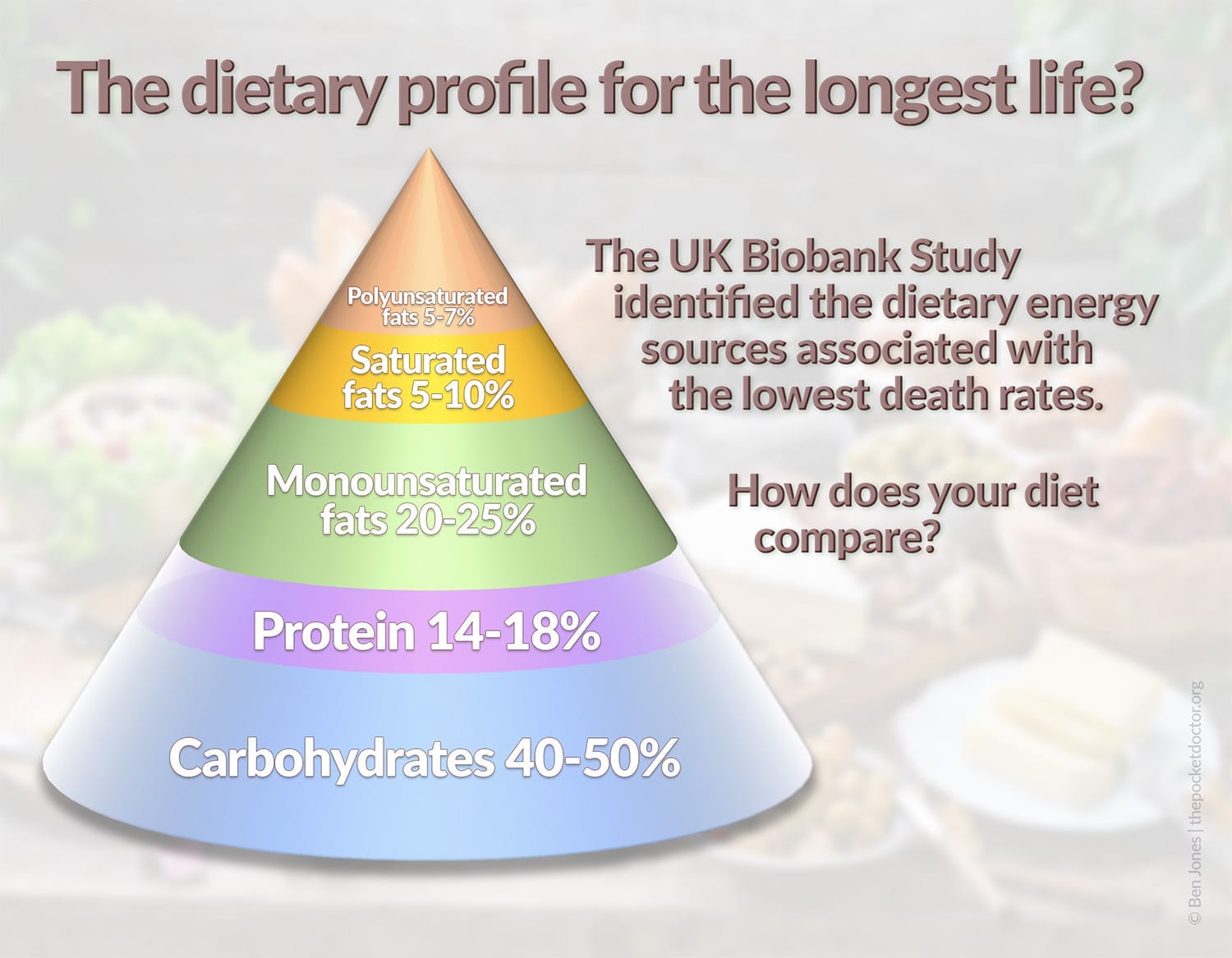
Here’s a food pyramid shaped by outcomes - not opinions.
At its base sit carbohydrates. The people living the longest - dodging heart disease, stroke, and cancer - aren’t cutting carbs. They’re eating plenty, and using them as the backbone of a balanced, fibre-rich diet.
You see the same thing in other large cohorts, like the ARIC and PURE studies.
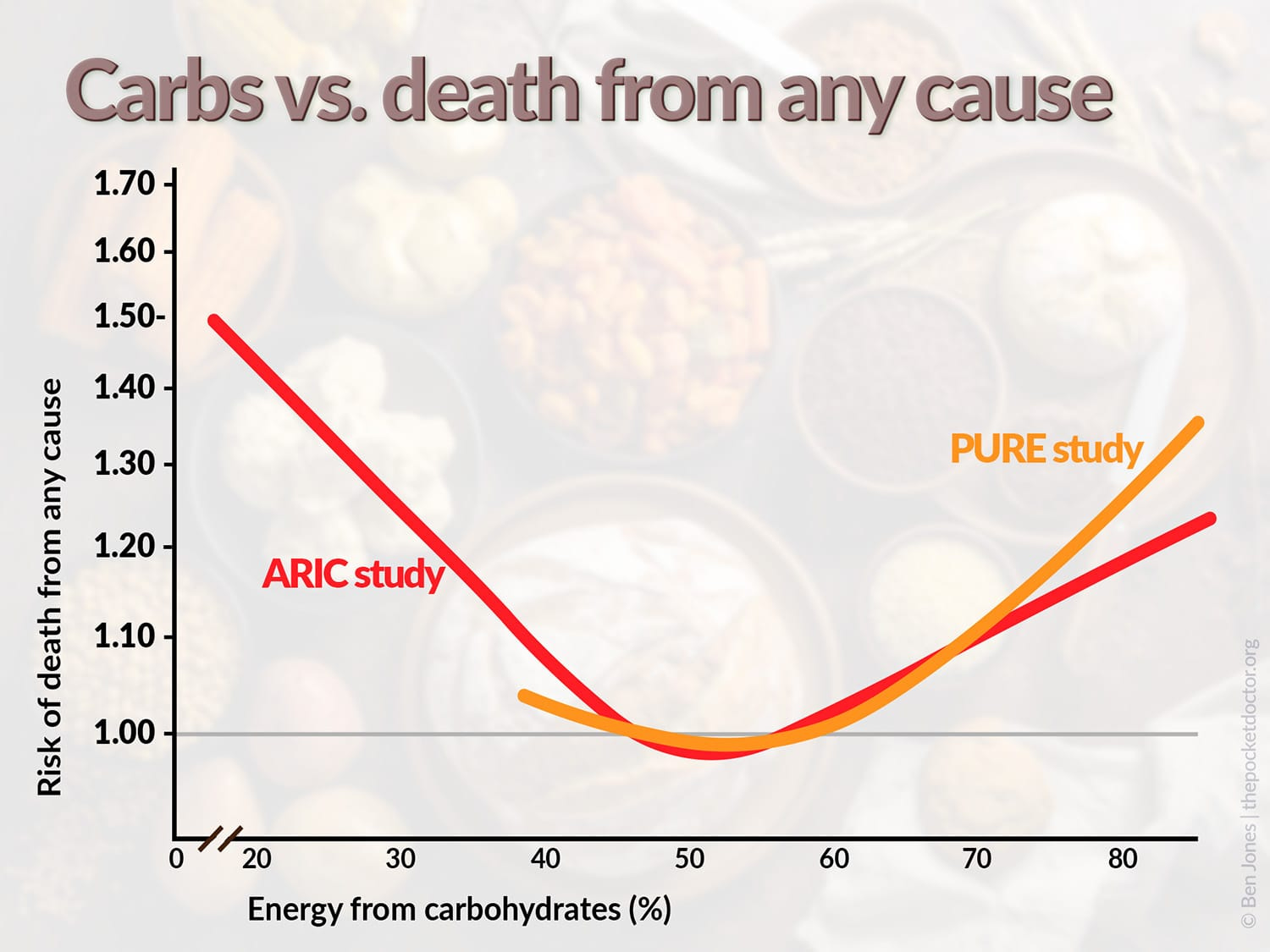
Plot total carbohydrate intake against risk of death, and you get a U-shaped curve. Mortality climbs when carbs fall well below half of daily calories - and again when they rise too high. The sweet spot? Around 50–55% of daily energy.
In PURE, one of the largest nutrition studies ever run, people eating moderate amounts of carbohydrates from whole plant sources had a 30% lower risk of death compared to both low-carb and high-carb extremes.
These findings aren’t outliers. They’ve been repeated across diverse populations and line up with decades of research linking dietary fibre, whole grains, and plant diversity to lower rates of heart disease, diabetes, and premature death.
In other words, when carbs are chosen well, they’re not a health hazard - they’re a foundation of healthy ageing.
Now, what do the findings from the Nurses’ Health study add?
The Right Carbs for a Long, Healthy Life
Researchers tracked 47,513 women for three decades, looking not just at who lived longest - but who reached age 70 in peak condition: free of major disease, mentally sharp, physically mobile, and emotionally well.
Only 7.8% - fewer than one in thirteen - met that high bar.
When the researchers sorted the women by the types of carbs they were eating, the pattern was clear:
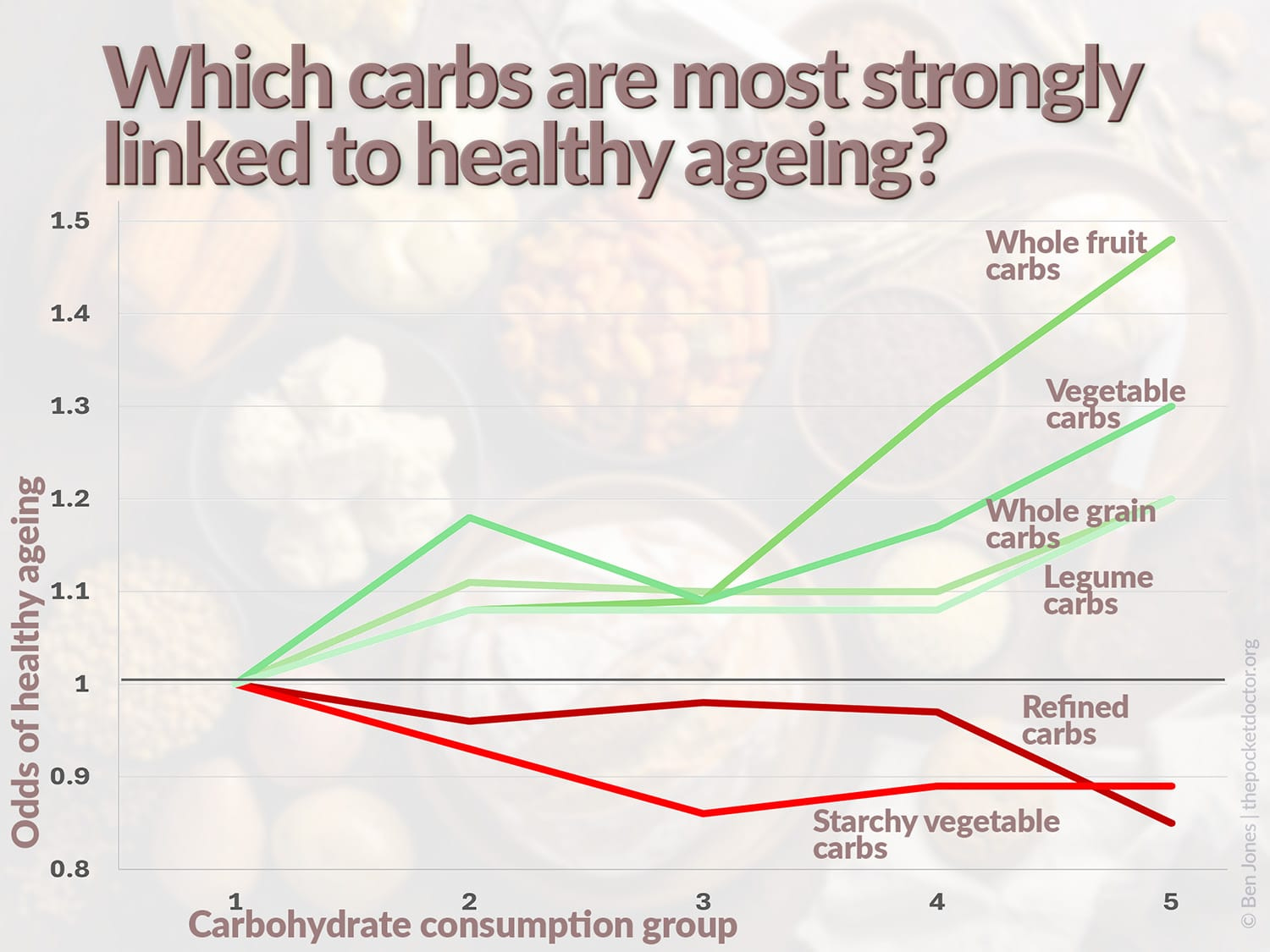
The graph shows a clear divide. Carbohydrates from whole fruit (not juice or smoothies), vegetables, whole grains, and legumes were linked to higher odds of healthy ageing. Refined carbs and starchy vegetables, by contrast, were associated with lower odds.
Here’s what stood out:
High-quality carbs were strongly protective
For every 10% of daily calories that came from whole-food carbs - fruit, veg, whole grains, and legumes - the odds of healthy ageing rose by 31%.
Refined carbs pulled the odds down
Each extra 10% of calories from refined grains (white bread, white rice, pasta, cakes, sugary snacks), or added sugar was associated with a 13% lower chance of healthy ageing. Carbs from starchy vegetables like potatoes and corn carried a similar 10% reduction.
Fibre was the common thread
Every additional 4-5g of daily fibre was linked to a 17% increase in the odds of reaching 70 in good health. When the researchers adjusted for fibre, many other associations faded - pointing to intact, fibre-rich carbs as the real driver. Fibre from fruit and vegetables outperformed fibre from cereals or legumes.
Low-GI eating mattered
Women with the highest dietary glycaemic index had 24% lower odds of healthy ageing than those with the lowest.
The glycaemic index (GI) ranks carbs by how quickly they raise your blood sugar after eating:
Pure glucose scores 100.
Slow-rise carbs like oats, lentils, and most fruits score low.
Fast-acting carbs like cornflakes, white bread, and cake score high.
A lower-GI diet generally means steadier blood sugar and insulin levels - one reason it’s often linked to better metabolic and cardiovascular health.
You can look up a food’s glycaemic index here.
🔁 Smart Swaps That Add Up
Healthy carbs are still carbs - and they come with calories.
If you just start piling them on, you’ll also be piling on the calories. So if you want to reap the benefits, you’ll need to swap them in for something else.
The researchers modelled the impact of trading other calories for high-quality carbs - while keeping total intake constant.
Swapping refined carbs for high quality carbs is associated with a 16% higher likelihood of healthy ageing.
Swapping animal protein for high quality carbs is linked to a 14% higher chance.
For total fat, the increase is 12%.
Switching from refined carbs to healthier ones is a no-brainer - it may increase your chance of reaching your seventies in peak health by 16%.
That may be tough - especially if, like me, you’ve got a sweet tooth. But it’s the best place to start.
Interestingly, some of the biggest gains came from replacing animal protein and fats with fibre-rich carbs - a finding echoed in other large studies.
👥 Does This Only Apply to Women?
The Nurses’ Health Study followed women - but there’s nothing uniquely female about the biology.
Men in the Health Professionals Follow-up Study show the same pattern: more intact grains, fruit, and fibre-rich vegetables → lower risk of chronic disease and early death.
And pooled US and European cohorts tell the same story.
In short, the benefits of high-quality carbohydrates aren’t gender-specific - they’re human.
The takeaway isn’t “eat more carbs for the sake of it.”
It’s: upgrade the carbs you already eat.
Swap white bread for seeded wholegrain.
Swap potatoes for beans.
Swap sugary snacks for fruit and veg.
The more of your daily carbohydrate intake you shift into the high-quality column, the better your odds of joining the 7.8% who reach their seventies sharp, mobile, and free of chronic disease.
🔧 Practical takeaways
Don’t start with carbs. Start with protein.
That’s your anchor - especially after 50, when muscle starts to disappear faster than you think.
Aim for around 0.8-0.9g per kg body weight in your fifties, and 1.2g/kg once you hit your mid-sixties.
Once that’s locked in - think poultry, Greek yoghurt, cottage cheese, fish, lean meat, tofu, beans - then build the rest of the plate with high-quality carbs.
Use fibre as your filter
If a carb-rich food doesn’t come with fibre, it’s probably not doing you any favours.
A simple label trick: check the carb-to-fibre ratio.
How:
Look at the nutrition panel - note total carbohydrates and fibre.
Divide carbs by fibre.
A ratio of 10:1 or lower = a solid choice.
For example:
Seeded whole-grain bread: 20 g carbs, 4 g fibre → 5:1 ✅
White sandwich bread: 22 g carbs, 1 g fibre → 22:1 🚫
Ignore the front-of-pack marketing. This ratio is a quick way to spot whether you’re getting the real thing - or just processed fluff.
🔁 Make simple swaps
The best-performing carbs in the study - in order - were those from whole fruits (not juices and smoothies), vegetables, whole grains, and legumes. That’s where you’ll get the most bang per gram.
So when you’re thinking about what to cut back on - and what to eat more of - here’s a good place to start:
Cut back on:
White bread
Sugary breakfast cereals
Potato crisps/chips
Biscuits/cookies
Potato-heavy sides
Ready meals high in refined starch and added fat
Fatty or processed meats
Swap in more of:
Whole fruits: apples, berries, citrus, pears, etc.
Vegetables: especially leafy greens, cruciferous, and colourful veg
Whole grains: seeded wholewheat or rye bread, rolled oats, farro, quinoa, barley
Legumes: lentils, chickpeas, black beans
Lean protein: fish, poultry, tofu, Greek yoghurt.
The goal isn’t perfection. It’s a steady shift toward carbs that come with fibre, colour, and structure.
Important: Don’t cut back on total protein to fit in more carbs.
Your protein target is non-negotiable - it’s what protects your strength and function as you age.
Once that’s covered, then look to trim ultra-processed foods, excess fats, and starchy extras to make room for high-quality carbs.
🍽️ Build real-world meals that tick both boxes
A healthy carb isn’t “a rice cake.” It’s a smart base that supports your protein and fibre goals.
Breakfast: Porridge with berries, Greek yoghurt, and a sprinkle of nuts and seeds
Lunch: Chicken or tuna on seeded wholegrain with a big handful of salad leaves and a piece of fruit
Dinner: Salmon with roasted veg and a scoop of quinoa or lentil pilaf
The meals aren’t fancy. But they’re working for you - keeping blood sugar steady, fibre intake high, and your odds of healthy ageing in the green.
HEALTH TWEAK OF THE WEEK
Choose carbs that help you age well.
Last week, we focused on bread additives. This week, we’re taking a step back to ask: what do the carbs themselves mean for healthy ageing?
Only 7.8% of the 47,513 women in a landmark 30-year US study reached their seventies in good health - still sharp, still active, and free of major disease.
What set them apart wasn’t eating fewer carbohydrates.
It was eating the right ones.
Women who replaced refined grains and sugary foods with high-quality carbohydrates - whole grains, fruit, vegetables, and legumes - had about 30% better odds of hitting that healthy-ageing benchmark. Those leaning on white bread, potatoes, and added sugars fared noticeably worse.
How to put this into practice this week
Secure your protein first.
That’s your anchor. Aim for 0.8–0.9g per kg of body weight in your fifties, and 1.2g/kg from your mid-sixties onwards to protect strength and muscle mass.
Use fibre as your carb filter
Glance at the nutrition panel and divide total carbs by fibre:
Seeded wholegrain bread: 20g carbs, 4g fibre → 5:1 ✅
White sandwich bread: 22g carbs, 1g fibre → 22:1 🚫
Aim for a ratio under 10:1 - the lower, the better.
Swap one refined carb a day
This week, trade a low-fibre staple for something better:
White bread → seeded rye
Potato crisps/chips → raw veg or nuts
Mashed potato → lentil or bean-based sides
Build meals around the combo
Protein + healthy carbs is your sweet spot:
Breakfast: Porridge with berries and Greek yoghurt
Lunch: Tuna or chicken on seeded wholegrain with salad
Dinner: Salmon or tofu with roasted veg and quinoa or lentils
The goal isn’t to eat more carbs overall.
It’s to upgrade the ones you’re already eating - shifting from fibre-poor, fast-digesting starches to fibre-rich, intact, colourful ones.
It won’t feel radical. But choosing lentils over mash might just mean you hit 70 with your memory intact and your hiking boots still laced.
You’re not just tweaking your diet. You’re designing a plate that echoes the habits of those rare few who stayed strong, sharp, and free of chronic disease well into their seventies.
🎧 If you’d rather listen while your lentils simmer…
🎙️ This week’s episode of the One Health Tweak a Week podcast is all about carbohydrates - and why the right ones might quietly be shaping who stays healthy into their seventies.
Here’s what you’ll hear:
Why the healthiest 7.8% ate more carbs, not less
Which carbs are most strongly linked to healthy ageing
How to spot the good stuff quickly when shopping or cooking

👉 Listen now while your lentils simmer or your sourdough toasts
(Psst: These episodes are free for now - but won’t be forever. Paid subscribers help keep this newsletter going and get bonus content, private member chat, and insider Q&As.)
👉 What’s next?
🗳️ Last week, 38% of you found calcium propionate in your bread - and 86% said as a result, you’d choose a different loaf next time. That’s exactly the kind of awareness we’re aiming for. Small actions, big ripple effects.
This week, I’m curious about another small habit:
💬 Which refined carb would be hardest for you to give up - and what might you swap in instead?
Pop your answer in the comments - it helps other readers find ideas that work in the real world.
📢 Know someone who’s still afraid of carbs?
Forward this to them - it might change how they see their lunch.
❓ Ever tried switching from potatoes to pulses?
Let me know your go-to recipes (or the ones that flopped - both are helpful).
👥 Paid Corner: Our private chat is open - it’s a small group of people who actually do the tweaks. No noise. Just useful ideas, accountability, and honest conversations about what’s working.
🔒 Want smarter tweaks every Saturday?
Upgrade to a paid subscription for bonus content, private member chat, Q&As, and the satisfaction of supporting independent, evidence-based wellness writing.
Until next time - stay curious, eat colourfully, and keep your quinoa fluffy.
– Ben
Ben, the “U”- shaped charts are interesting. However, there is another plausible theory for the poor outcomes of those individuals who eat too few carbs. I bet they are largely folks who also eat less total calories and less protein and fats. They may have underlying diseases like advanced heart and lung disease or cancer, or eating disorders or bowel disease.
Does putting a variety of whole fruit in a blender and making a smoothie reduce the nutritional value?