
Is Dieting the Best Way to Reduce Belly Fat?
Large reviews suggest exercise reduces belly fat more effectively than dieting alone - even when dieting leads to more total weight loss.

A few months back, I told you about my expanding waistline episode: I’d been going with a friend to fast-food lunches, and within weeks my waistband started protesting. The fix, once I noticed, was straightforward: back to my usual whole-food diet, plus a non-negotiable 45-minute brisk walk every lunchtime. The inches came off.
That piece drew a lot of comments and questions. Clearly, belly fat is something many of you are concerned about.
In previous issues, we’ve talked about ultra-processed food and frequent snacking as important drivers of belly fat. Cutting back on both can make a real difference. But that still leaves an obvious question: if you want to reduce the fat already there, what works best?
When it comes to losing the fat that wraps around your organs, the most effective tool isn’t the one most people reach for first.
It’s not calorie counting. It’s not a special diet. It is, regrettably for those of us who enjoy sitting down, exercise: specifically, exercise that actually feels like exercise.
And the relationship between effort and result turns out to be pretty simple.
Why visceral fat deserves your attention
Quick recap for anyone new. Visceral fat is the fat packed around your abdominal organs: liver, pancreas, intestines. It’s metabolically active in ways that subcutaneous fat (the kind you can pinch) largely isn’t.
Excess visceral fat is strongly associated with insulin resistance, unfavourable cholesterol profiles, chronic inflammation, and elevated long-term risk of cardiovascular disease and type 2 diabetes.
You don’t need a scan to suspect it’s there. A steadily expanding waistline is a reasonable sign, though not a perfect one.
Encouragingly, even modest reductions in visceral fat can produce disproportionate metabolic benefits. Which brings us to the question: what actually shifts it?
Exercise beats dieting for this specific target
If you’ve been trying to shrink your waistline primarily by eating less, the evidence suggests there’s a better way.
A meta-analysis of 117 studies found that exercise was associated with a significantly larger reduction in visceral fat than calorie restriction alone: about 6.1% versus 1.1%, even when overall weight changed less with exercise.
Read that again. People who exercised lost less weight on the scales but more of the dangerous fat around their organs. People who dieted lost more weight overall but barely touched their visceral fat.
That’s a distinction worth remembering.
It means the scale is a blunt and sometimes misleading instrument for this particular goal. You can be losing visceral fat, gaining or preserving lean muscle, and seeing almost no change in body weight. That’s not failure. That’s your body recomposing itself in a healthier direction.
It’s important to say that combining exercise with calorie restriction appeared most effective of all for cutting visceral fat. So dieting isn’t useless. It’s just not the primary lever for the fat that matters most metabolically.
As always, your responses are anonymous, but they really help me ensure future content is what’s most helpful to you. Please take a moment to click a button.
More effort, more visceral fat lost
This is one of the more useful findings.
A meta-analysis of 40 studies found a clear dose-response relationship between exercise and visceral fat loss: the more energy people expended through exercise, the more visceral fat they tended to lose.
Not a vague trend. A straight line.
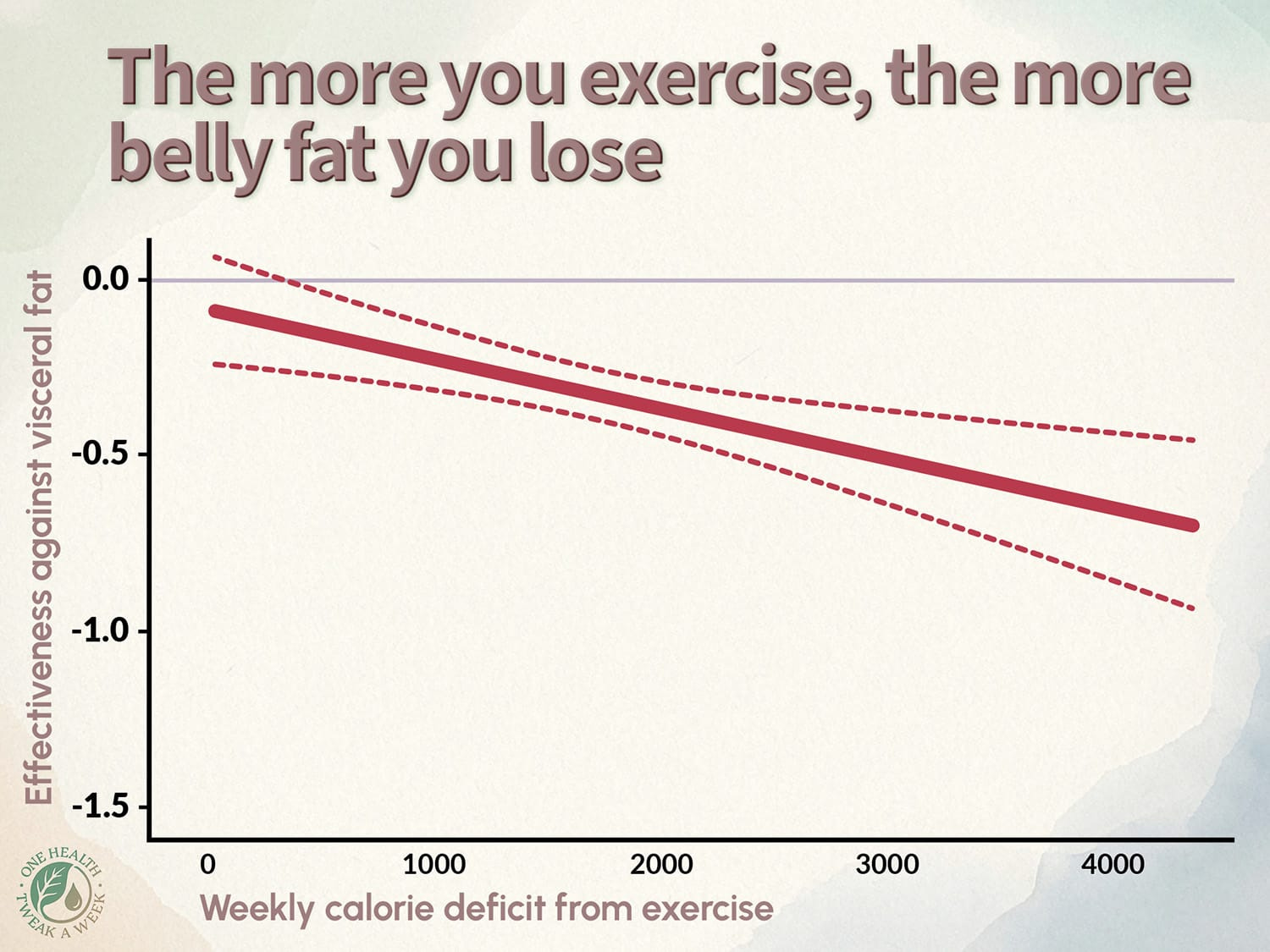
I find that graph motivating. It means visceral fat loss isn’t random, and it isn’t gated behind some magic threshold. It scales with what you put in. The more you do, the more visceral fat you’re likely to lose.
But let’s be honest about what “more” looks like in practice. Our bodies are efficient machines, which is impressive from an evolutionary standpoint and mildly annoying from a waistline standpoint.
For an average-sized adult, burning 1,000kcal through exercise would take roughly:
Three hours of brisk walking
An hour and a half of jogging
Two hours of recreational cycling
Two hours and twenty minutes of recreational swimming
That’s not trivial.
It means a couple of ten-minute strolls with the dog, pleasant and civilised as they are, probably won’t move the needle on visceral fat. You need structured, sustained effort: the kind where you’re breathing harder than you would in conversation and you know you’ve done something by the end.
One important caveat here: this assumes you don’t simply eat more to compensate for the energy you burned. Our appetites can be sneaky about that.
Not all exercise is equal
So exercise works, and more works better. The next question is whether the type of exercise matters.
It does.
A meta-analysis of 84 randomised controlled trials ranked exercise types by their effectiveness at reducing visceral fat:
Vigorous aerobic exercise came out on top.
HIIT (high-intensity interval training) was second.
Combined aerobic + resistance exercise came next.
Moderate-to-vigorous aerobic exercise followed.
Moderate aerobic exercise after that.
Resistance training alone was least effective for visceral fat specifically.
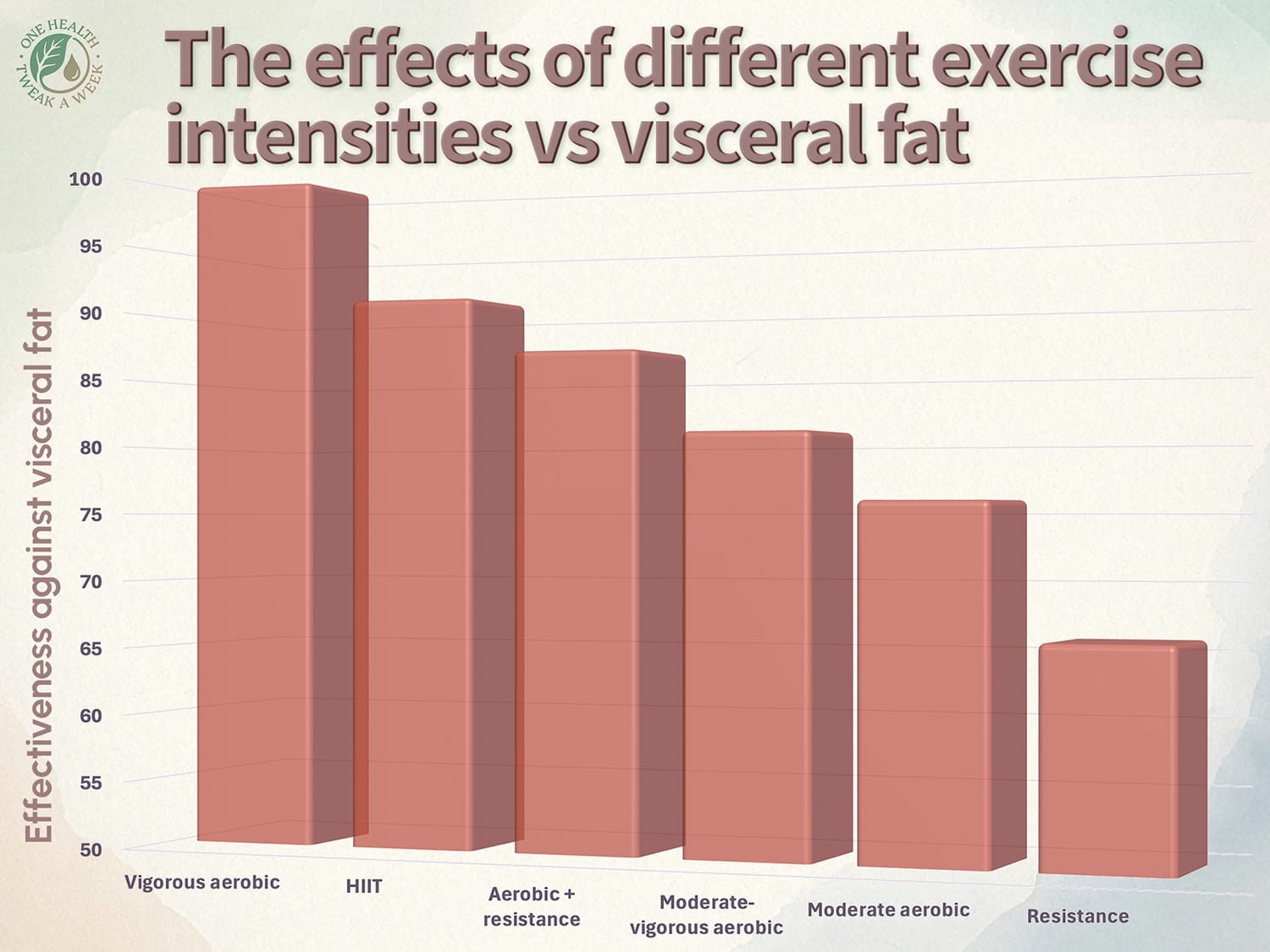
The pattern is clear: intensity matters. The harder you work, the more visceral fat you tend to lose.
That’s likely because higher-intensity exercise burns more energy per minute, triggers larger surges in adrenaline (which visceral fat cells are particularly responsive to), and produces greater improvements in mitochondrial function and insulin sensitivity.
But don’t write off resistance training. Resistance exercise on its own may be the least effective type for visceral fat, but when paired with aerobic exercise, it boosted the effectiveness of that aerobic work.
And resistance training does something aerobic exercise can’t do as well: it builds and preserves lean muscle mass, which matters enormously for strength, metabolic health, and independence as you age.
In practice, the sweet spot is probably a combination of vigorous aerobic work (your main engine for visceral fat loss) and regular resistance training (your insurance policy for lean mass and long-term function).
If time is tight
If you’re short on time, HIIT deserves a closer look. It ranked second for visceral fat reduction and involves repeated short-to-long bursts of high-intensity effort interspersed with recovery periods.
In practice, that might look like:
alternating 30 seconds of fast running with 90 seconds of walking, repeated 8-10 times
a cycling session with hard intervals built in
pushing hard uphill on a walk or jog, then recovering on the way back down
The appeal is obvious: you can accumulate a meaningful exercise dose in less time, which is useful if your calendar is full and your enthusiasm is temperamental. But it is demanding, so it’s probably not the place to start if you’re very unfit, significantly overweight, or have cardiovascular or joint problems.
Why does exercise target visceral fat?
Why would exercise preferentially reduce the fat around your organs rather than the fat under your skin?
The answer lies in the biology of visceral fat cells.
They’re more metabolically active than subcutaneous fat cells, with more receptors for adrenaline and a higher rate of fat breakdown in response to the hormonal conditions that exercise creates. When you exercise hard, circulating adrenaline rises, insulin drops, and blood flow to the abdominal organs increases: precisely the conditions that favour mobilising visceral fat stores.
Exercise also improves insulin sensitivity, reduces chronic inflammation, and enhances mitochondrial activity within fat cells: all of which tend to shift the balance away from visceral fat accumulation and towards its breakdown.
The part people struggle with
There is, however, a practical snag, which is that bodies respond to exercise more faithfully than most people manage to do it.
In a 12-month study of middle-aged adults with obesity, only the group that adhered well to their exercise programme showed meaningful reductions in visceral fat. The best performers exercised, on average, about once every four days and lost roughly 10% of their visceral fat.
That’s a modest return for a modest effort. And only about one in three participants managed to sustain that level of commitment.
A 10% reduction in visceral fat is still worthwhile, especially when you consider that most of us are slowly gaining it as we age. Holding steady would be a win. Going backwards by 10% is better still. But if you want more dramatic results, you will probably need to exercise more consistently, more frequently, and at higher intensity.
So yes, the biology is clear. The harder part is doing enough of it, often enough, for long enough.
What this means for your health
The overall message is fairly straightforward. Exercise reduces visceral fat, and the effect tends to rise with dose: the more you do, the more you are likely to lose.
Intensity matters too. Vigorous aerobic work and HIIT seem to be the most effective, while resistance training on its own does less for visceral fat but remains a valuable partner to aerobic exercise for overall body composition. And importantly, you can be losing this deeper, more harmful fat even while the number on your bathroom scale barely shifts.
The decision rule is simple: if you want to target visceral fat, treat it as an exercise problem, not just a dieting problem. And take your exercise seriously enough that it actually counts.
Casual movement is still good for general health, mood, and longevity. But unless the dose and intensity are genuinely there, it is unlikely to make a meaningful dent in visceral fat.
HEALTH TWEAK OF THE WEEK
If you’re carrying extra visceral fat, this is the fat most strongly linked to insulin resistance, worse cholesterol patterns, and longer-term cardiometabolic risk.
The encouraging part is that visceral fat responds to exercise in a dose-dependent way, with vigorous aerobic work and HIIT producing the largest reductions.
Exercise can reduce visceral fat even when overall weight barely changes, but the effort needs to be real and sustained: walking the dog doesn’t count - unless you’re chasing your greyhound!
1. Commit to a weekly dose that actually moves the needle.
Aim for 2.5 to 5 hours a week of exercise at moderate intensity or higher.
That might look like 3-6 hours of brisk walking, 1.5-3 hours of jogging, 2-4 hours of recreational cycling, or 2-4 hours of swimming.
If time is tight, consider HIIT: 2-3 sessions a week of 20-30 minutes can deliver comparable visceral fat benefits in less time.
The key test: it should feel like exercise, not a leisurely meander. You should be noticeably breathing harder and, ideally, slightly reluctant to do the next interval.
2. Add resistance training for the full picture.
Aerobic exercise is your primary engine for visceral fat loss, but adding 2-3 resistance sessions a week (bodyweight exercises, dumbbells, resistance bands, or gym machines) protects lean muscle mass and improves the overall effectiveness of your aerobic work.
Combined training is likely the best strategy for long-term body composition: less visceral fat and more functional muscle.
3. Track waist, not just weight.
Since visceral fat can fall while weight stays fairly stable, body weight on its own may tell you very little.
Pay attention to your waistline, how your clothes fit, and whether you’re actually sustaining the exercise dose you set out to do
What I hope this leaves you with is a clearer picture of the problem. If you want to reduce belly fat, the answer is not endless frustration with the bathroom scale or ever more aggressive dieting. It’s to give your body a meaningful exercise dose, consistently enough to matter.
That’s harder than wishful thinking, admittedly, but it is also far more actionable.
🎧 Want company while you lace your trainers and will yourself outside?
🎙️ This week’s One Health Tweak a Week podcast is all about the kind of exercise that actually makes a dent in visceral fat - the fat around your organs that matters far more to your metabolic health than the number on the scale.
In this episode, we dig into:
Why exercise appears to be more effective than dieting alone for reducing visceral fat
Why the scale can stay stubbornly still even while you are losing the fat that matters most
What “enough” exercise really looks like in practice - and why a few gentle strolls usually won’t cut it
We’ll also talk through the most effective exercise types, why intensity matters, and how to think more clearly about progress if your goal is a healthier middle rather than just a lower number on the bathroom scale.
👉 Ideal listening for your next walk, commute, or while doing the very sort of brisk movement this issue is gently trying to push you into.

(Episodes are free. Paid subscribers help fund the time and tools I’m building to help turn these weekly tweaks into habits that actually stick.)
🧭 Before you go
💬 If you’re going to act on this, tell me what your version of “exercise that actually feels like exercise” will be this week. A brisk lunchtime walk? A couple of hill sessions? A return to the bike? Think of the comments as our shared planning space.
📤 If someone in your life is still judging their health entirely by the scale, but worries about their waistline, send this their way.
👥 Paid corner - If you’re trying to work out what a realistic weekly exercise target looks like for your life, drop me a note in our private chat and we’ll think it through together.

Until next Saturday - one clearer target, one more purposeful walk, one week more on your side.
– Ben
Ben, this piece perfectly highlights one of the most dangerous blind spots in modern health metrics: our obsession with the bathroom scale.
The distinction you make between subcutaneous and visceral fat is vital. From a biochemical perspective, visceral fat isn't just inert energy storage; it is an actively inflammatory endocrine organ. Because it is highly sensitive to catecholamines - like the adrenaline released during intense effort - it requires the specific hormonal cascade generated by actual physical exertion to mobilize. Caloric restriction alone simply doesn't send a loud enough chemical signal to that specific tissue.
This is exactly why the intensity metric you highlighted is non-negotiable. The body needs the friction of vigorous work to adapt. The scale might not move because muscle density is replacing fat volume, but the internal metabolic engine is being completely rebuilt in the process.
It is a brilliant reminder to stop starving the body just to see a lower number, and start challenging it for better cellular function. Great work breaking this down.