


Some years ago, I took a spectacular faceplant on a busy, icy shopping street in Boston. The embarrassment far exceeded any physical discomfort. I picked myself up, brushed myself off and carried on, hoping nobody I knew had seen me.
We’ve all tripped over a rug or caught a foot on an uneven pavement. Usually, we get up, glance around to see who noticed and carry on. We’re oddly reluctant to admit to them, too. Doctors are advised to ask about falls proactively, because patients so rarely volunteer the information. That’s worth remembering if you have older adults in your life.
But as we get older, the consequences of a fall become far less forgiving, sometimes threatening independence, and occasionally life itself.
I’ve always walked regularly, and I started strength training a few years ago when I saw how convincing the evidence was for preserving muscle as we age. I assumed I had the exercise bases fairly well covered. So it was a little disheartening to discover, while researching this edition, that walking and resistance training may still leave a meaningful gap - balance.
What surprised me was how much targeted balance exercises can reduce our risk of falling as we get older, and how important it may be to start early. And the encouraging thing is that many of these exercises are surprisingly simple and can fit into activities we’re already doing, without finding time for another workout.
Why should we take falls seriously?
At least a third of adults aged 65 and over who live independently fall every year, and the rate of fall-related injuries increases with age.
The consequences can be severe. Up to around 10% of adults over 50 who sustain a hip fracture die within 30 days, and as many as a third of older hip-fracture patients die within a year. In the US, falls are the leading cause of accidental death among those aged 65 and above, and the age-adjusted fall-related death rate rose by 41% in the decade to 2021.
Of course, these deaths aren’t all directly attributable to the fracture. Frailer patients are more vulnerable to both injury and subsequent illness, but recovery becomes much harder with age. A fall that leaves a younger, fitter person with nothing more than an embarrassing story can mark the start of a serious decline for someone older and frailer.
Even falls that don’t end in a fracture can set off a damaging cycle. Fear of falling leads people to restrict their activities. Less activity means less strength and fewer social interactions. Less strength means a higher risk of falling again.
My Boston tumble was harmless because I was young and fit. For an older, frailer person, the same stumble on the same pavement could have ended very differently.
Why your balance in midlife matters
You might assume that falls prevention is something to think about in your seventies. The evidence suggests it’s worth paying attention much earlier.
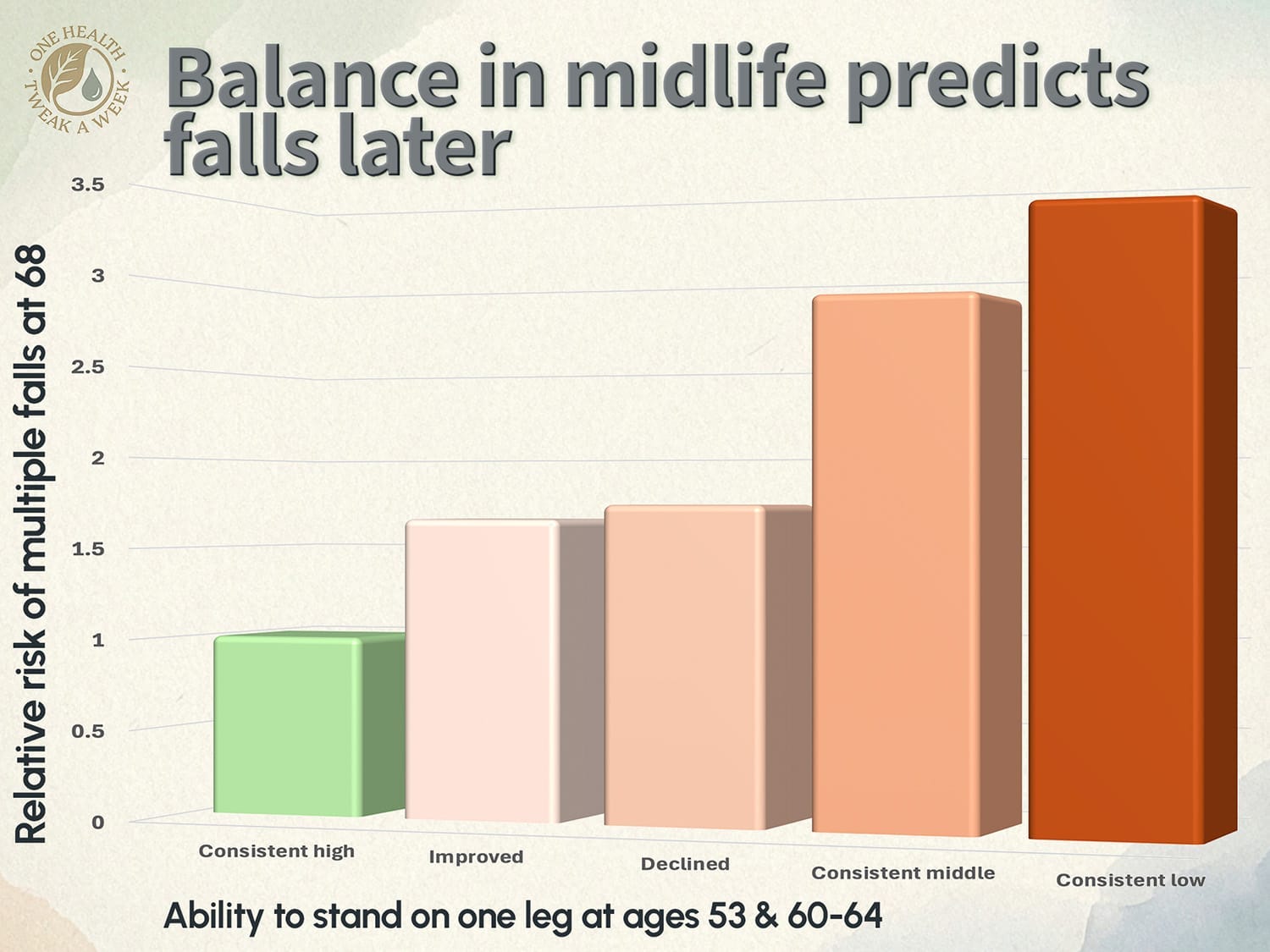
British researchers assessed 2,046 adults for their ability to stand on one leg for 30 seconds at age 53 and again between 60 and 64. They then compared these results with how often the participants fell at age 68. Poorer balance in midlife independently predicted multiple falls in later life, even after controlling for BMI, physical health, cognitive function and other factors.
Those with poor balance scores at both 53 and 60-64 were almost 3.5 times more likely to experience multiple falls at age 68.
A separate study followed adults aged 51 to 75 and found that those unable to stand on one leg for 10 seconds were 84% more likely to die over the next seven years, after adjusting for other risk factors.
That’s a striking association, but it does need careful interpretation. Both studies are observational. Poor balance is likely a marker of underlying health, neuromuscular function or early frailty rather than a direct cause of death.
Practising your one-leg stand won’t necessarily prolong your life. But maintaining the overall health, strength and coordination that allow you to stand comfortably on one leg? That seems like a good long-term investment, and one worth starting before problems develop.
How good is your balance right now?
Can a quick home test predict your risk of falling?
Unfortunately, not reliably. A review of fall-risk assessments found no single test sufficiently accurate for predicting whether an individual would fall. Combining tests helped distinguish higher-risk groups, but remained imperfect for individual prediction.
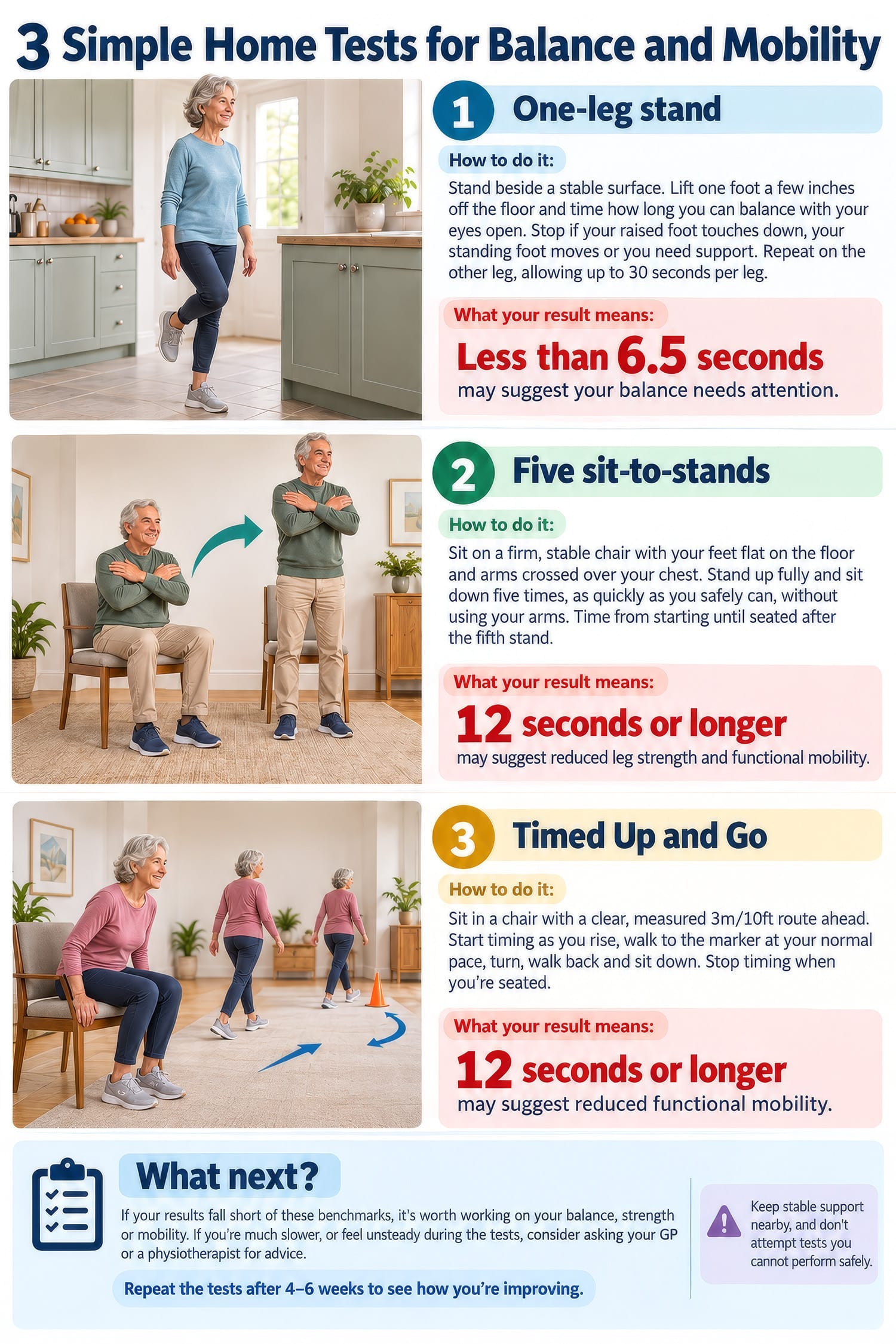
That said, three simple tests can give you a useful snapshot and, more importantly, a baseline against which to track improvement:
One-leg stand, eyes open. Measures static balance and postural control. Record how long you can hold it on each leg.
Five sit-to-stands. Measures lower-limb strength and functional performance. Time how long five complete repetitions take.
Timed Up and Go. Measures functional mobility: stand up from a chair, walk a short distance, turn around, walk back and sit down. Record the total time.
For context, in studied populations aged 65 and above, clinicians would be more concerned if someone could stand on one leg for less than 6.5 seconds, five chair rises took 12 seconds or longer, and a timed up and go took 12 seconds or more.
These are population-level figures from older adults, not diagnostic cut-offs for a healthy 55-year-old, so think of these tests less as a risk calculator and more as a functional fitness check to help you understand where you are now and whether you’re improving.
Can balance training prevent falls?
The observational studies tell us that poor balance predicts later falls, but they can’t establish whether training our balance prevents them. For that, we need randomised trials.
A major Cochrane review brought together 108 randomised trials involving more than 23,000 adults aged 60 and over, from 25 countries.
Exercises focused on balance and everyday movements, such as getting out of a chair, reduced the risk of experiencing a fall by 13%.
Programmes that also included strength training showed larger benefits: 22% fewer people experienced a fall, and the total number of falls dropped by 34%.
Why the difference? Some people fall repeatedly. Preventing those additional falls matters, too, because every fall brings another risk of injury.
The combined programmes look particularly promising, although these weren’t direct comparisons proving that adding strength training accounted for the additional benefit.
What about broken bones? Across the exercise trials, 27% fewer participants experienced fall-related fractures, although the certainty of that evidence was low. A separate review of 28 trials involving almost 28,000 older adults found 15% fewer people falling with exercise, but no clear reduction in fractures or other fall-related injuries.
Tai Chi also looks useful. The Cochrane review found it may reduce falls by approximately 19-20%. And a further review of 219 studies covering almost 168,000 participants confirmed particularly strong benefits from sustained balance and resistance programmes and from Tai Chi.
Most programmes lasted at least three months, and nearly a third continued for a year or more. Improving our balance and maintaining its benefits means making these exercises part of our weekly routine, rather than something we try for a few weeks and then forget.
Why walking and strength training don’t cover everything
If you’re already active, you might assume that’s enough.
Picture catching your foot on an uneven pavement. Strong legs help you recover, but you also need to shift your weight and reposition your feet quickly enough to stay upright. These capabilities overlap, but they aren’t the same thing.
Exercise develops different capacities. Walking, cycling and other aerobic activities are excellent for our hearts and lungs. Resistance training helps preserve the muscle strength needed to climb stairs, rise from chairs and recover from a stumble. In one study cited in the Cochrane review, older adults with weak leg-extensor muscles were 43% more likely to fall at home than those with stronger legs.
Balance training develops the postural control and coordination needed to shift weight, turn, reach or respond quickly when your footing slips.
If you stumble, strong legs help you recover; good balance coordinates that response quickly enough. Neither is the same as the stamina for a long walk.
Crucially, neither the Cochrane review nor the larger 2024 review found sufficient evidence that walking alone reduced falls. That doesn’t prove walking is ineffective; the specific evidence simply isn’t there yet. Walking remains enormously valuable, but we shouldn’t assume our daily walk provides the specific protection that targeted balance training does.
Keeping our balance involves much more than simply standing upright. Our brains constantly combine information from our eyes, inner ears, muscles and joints, making small adjustments to keep us steady. Walking exercises this system, but on familiar, even ground, the demands are fairly predictable. Standing with our feet closer together, shifting our weight, reaching sideways or stepping in different directions challenges our balance in new ways.
And just as with strength training, we need to make these exercises progressively harder as we improve. We’re training our ability to make the quick, coordinated adjustments that might save us when we stumble.
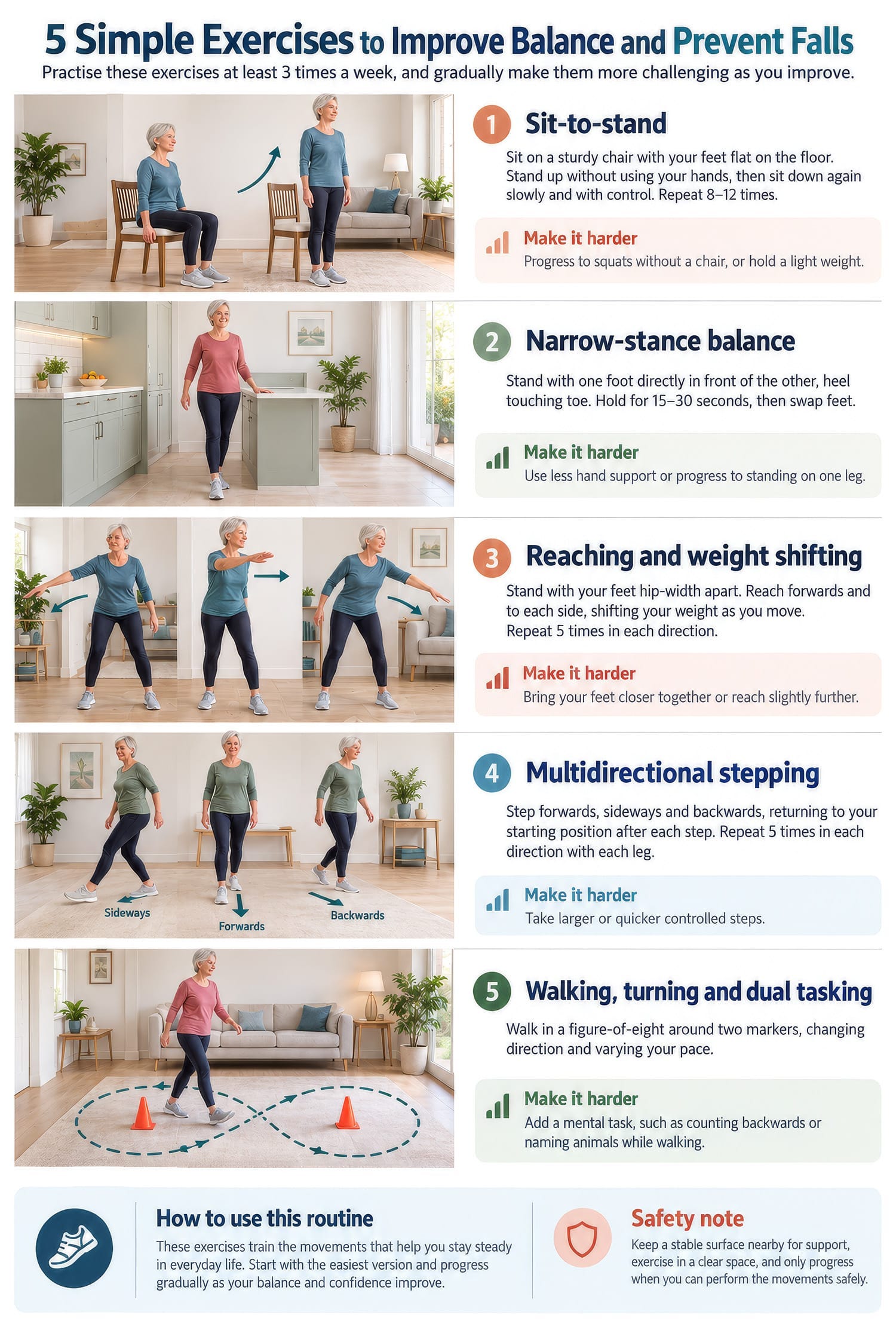
So what does effective balance training look like? The World Falls Guidelines Task Force recommends exercises based on everyday movements, progressively increased in difficulty. These include:
Sit-to-stands and squats
Reaching while standing and shifting body weight
Standing with a narrower base of support
Stepping in different directions
Walking with changes of direction, speed and environment
Adding resistance or dual-task activities as you progress
Because functional movements combine strength and balance challenges, three separate workouts aren’t always necessary. Many of these exercises can be woven into what you’re already doing.
Balance isn’t the whole story.
Poor eyesight, dizziness, low blood pressure on standing, sedatives, neurological or cognitive problems, unsuitable shoes, poor lighting and loose rugs can also contribute to falls.
If you or someone close to you has recently become unsteady or started falling, don’t assume extra exercise will solve it. A medical assessment, medication review, eyesight check or changes around the home may be more urgent. Those at substantial risk should be assessed by a multidisciplinary falls team.
What this means for your health
The randomised trials make a persuasive case for balance and functional exercises in older adults. The studies linking balance in our fifties and early sixties with falls later in life suggest that starting earlier is sensible.
If you’re already walking regularly and doing some strength training, keep both. They’re valuable, but deliberately practising your balance deserves a place alongside them. And just as with strength training, the exercises need to become more demanding as you improve.
Fortunately, there’s no need to schedule another hour of exercise. You might practise standing on one leg beside the worktop while the kettle boils, try controlled sideways steps during your walk or add chair rises to a strength session.
Choose a few movements that fit your routine and practise them regularly. Waiting until your balance is already causing problems seems a poor time to begin.
As always, your responses are anonymous, but they really help me tailor future content to what’s most helpful to you. Please take a moment to click a button.
HEALTH TWEAK OF THE WEEK
As we get older, a fall can have serious consequences for our health and independence. Fortunately, there’s strong evidence that targeted balance and functional exercises reduce our risk of falling, particularly when combined with strength training.
Walking and strength training are important, but they don’t necessarily develop all the coordination and postural control we need to recover from a stumble. And since balance in our fifties predicts falls later in life, it makes sense to start working on it before we become noticeably unsteady.
This week’s tweak is to make progressively challenging balance exercises part of your existing routine at least three times a week.
1. Find your starting point.
Try the three home assessments in the infographic: standing on each leg with your eyes open, five sit-to-stands and Timed Up and Go. Record your times, using support where necessary. Look on the results as a way to see what you can do now and compare it with how you’re doing later, rather than a medical verdict on your likelihood of falling
2. Build balance challenges into things you already do.
At least three times each week, choose a few movements from the five-exercise infographic. While the kettle boils or you’re on the phone, practise standing with your feet closer together or briefly on one leg, beside a secure worktop. During a strength session, include controlled chair rises, squats or steps. On a walk, try deliberate changes of direction and carefully controlled stepping where the ground is safe. There’s no need to do everything at once.
3. Keep practising, and make it harder gradually.
As an exercise becomes easy, increase the challenge: reduce hand support, narrow your stance, change direction or add suitable resistance. Keep something stable nearby, and don’t trade safety for difficulty. Continue over months, not days, and repeat your three tests periodically to see whether you’re improving.
If you or someone you care about has started falling or feels increasingly unsteady, talk to your doctor. Consider whether eyesight, medications, blood pressure or hazards around the home might be contributing, and don’t rely on exercise alone.
For the rest of us, a few well-chosen balance challenges slipped into the week seem a small but valuable investment in staying on our feet and keeping our independence for longer.
🎧 Prefer to listen while standing on one leg?
🎙️ This week’s One Health Tweak a Week podcast explores an often-overlooked part of staying fit as we age: balance. We look at why walking and strength training may not be enough to protect us from falls, what the research tells us about preventing them, and how to improve our balance without adding another workout to the week.
You’ll hear:
Why falls become increasingly dangerous as we age, threatening health, confidence and independence
Why your balance in your fifties may predict your risk of falling years later
How targeted exercises can reduce the risk of falling by 22% and the total number of falls by 34%
Why walking and strength training don’t necessarily develop the balance and coordination needed to recover from a stumble
How three simple home tests can help you assess your balance, strength and mobility
Which five exercises can improve balance, and how to fit them into your existing routine
👉 Good company for your next walk, commute, or while waiting for the kettle to boil. Although perhaps not the best time to attempt your first one-legged balance test!

(Episodes are free for now. Paid subscribers support the deeper research - and unlock practical tools to help you improve your health without turning it into a second job.)
🧭 Before you go
💬 Have you ever taken an unexpected tumble that made you wonder whether your balance was quite as good as you thought? Or have you already made balance training part of your routine?
📤 Know someone who walks regularly, perhaps even lifts weights, but has never given much thought to their balance? They might find this week’s article particularly useful.
👥 Paid corner - If you try the three home balance tests this week, tell us how you got on in our private chat. Did any of the results surprise you? And have you found a convenient way to incorporate some balance practice into your day?

Until next Saturday - keep walking, keep those muscles strong, and give your balance a little attention, too.
– Ben
From the surgical end of this story: once someone falls, how they fall carries its own risk, apart from bone density. In a Boston case-control study of community-dwelling fallers aged 65 and over (Greenspan and colleagues, JAMA, 1994), the direction of the fall was an independent risk factor for hip fracture, with an adjusted odds ratio of 5.7, and that estimate did not change when bone density was added to or removed from the model. The potential energy of the fall and a lower body mass index also counted. The authors suggested reducing fall severity, for example through muscle strength, as an additional strategy, which fits your case for keeping the strength work next to the balance work.
About 15 years ago I briefly met an elderly woman who was a former gymnast and she wrote a book about how to prevent falls AND as she said "to fall properly so you don't injure yourself." I don't remember the book title but I think it's a great strategy to address both fall prevention and falling in a way that prevents serious injuries. She also made the point that "You don't need to be an olympic gymnast to fall in a way that prevents you from injuring yourself.