

Last week, we looked at why fibre deserves your attention. The headline numbers were hard to ignore: people who eat the most fibre have a 15% lower risk of premature death from any cause and a 24% lower risk of coronary heart disease. And the benefits don’t seem to plateau at 30g a day - studies suggest they keep accruing beyond that.
The obvious response is to eat more of the stuff. And most of us badly need to. In the US, fewer than 10% of women and just 3% of men reach the recommended 25–30g a day. Among UK adults over 65, fewer than 6% manage 30g.
So, we’re agreed. More fibre would be a good idea.
But what does that actually mean when you’re standing in the kitchen tomorrow morning? You could eat a bowl of All-Bran and congratulate yourself, but those extra grams of fibre could just as easily come from oats, beans, nuts, fruit, vegetables or a spoonful of psyllium. And, as it turns out, they’re not all doing quite the same thing.
Fibre is rather more complicated than the number on the nutrition label.
Most fibre-rich foods contain a mixture of types, but not in the same proportions. That affects what they do in the gut, and some foods also make it much easier to reach 30g in the first place.
So this week, I want to tackle the practical question we left hanging last time. If you’re going to eat more fibre, how should you get it?
Much of our fibre comes in the wrong package
A UK national dietary survey examined fibre sources for adults over 65. The average intake was just 18.3g/day, and the breakdown of where that fibre came from was just as revealing as the number itself.
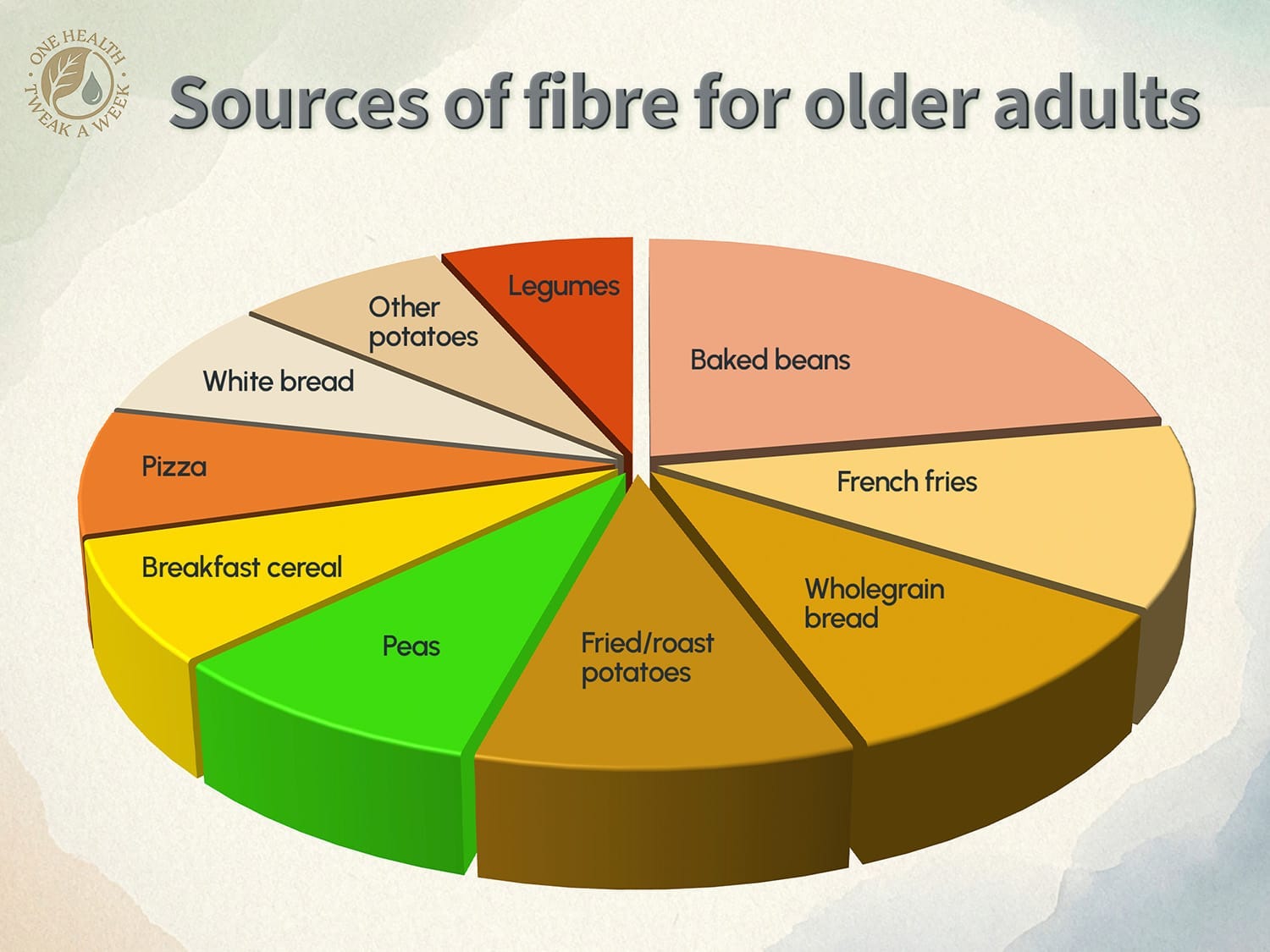
It’s not a picture that fills you with confidence.
There are some whole grains, some peas and a few legumes. But major contributors otherwise include baked beans (okay in principle; in practice, often full of sugar and paired with processed meat), French fries and other fried potatoes, breakfast cereal (mostly ultra-processed, frequently sugar-laden), pizza, white bread and non-fried potatoes.
I can’t help but feel we could do better.
If we’re going to eat more fibre, I’d rather those extra grams came from foods that bring plenty of other useful things with them, rather than arriving incidentally in pizza, fries and sugary breakfast cereal.
And there’s another reason to care where our fibre comes from: different foods don’t give us the same mix of fibres.
Different fibres do different things
Most of us picture fibre as rough stuff: plant material that passes through largely undigested. That’s insoluble fibre, and it’s genuinely useful. It absorbs water, adds bulk, and speeds transit through the gut. This is partly why higher fibre intake is linked to lower rates of colon cancer. Waste material spends less time sitting against the gut wall, and increased bulk dilutes potential carcinogens.
But insoluble fibre is no one-trick pony.
In a study of more than 86,000 US adults, those consuming the most fibre had a 29% lower risk of premature death from any cause, a 27% lower risk of dying from cardiovascular disease, and a 23% lower risk of dying from cancer. Both soluble and insoluble fibre showed broadly similar associations.
Soluble fibre behaves rather differently. Some types form gels in the gut that are particularly effective at binding bile acids.
Bile acids are made from cholesterol in the liver and used to help absorb fats. Normally they’re recycled, but those bound by fibre are carried out of the body. The liver has to make replacements, and to do that it pulls additional cholesterol from the bloodstream. Do that every day, and your blood LDL cholesterol levels can fall meaningfully.
A third important property is fermentability. Some fibres, whether soluble or insoluble, are broken down by gut bacteria. This produces short-chain fatty acids, which may help explain some of fibre’s broader health effects. As we discussed last week, though, that evidence remains plausible rather than conclusive.
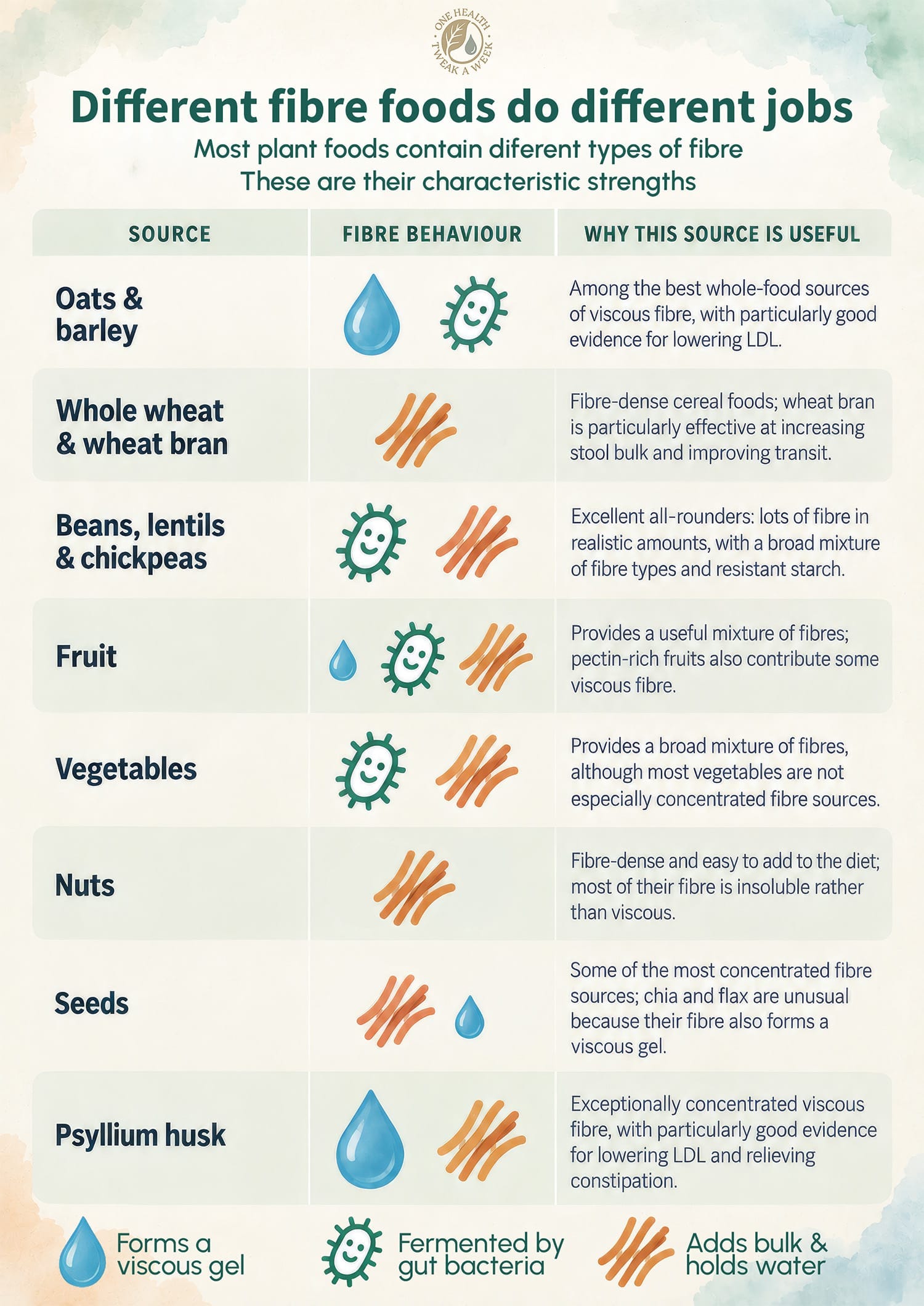
Most whole foods contain more than one type of fibre, but not in the same proportions. Oats contain both soluble and insoluble fibre; legumes provide both fermentable and bulking fibres, but their overall fibre profiles are different. No single food gives you the same mix in the same amounts, which is why variety still makes sense.
And, of course, we’re not just eating for fibre. Different foods also bring along different combinations of proteins, resistant carbohydrates, vitamins, minerals and polyphenols.
Getting to 30g: what makes it easier
So, how do you actually reach 30g a day? Some foods are more fibre-dense than others, but you might be surprised at how much they vary.
Before you look at the graph below, try putting these five foods in order from most to least fibre-dense: broccoli, brown rice, prunes, wholewheat bread and an apple.
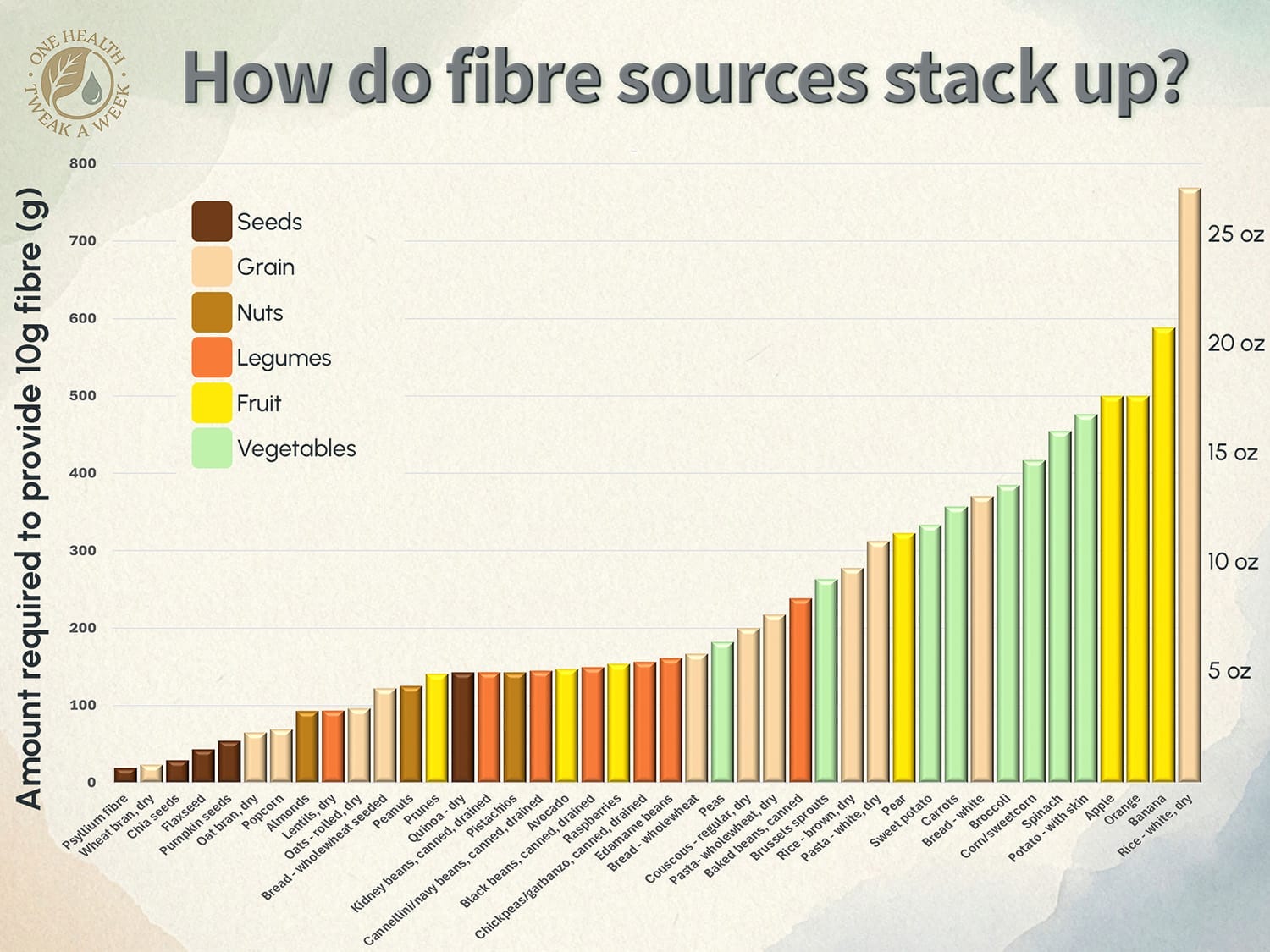
How did you do? Any surprises? Broccoli perhaps gets a little more credit than it’s properly earned.
(I realise you’ll need to zoom in to see the detail here, but that felt more useful than just giving you a handful of foods).
A common piece of advice for getting more fibre is to eat more fruit and vegetables. That’s a great strategy for long-term health, but as you can see, fruits (yellow) and vegetables (green) sit mostly to the right of the graph - you need to eat considerably more of them to get 10g of fibre. The left side, the most fibre-dense foods, is dominated by grains, seeds and nuts, with legumes holding the middle ground.
Fruit and vegetables remain valuable for many reasons beyond fibre. But if you’re trying to increase your fibre intake efficiently, grains, nuts, seeds and legumes generally provide fibre more efficiently.
Why whole grains deserve a place on your plate
Not all fibre sources appear to be equally associated with long-term health outcomes. Cereal fibre, in particular, has shown unusually consistent links with lower disease risk.
In a study of more than 39,000 mid-life Australian adults followed for almost 14 years, those eating the most cereal fibre were 25% less likely to develop type 2 diabetes. Fruit and vegetable fibre did not show the same protective association. Cereal fibre has also been consistently linked to lower rates of cardiovascular disease and colorectal cancer.
In a separate study of 4,125 older US adults, cereal fibre, but not fibre from other sources, was associated with lower blood levels of inflammatory markers.
Why might whole grains show a stronger signal?
It isn’t entirely clear. They contain a mixture of insoluble bran fibres and more soluble fibres, alongside minerals and phytochemicals that may contribute independently. Some cereal fibres are fermented by gut bacteria; others seem to work through quite different routes, including improving bowel transit and possibly insulin sensitivity.
The stronger associations seen with cereal fibre don’t prove that cereal fibre itself is uniquely protective; whole grains bring along plenty besides fibre. But the broader evidence for fibre, including intervention studies, is strong enough to support a causal effect on cardiovascular health.
When you’re thinking about where to get your fibre, make sure some of it comes from whole grains: oats, barley, wholemeal bread, wholegrain pasta, etc.
What about fibre supplements?
Perhaps it’s a sign of the times that, when something in our diet needs fixing, we’re increasingly inclined to ask whether there’s a pill for it. Or, these days, an injection.
Fibre is no exception. The fibre supplement shelves are certainly well stocked. But now that we’re budding fibre experts, we know enough to assume they’re not all interchangeable.
Psyllium (Metamucil) is the most versatile. Made from the husk of a plantain (the weed in your lawn, not the banana relative), it works as both a bulking agent and a gel-former. In a meta-analysis of 28 studies, about 10g/day of psyllium reduced LDL cholesterol by approximately 0.33mmol/L (~11%) and apoB by 0.05g/L (~6%).
Wheat bran is primarily a bulking agent for bowel regularity, though it can also reduce post-meal blood sugar spikes.
Methylcellulose (Citrucel) and polycarbophil (FiberCon) are water-absorbing, bulk-forming products used mainly for constipation.
Then there’s a broader category: wheat dextrin, inulin, chicory root fibre, partially hydrolysed guar gum and others. These are often marketed as “prebiotics” because they feed gut bacteria and can shift the composition of the gut microbiome. Whether those shifts translate into the kind of meaningful health benefits associated with fibre-rich whole foods is much less certain.
My take is that whole foods should be your default. They provide fibre alongside a host of other beneficial nutrients that supplements can’t replicate. Psyllium has its place, particularly for bowel regularity and LDL reduction. If you do use it, plain, unflavoured psyllium husk added to food is preferable to highly processed versions containing artificial sweeteners, flavourings, and emulsifiers.
If someone came to mind while you were reading this, please forward it to them. These tweaks may be small, but practised consistently they can genuinely change long-term health. A useful nudge at the right moment can make all the difference.
What this means for your health
Most of us need a meaningful increase rather than fine-tuning, and, as we saw last week, the evidence suggests benefits continue beyond 30g. So 30g is a useful target to reach, but not a point at which the benefits suddenly stop.
The solution isn’t to find the single “best” fibre source and eat lots of it. Different fibres do different jobs, and different fibre-rich foods bring along different packages of nutrients. A mix of whole grains, legumes, nuts, seeds, fruit and vegetables will serve you better than any one of them alone.
What matters in practice is the fibre you keep eating. Nuts you look forward to, oats you enjoy at breakfast or beans you happily add to chilli will do more for you over time than a bag of wheat bran slowly going stale at the back of the cupboard.
Because my diet is largely plant-based, and full of fruit, vegetables and whole grains, I don’t really need to think about fibre targets. I average 34g a day without trying.
My breakfast is usually muesli. Rolled oats provide the base, then I add nuts, seeds, and dried fruit, plus whatever else appeals that morning: apple, berries, cocoa nibs, or something different. I’m not sitting down to a medicinal bowl of fibre. It’s breakfast I enjoy that happens to contain several good sources of it. Add a slice of seeded, wholegrain bread, and I’m already at 14g of fibre.
The trick is to find your own version of that, a meal or two you genuinely enjoy that does a lot of the fibre work for you.
As always, your responses are anonymous, but they really help me tailor future content to what’s most helpful to you. Please take a moment to click a button.
HEALTH TWEAK OF THE WEEK
There’s convincing evidence that getting enough fibre is linked to major long-term health benefits, including a lower risk of cardiovascular disease and premature death. Most of us, though, are nowhere near recommended intakes: fewer than 10% of US women and just 3% of men reach them, and among UK adults over 65, fewer than 6% get to 30g/day.
So the first job is to get more of it. But fibre isn’t a single substance, and foods don’t all provide the same mix. Whole grains, legumes, nuts, seeds, fruit and vegetables each contribute something a little different, which is why a varied mix makes more sense than relying heavily on one source.
Use 30g/day as a practical target to reach, then keep going if you can. The easiest way to get there is to build more fibre into foods you already enjoy, while adding a few new options that sound appealing enough to become habits.
1. Recheck your baseline. Go back to the 3-day food diary from last week and look at your average daily fibre intake. Work out roughly how far you are from 30g.
2. Choose 2–3 changes that will meaningfully raise your fibre intake. Start from the way you already eat, but give yourself a few different routes in. If you’re well below 30g/day, the aim is to build a noticeably more fibre-rich diet, not just add the occasional virtuous apple.
Upgrade the staples. Switch white bread, pasta and rice for wholegrain versions. Have baked beans on wholegrain toast for a quick lunch, but avoid versions loaded with added sugar or processed meat. Add canned beans or lentils to soups, stews, sauces or rice.
Use snacks to your advantage. When you want something between meals, reach for a handful of nuts, some fruit or a bowl of popcorn rather than something with virtually no fibre.
Add fibre without creating another meal. Toss pumpkin, sunflower, sesame or chia seeds over breakfast, yoghurt or a salad. Stir ground flaxseed into oats. Add a spoonful of nuts or seeds to something you already eat.
Try one new thing. Make a chia pudding and see whether you like it. Swap rice for quinoa one evening. Open a can of mixed beans, rinse them, add a dressing you enjoy and have them with salad and some crusty wholegrain bread. Try barley or bulgur somewhere you’d normally use rice or pasta.
If you’re already eating plenty of plants, push the variety and density higher. Add another serving of legumes, use nuts and seeds more deliberately, choose denser whole grains, and look at where another 5–10g could come from without simply eating more food.
Breakfast is still one of the easiest places to make progress. As my muesli shows, oats, wholegrain bread, nuts, seeds and fruit can do a surprising amount of the work before the day has really begun.
The point of the list is that somewhere in it there should be two or three things that make you think, I could do that. Try those this week. If you enjoy them and they fit easily into your life, keep them. Then try something else.
A few changes that stick can shift your fibre intake surprisingly quickly. Get closer to 30g, keep building from there, and you’ve made one more useful change that should pay you back for years to come.
🎧 Prefer to listen while deciding whether your fibre really needs to come from bran?
🎙️ This week’s One Health Tweak a Week podcast picks up where we left off last week. We know most of us need more fibre. The more useful question now is: where should it come from?
You’ll hear:
Why different fibres do different jobs, from keeping things moving to lowering LDL cholesterol
Why the fibre in oats, beans, nuts, seeds, fruit and vegetables isn’t nutritionally interchangeable
Which foods make getting to 30g a day much easier than others
Why whole grains deserve rather more attention than they usually get
What psyllium, wheat bran and “prebiotic” fibres can and can’t do
How to raise your fibre intake without suddenly becoming someone who prepares grain bowls for lunch
👉 Good company for your next walk, commute, or while staring into the cupboard wondering whether there’s anything in there that could quietly add another 5g of fibre to your day.

(Episodes are free for now. Paid subscribers support the deeper research - and unlock practical tools to help you improve your health without turning it into a second job.)
🧭 Before you go
💬 Which of this week’s suggestions are you actually going to try? Wholegrain swaps, nuts for snacks, seeds on breakfast, beans somewhere unexpected, quinoa, chia pudding - or something else entirely?
📤 Know someone who wants to eat more fibre but would rather not reorganise their entire life around lentils? Forward this to them.
👥 Paid corner - If you did last week’s 3-day fibre check, tell us where you landed and what you’re changing first. I’m particularly interested in the small swaps and additions that feel realistic enough to stick.

Until next Saturday - pick two or three things from the menu and give them a try. A few changes that genuinely suit the way you eat can add up surprisingly quickly.
– Ben
If you missed last week’s issue on the health benefits of eating more fibre, you can find it here:
Could Your Healthy Diet Still Be Too Low in Fibre?

As a kid, I watched my dad struggle through a bowl of All-Bran every morning. It was a hard watch, and no doubt a harder eat.