


As a kid, I watched my dad struggle through a bowl of All-Bran every morning. It was a hard watch, and no doubt a harder eat.
Back then, fibre was “roughage”. It kept you regular, and that was pretty much the sales pitch.
It’s no wonder few of us got excited about it. Who wants to sit down to a plate of roughage? If you understood the rationale, it felt like duty at best. If you were less convinced, it felt like punishment.
The old story wasn’t wrong. Chronic constipation affects roughly 1 in 8 of us, and fibre really can help.
But fibre’s effects extend well beyond keeping your bowels moving.
Higher fibre intake is consistently associated with lower rates of premature death, cardiovascular disease, type 2 diabetes and colorectal cancer. It’s also associated with lower LDL cholesterol, blood pressure, fasting glucose and body weight.
The problem is working out how much credit fibre deserves. People who eat lots of fibre generally get it from whole grains, fruit, vegetables and legumes. Perhaps fibre is just travelling with a healthier diet.
So let’s look at what fibre actually seems to be doing, how much most of us are getting, and whether the usual 25–30g/day target is really enough.
From roughage to long-term health
One of the largest reviews, published in 2019, pulled together 243 studies representing 135 million person-years of data. In other words, this isn’t a small signal from a handful of studies.
Compared with those eating the least fibre, those eating the most saw:
15% lower risk of premature death from any cause
31% lower risk of death from coronary heart disease
24% lower risk of developing coronary heart disease
26% lower risk of developing type 2 diabetes
16% lower risk of developing colorectal cancer
13% lower risk of dying from cancer
Higher fibre intake was also associated with lower weight, total and LDL cholesterol, systolic blood pressure and fasting glucose.
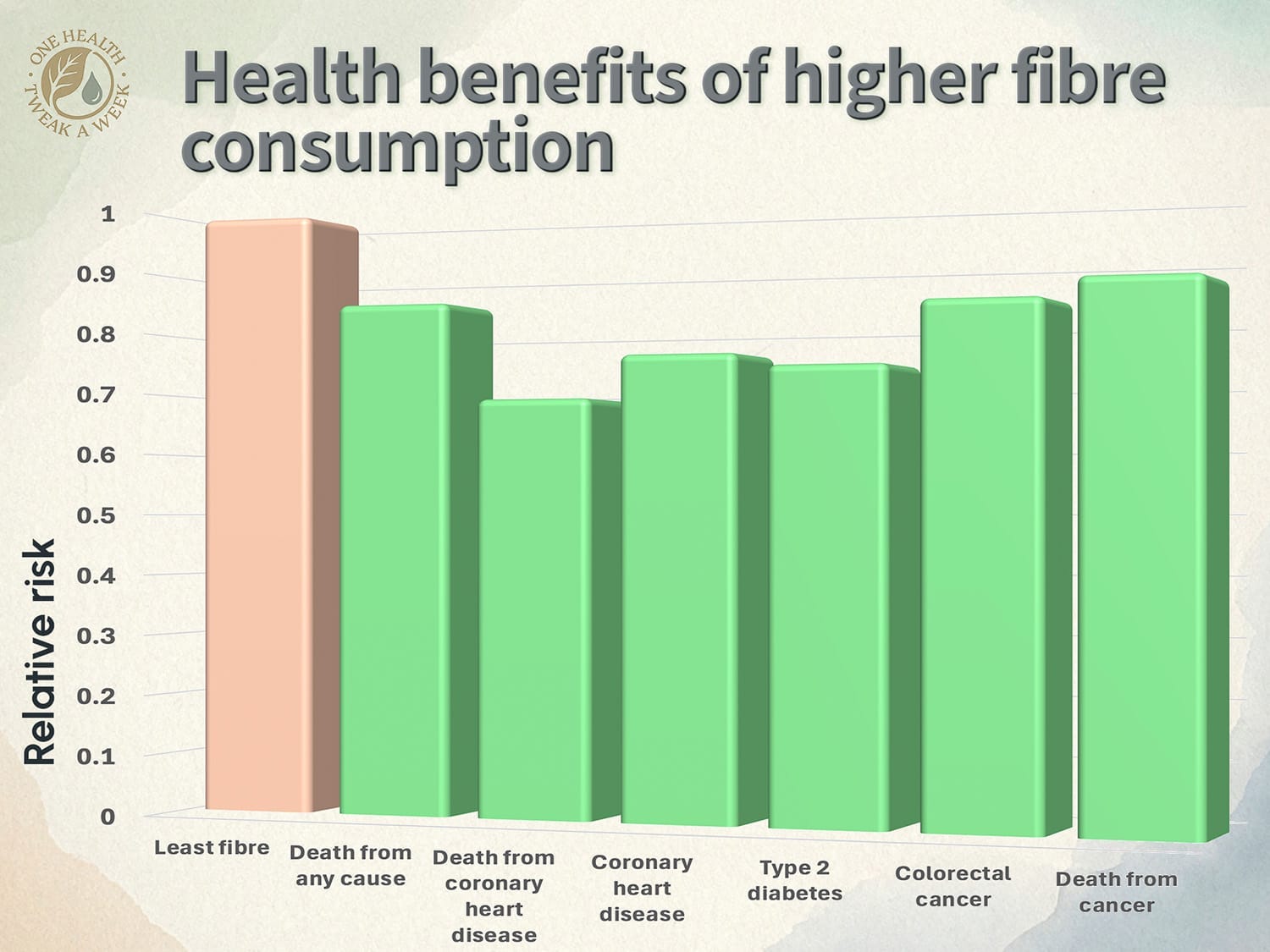
These feel like the kind of benefits that might make wearing your teeth away on All Bran every morning worthwhile.
Another large review found much the same pattern: 16% fewer premature deaths from any cause and 18% fewer deaths from cardiovascular disease at higher fibre intakes, along with less cardiovascular disease, type 2 diabetes and several cancers.
Some of the relative reductions reported for individual cancers were very large, but the strength of evidence varied considerably between outcomes. I wouldn’t give a 40–50% reduction in one particular cancer the same weight as the much more consistent signals for cardiovascular disease, diabetes and overall mortality; still, they’re worth further study.
And these big disease outcomes are mostly observational. Researchers can adjust for smoking, exercise, body weight, and other aspects of diet, but we can’t be certain that other factors aren’t playing a role.
So we’re left asking if fibre itself is contributing, or is it simply a marker for eating well?
What happens when you add the fibre itself?
One useful way to test this is to leave the rest of the diet broadly unchanged and add a specific fibre.
A group of researchers pooled the results from 28 trials of psyllium fibre. A typical dose of about 10g/day reduced LDL (bad) cholesterol by 0.33mmol/l and apoB by 0.05g/l.
Using typical population levels as a reference, those reductions are roughly 11% for LDL and 6% for apoB. Those percentages are my estimates rather than figures reported by the paper, and there was no clear dose-response across the doses studied.
A separate meta-analysis of 28 trials found that at least 3g/day of oat beta-glucan reduced LDL by 0.25mmol/l, roughly 9%. Oat beta-glucan is the main soluble fibre found in oats, and is thought to be the principal component responsible for their cholesterol-lowering effect.
These trials don’t tell us that every type of fibre behaves the same way. What they do show is that fibre itself can have meaningful effects on health, independently of the other benefits that come with fibre-rich foods.
How can something we don’t digest lower cholesterol and improve metabolism?
Psyllium and oat beta-glucan share an important property: they become viscous in the gut and form a gel.
Your liver makes bile acids from cholesterol and sends them into the intestine to help digest and absorb fat. Normally, much of that bile is reabsorbed and recycled.
Viscous fibres interfere with that reabsorption. Instead of being recycled, more of those bile acids leave via the less glamorous end of the digestive tract. The liver has to make replacements, and that requires cholesterol, so more is taken from the circulation.
The mechanism fits well with the LDL reductions seen when these fibres are tested directly. A roughly 10% fall in LDL could translate into about a 7% reduction in the risk of a major cardiovascular event over the next few years.
Viscosity can also slow nutrient absorption, blunting the rise in blood glucose after a meal.
That may contribute to the relationship between fibre and type 2 diabetes. In a meta-analysis of 53 studies, each additional 10g/day of dietary fibre was associated with a 9% lower risk of developing type 2 diabetes. The association was considerably stronger for cereal fibre than for fibre from vegetables or fruit.
Those differences are a reminder that fibre isn’t one thing. “Roughage” captures only one small part of what different fibres do.
Fibre is a family of substances
We often divide fibre into soluble and insoluble types. That’s useful, but incomplete.
Different fibres also vary in viscosity, water-holding capacity and fermentability.
Some insoluble fibres retain water and add bulk to the contents of the bowel, helping stool move through more quickly. Some soluble fibres, including psyllium and beta-glucan, form viscous gels and affect bile-acid recycling and nutrient absorption.
Fermentability is another property. Many soluble fibres, and some insoluble ones, are fermented by bacteria in the colon.
This is where the microbiome usually enters the story.
You may have read that gut bacteria ferment fibre to produce short-chain fatty acids, which then improve metabolism, immune function, blood sugar regulation, appetite and the intestinal barrier.
Biologically, that’s quite plausible, but the human evidence is much less certain, even though most health articles present it as established fact.
A comprehensive 2022 review found large differences in how studies measured short-chain fatty acids and highly inconsistent results. The authors concluded that we just don’t have sufficient evidence to define the relationship between dietary fibre, short-chain fatty acids and health outcomes.
The basic idea may well be right. We just don’t yet have consistent enough human evidence to know how much short-chain fatty acids actually explain the benefits of fibre.
Higher fibre intake is also associated with lower inflammatory markers such as CRP. That could contribute to some of the broader associations with cardiovascular disease and cancer, although here again the causal chain is much less secure than the evidence for the lowering of LDL (bad) cholesterol.
And yes, it really does keep you regular
So after all that, what about the reason my dad was eating the All-Bran in the first place?
A meta-analysis of 16 studies found that about two-thirds of participants with chronic constipation improved with fibre treatment when the dose was at least 10g/day and treatment continued for at least 4 weeks.
Overall, fibre increased the likelihood of improvement. Psyllium performed particularly well, increasing the likelihood of improvement by 82%, while pectin showed an even larger effect. Psyllium was as effective as or more effective than laxatives.
Interestingly, there was also a substantial placebo response. Forty-one percent of participants improved just on placebo, without any active fibre treatment.
So the traditional bowel-health story holds up rather well. We just gave it far too much of the billing.
Most of us aren’t getting much fibre anyway
Recommendations vary around the world but generally sit between 25 and 30g/day.
Actual intake is substantially lower.
A review of international data found average intakes of around 14g/day in the UK, 15g in Canada, 17g in France, 18g in the US, and 20g in Sweden. Germany is doing rather better at 24g; the rest of us have some catching up to do.
More recent UK data in adults over 65 found an average of 18.3g/day, with fewer than 6% reaching the UK recommendation of 30g/day.
In the US, fewer than 10% of women and just 3% of men reach fibre recommendations.
Whichever country you look at, the same problem keeps showing up: most of us aren’t eating enough fibre.
Is 30g enough?
That huge meta-analysis concluded that total fibre intake should be at least 25–29g/day, with additional benefits likely at higher intakes, and most national guidelines recommend similar values.
However, the dose-response curves didn’t show a clear plateau at 30g.
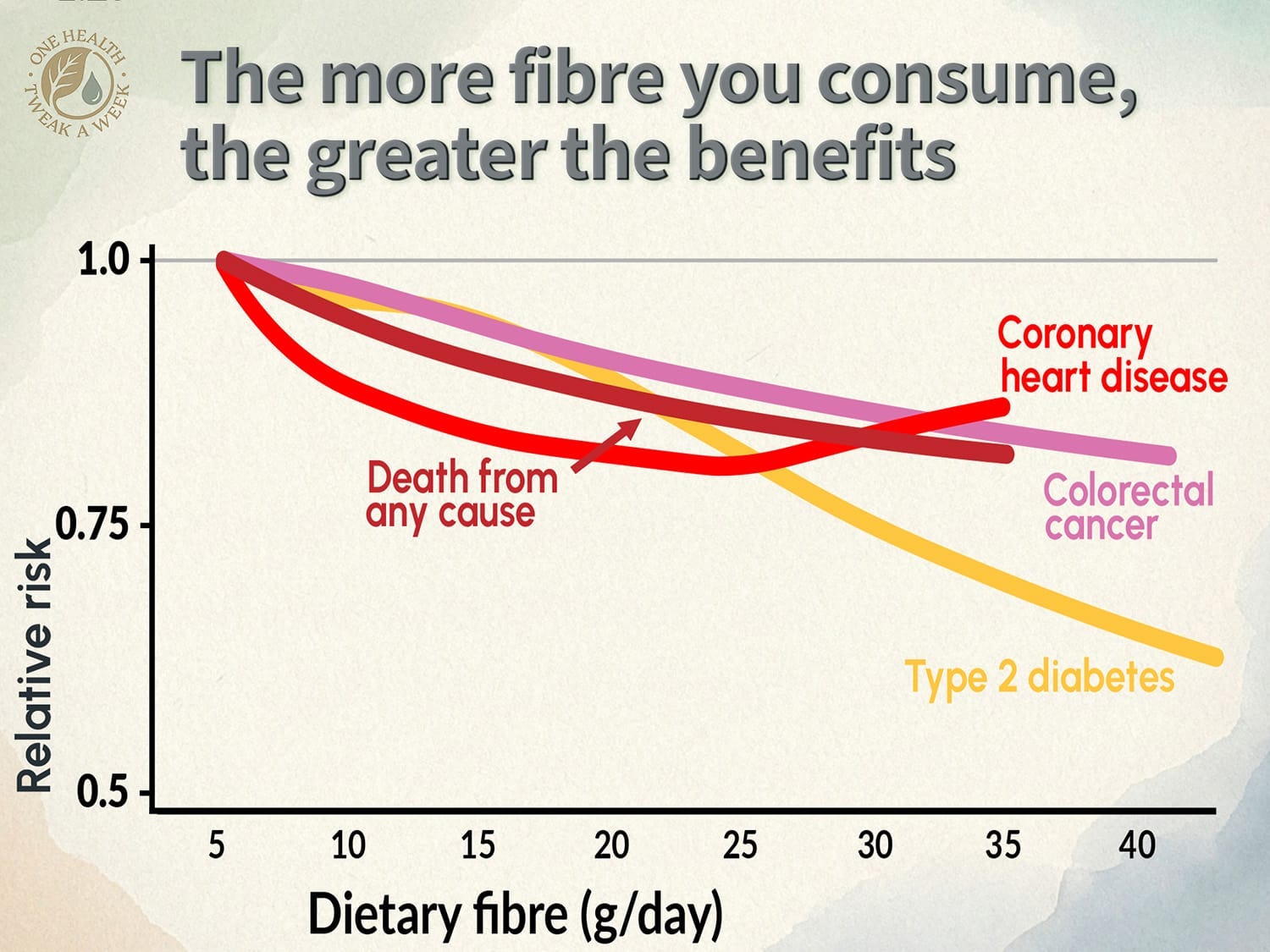
You can see that the risk keeps falling as fibre consumption increases beyond 30g/day.
(The apparent increase in coronary heart disease above 25g appears to be a statistical artefact rather than a real increase in risk. Coronary heart disease risk likely does plateau around 25g).
So I’d think of 30g/day as a sensible minimum target, not an optimum. And most of us are still well short of even that.
What this means for your health
Fibre’s old reputation as something that keeps you regular was deserved, but far too narrow.
Eating more fibre is linked to lower risks of cardiovascular disease, type 2 diabetes, colorectal cancer and premature death, while specific fibres can also lower LDL (bad) cholesterol, improve blood sugar control and relieve constipation. Taken together, the evidence is unusually consistent. Most of us would benefit from eating more fibre.
And for most of us, this isn’t fine-tuning an already excellent diet. Typical fibre intakes are well below current recommendations, leaving plenty of room for improvement.
The first step is finding out how big that gap is for you.
As always, your responses are anonymous, but they really help me tailor future content to what’s most helpful to you. Please take a moment to click a button.
HEALTH TWEAK OF THE WEEK
Higher fibre intake is associated with substantially better long-term health, including lower risks of cardiovascular disease, type 2 diabetes, colorectal cancer and premature death.
The usual recommendations cluster around 25–30g/day, yet average intakes in countries such as the UK, US, Canada and France fall well short of that. And the available dose-response evidence suggests that the benefits continue beyond 30g/day rather than stopping there.
So use 30g/day as your first target, not necessarily your optimum. Before trying to increase your fibre intake, spend 3 days finding out how much you currently eat.
1. Eat normally for 3 days. Pick 3 reasonably typical days and don’t deliberately change your diet while you’re measuring it.
2. Log what you eat. Use Cronometer, MyFitnessPal, CheckYourFood or another nutrition tracker that reports fibre. You don’t need laboratory precision. Reasonable estimates are enough to tell whether your usual intake is closer to 12g, 20g or 30g.
3. Calculate your average. Add the fibre totals from the 3 days and divide by 3. Compare the result with roughly 30g/day. If you’re well below that, you’ve identified a useful target for improvement. If you’re already around 30g or above, don’t assume you’ve reached an optimum: benefits seem to increase beyond 30g.
For now, just find your baseline. Next week, we’ll look at how to close the gap, which foods provide the different types of fibre, and whether getting fibre from psyllium is really equivalent to getting it from whole foods.
Could your kitchen use a second opinion?
I’m sure you already know the broad principles of healthy eating. The harder part is seeing your own blind spots.
Maybe you’re eating plenty of vegetables but very few legumes. Perhaps your fish choices are mostly lean rather than oily. Or you’re worrying about one food that probably isn’t the main issue while overlooking something more useful.
With my Kitchen Snapshot Audit, you send me photographs of your fridge, freezer and cupboards, along with a few brief details about how you normally eat. I’ll personally review the overall pattern and prepare a report showing what’s already working, what may be missing, and which changes are most worth making first.

It’s essentially a chance to open your kitchen wide and ask: “Okay, doc. What do you reckon?”
I’m currently doing a limited number at the introductory price of $149.
See how the Kitchen Snapshot Audit works
🎧 Prefer to listen while wondering whether fibre really has to involve a bowl of All-Bran?
🎙️ This week’s One Health Tweak a Week podcast takes a closer look at dietary fibre: why its benefits extend far beyond keeping you regular, how much of the health signal seems to come from fibre itself, and why 30g a day may be better thought of as a minimum than an optimum.
You’ll hear:
Why higher fibre intake is linked with lower risks of premature death, cardiovascular disease, type 2 diabetes and colorectal cancer
Why fibre appears to be doing more than simply travelling with an otherwise healthy diet
How specific fibres such as psyllium and oat beta-glucan can lower LDL cholesterol
Why the familiar microbiome and short-chain-fatty-acid story is less settled than it often sounds
How most of us are still eating well below recommended fibre intakes
The simple 3-day check that will tell you whether you’re one of them
👉 Good company for your next walk, commute, or while eyeing the cereal aisle and wondering whether “roughage” really needed such terrible branding.

(Episodes are free for now. Paid subscribers support the deeper research - and unlock practical tools to help you improve your health without turning it into a second job.)
🧭 Before you go
💬 Before reading this, what did fibre mostly mean to you? Keeping regular, gut health, cholesterol, or were you already well beyond the roughage era?
📤 Know someone whose idea of fibre still begins and ends with bran cereal and bowel movements? Forward this to them.
👥 Paid corner - If you do the 3-day fibre check and the result surprises you, drop me a message in our private chat. I’d be interested to hear where you landed before we get into the practical side next week.

Until next Saturday - don’t start forcing down All-Bran out of duty just yet. First, find out where you’re starting.
– Ben
A couple of weeks ago, I asked you to send me some suggestions for simple bean and lentil recipes suitable for those keen to eat more, but not quite sure where to start. Oh boy did you respond!
Do go back and check out the comments on that issue. There’s sure to be something that whets your appetite! And, a big thanks to everyone who contributed. I love how engaged and helpful this community is.
Are You Chasing the “Healthiest” Bean and Missing What Matters?

I eat quite a lot of legumes these days. But put me in front of a supermarket wall of kidney beans, chickpeas, lentils, cannellini beans and half a dozen varieties I barely recognise, and I still have a nagging sense that there must be a right one to buy.
I agree with Julie. When you eat a lot of naturally fiber-filled foods, you don’t have enough room for processed foods. I have stocked my pantry, fridge and freezer with fruits, veggies and beans and whole grains. I’ve been having fun finding new recipes that include a lot of these. I’ll have to check to see what my fiber number actually is now. Another good one Dr. Ben!
Ben, as a vegetarian and a regular consumer of legumes of every kind, and one who eats a lot of leafy greens and a variety of vegetables and not much processed food, I should be hitting the fiber quota, I think. I am very curious about the viscosity angle. How do soaked flax seeds, fenugreek seeds, and chia seeds compare? They all become like a gel. Do they help as well? Okra is also a very gummy vegetable. Just wondering. I read recently that soaked fenugreek seeds and okra remove a small percentage of microplastics from our bodies. Hopefully there is some truth in it.