
Extra-Virgin Olive Oil: The Small Daily Habit That Helps You Age Better
Why extra-virgin olive oil is such a strong health investment - and roughly how much you need for it to really count.

If a drug lowered your risk of dying early, cut your chances of a heart attack, helped protect against type 2 diabetes, and nudged dementia risk in the right direction, every doctor’s surgery in the world would have a poster about it. It would be on prescription. It would probably cost a fortune.
And yet there’s something exactly like that - but it’s not a drug, it doesn’t need a prescription, and it typically costs less than a dollar a day.
It’s extra-virgin olive oil (EVOO), and the gap between what the data shows and how most people actually use it is one of the more striking mismatches in everyday nutrition.
I’ve cooked with EVOO for years. It goes in the pan, over roasted vegetables, and into salad dressings. I’ve been telling patients and readers for a long time that it’s one of the better things you can do for your health.
What I hadn’t done, until I sat down to write this, was properly interrogate the dose question: how much do you actually need to see meaningful benefit, and what does it need to be replacing? Turns out those two things matter more than almost anything else about how you use it.
Most of us treat EVOO like a condiment rather than a foundation. The research doesn’t reward a Friday-night drizzle. It rewards a daily habit at a specific dose, replacing the fats doing you less good.
That’s what this issue is about: the evidence, the dose, and the one variable that matters more than how much you pour.
Before we start to look at the evidence, let’s capture how much extra virgin olive oil you’re using right now.
As always, poll responses are anonymous, and they help me tailor content to what’s most helpful for you. Please take a moment to click a button!
The science: what happens when EVOO is your main added fat?
Let’s start with the broadest outcome, because it’s the one that puts everything else in context.
It’s linked with living longer
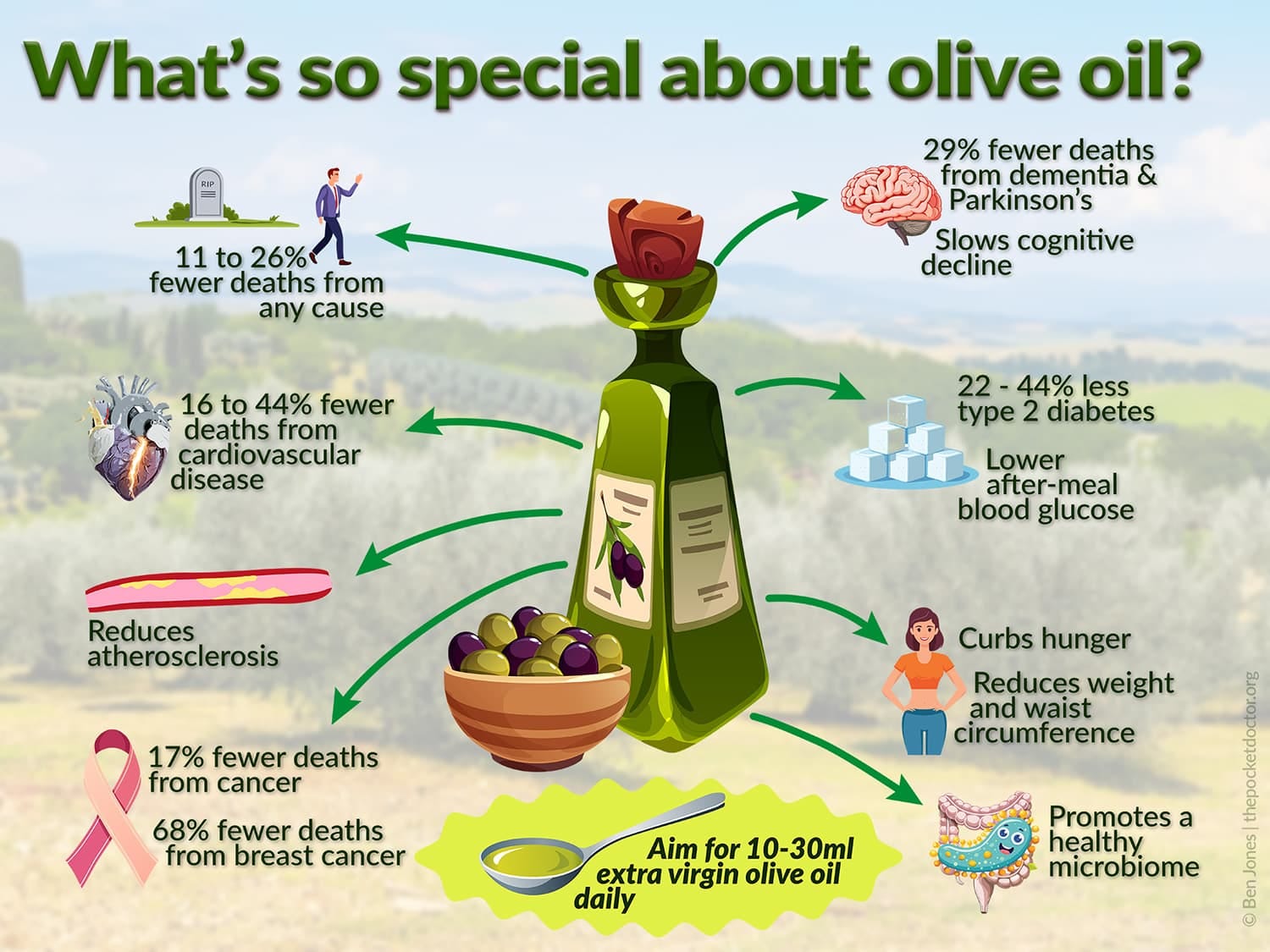
Across several large European and US studies, people who use olive oil regularly have about an 11-26% lower risk of dying from any cause compared with those who use little or none.
That’s not a modest signal. For context, that’s the kind of risk difference that would make a drug front-page news.
In one long-running US analysis, researchers estimated that when people replaced just 10g a day (roughly a tablespoon) of butter, margarine, mayonnaise, or dairy fat with olive oil, they had a 13% lower risk of premature death.
One tablespoon. Swapped for the spread on your toast or the butter in your pan. Leading to a 13% lower chance of dying prematurely. That’s huge.
Your heart and cardiovascular system
This is where the evidence is strongest, and where we have the best trial data to back up what the observational studies suggest.
In studies in Southern Europe, regular olive oil use is associated with a roughly 16 - 44% lower risk of dying from cardiovascular disease.
The headline trial is PREDIMED, one of the largest and most rigorous dietary intervention studies ever conducted. Participants following a Mediterranean-style diet with generous extra-virgin olive oil (around 40-50g per day) had 39% fewer major cardiovascular events (heart attack, stroke, cardiovascular death) than those on a low-fat diet and a 48% lower rate of dying from cardiovascular disease
Thirty-nine to 48 percent. From a dietary pattern, not a statin.
Your brain
This one tends to surprise people. In a large US study, people getting more than about 7g a day of olive oil (just over half a tablespoon) had around 27% fewer dementia-related deaths compared with those who rarely used it.
We don’t fully understand the mechanism yet, though the leading candidates include olive oil’s anti-inflammatory polyphenols and its effects on vascular health. But the association is striking, and it showed up at a dose most people could easily hit.
Blood sugar and metabolic health
People who eat more olive oil as part of a Mediterranean-style diet have about a 22 - 40% lower risk of developing type 2 diabetes over time.
Olive-oil-rich meals also increase GLP-1, the gut hormone that Ozempic and Wegovy are designed to mimic. The difference is that GLP-1 from your dinner doesn’t require a prescription, mountains of paperwork, or a four-figure price tag. It simply helps you feel full for longer and makes between-meal snacking less tempting.
Cancer
In the same US fat-swap analysis, replacing 10g a day of butter or margarine with olive oil was associated with about a 17% lower risk of dying from cancer. And in PREDIMED, a Mediterranean diet enriched with extra-virgin olive oil was linked with a striking 69% reduction in breast cancer risk. (We should treat the size of this result with some caution, as it was a secondary analysis and numbers were small; still, it’s a hopeful signal).
These are associations, and cancer causation is complex. But the direction is consistent.
Bones
This one flies under the radar. In an analysis from the PREDIMED trial, people in the highest third of extra-virgin olive oil intake had about a 51% lower risk of osteoporotic fractures compared with those in the lowest third. Notably, standard “common” olive oil didn’t show the same benefit, suggesting the polyphenols specific to extra-virgin matter here.
Bone health rarely gets anyone excited, which is probably why this finding doesn’t get much airtime. But when you consider that up to a third of older people die within a year of a hip fracture, it’s a big deal.
Weight and waist
Within Mediterranean-style eating patterns, higher olive oil intake is linked with better long-term weight control and a smaller waist, particularly when it displaces butter and margarine. Each additional 7g a day was associated with slightly less weight gain over time.
Olive oil is calorically dense, so this is a fair concern. But the data suggest that when EVOO displaces other fats rather than adding to total calories, it doesn’t promote weight gain and may even nudge things in the other direction.
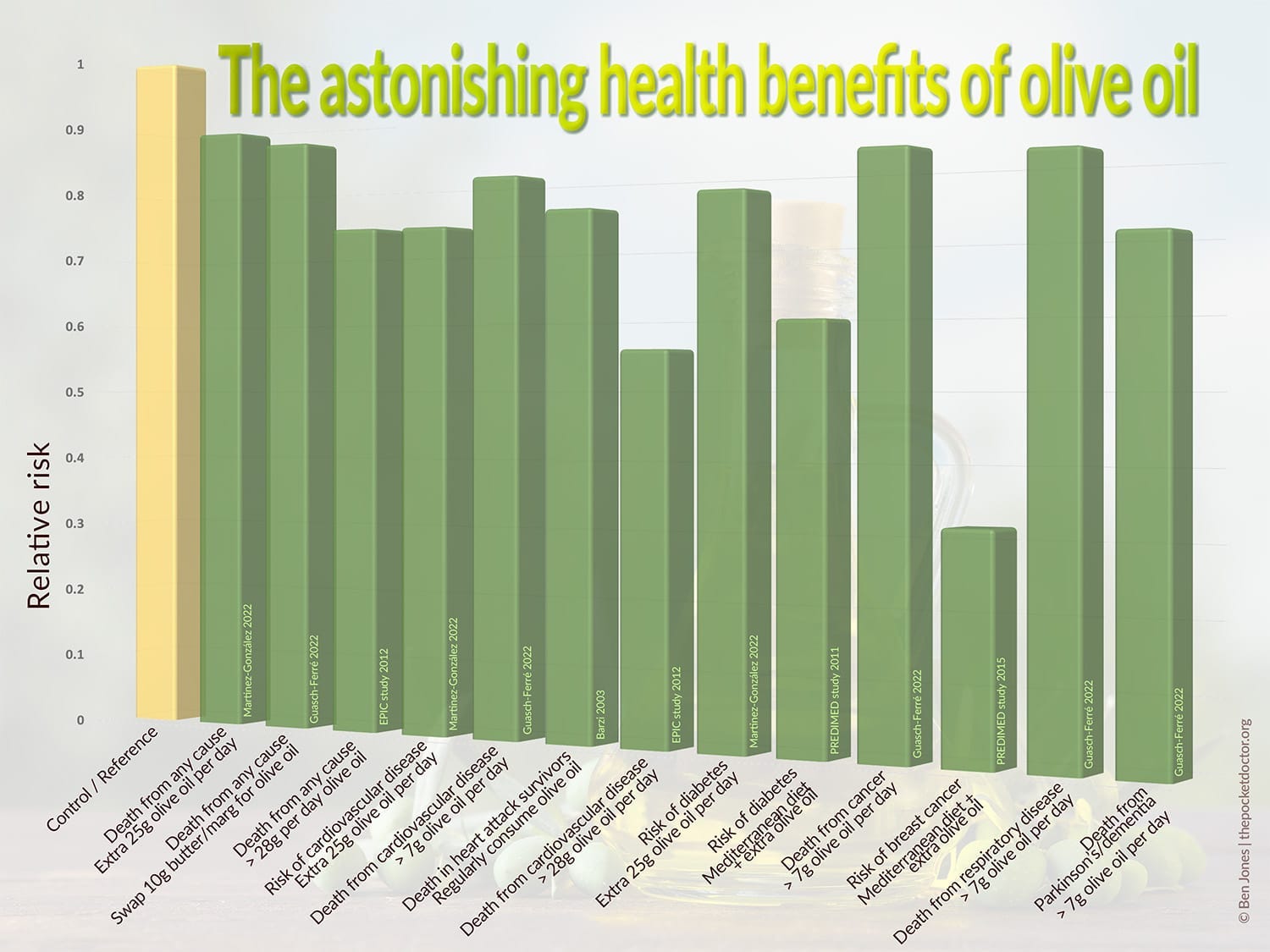
Here’s a visual summary of all these study results. The yellow bar represent people who consume little or no olive oil. The lower the bar, the lower the risk of the diseases mentioned.
A word on what this evidence can and can’t tell us
None of this proves that olive oil is doing all the heavy lifting on its own. Most of these findings come from observational studies, where people who use more olive oil may also eat better in other ways. The strongest trial evidence, PREDIMED, tested a whole Mediterranean-style pattern with extra-virgin olive oil built in generously, not olive oil alone in an otherwise unchanged diet.
What we can say is that the signal is consistent, it shows up across different populations and study designs, the effect sizes are meaningful, and the substitution effect (olive oil instead of butter and refined oils, not just olive oil added on top) appears to be a big part of why. That’s enough to make it one of the most evidence-backed single dietary moves available.
On safety and tolerability, the picture is reassuring:
Up to 50-60g per day of EVOO, used within a calorie-appropriate diet, doesn’t seem to promote weight gain; if anything, higher olive oil intake is associated with slight weight loss when it displaces butter and margarine.
Like any fat, olive oil makes the gallbladder contract, so people with symptomatic gallstones can sometimes notice discomfort when they rapidly increase fat intake. That’s a general “go gently” point rather than a specific EVOO hazard.
How much is “enough”?
The next natural question: do you need to pour the stuff with the abandon of a Sicilian nonna?
The short answer is no.
In Mediterranean cohorts, a 10g per day increase in olive oil is associated with about 7% lower risk of dying from any cause and 13% lower cardiovascular mortality.
For cardiovascular disease and stroke, one analysis found maximal benefit around 20-30ml per day - roughly 1-2 tablespoons.
For breast cancer in PREDIMED, the strongest protection appeared at about 35ml per day.
In US studies, where baseline olive oil intake is very low, as little as 9ml per day (not even a full tablespoon) was associated with 19% fewer cardiovascular deaths, 17% fewer cancer deaths and 18% fewer deaths from Alzheimer’s and Parkinson’s.
A practical way to think about it:
The threshold where benefits kick in seems to be around 7-10ml per day, especially if you’re starting from a low baseline.
A realistic “benefit zone” for everyday life is probably 10-30ml per day (2 teaspoons to 2 tablespoons).
In Mediterranean trials like PREDIMED, people often sit in the 40-60g per day range without weight gain or safety signals at the population level.
For most of us, 10-30ml per day is very achievable if EVOO is your main cooking and dressing fat - provided something else is making room for it.
It isn’t just “any olive oil”: why EVOO matters
Olive oil’s base fat is oleic acid, a monounsaturated fat that behaves better than saturated fat for cholesterol and lipoprotein profiles.
But when researchers directly compare extra-virgin olive oil with higher polyphenol content to refined or low-polyphenol olive oils, they see extra benefits at the same dose.
So, olive oils are not all equal.
This is the whole focus of next week’s issue: what actually counts as decent EVOO, and how to pick a bottle that’s likely to contain the polyphenols you’re paying for.
For this week, all you really need to know is:
“Olive oil” is not a single thing. The bottle matters - and not all of them match the oils used in the best trials.
Substitution is key to maximising the benefits of olive oil
There’s one more crucial piece: what EVOO replaces.
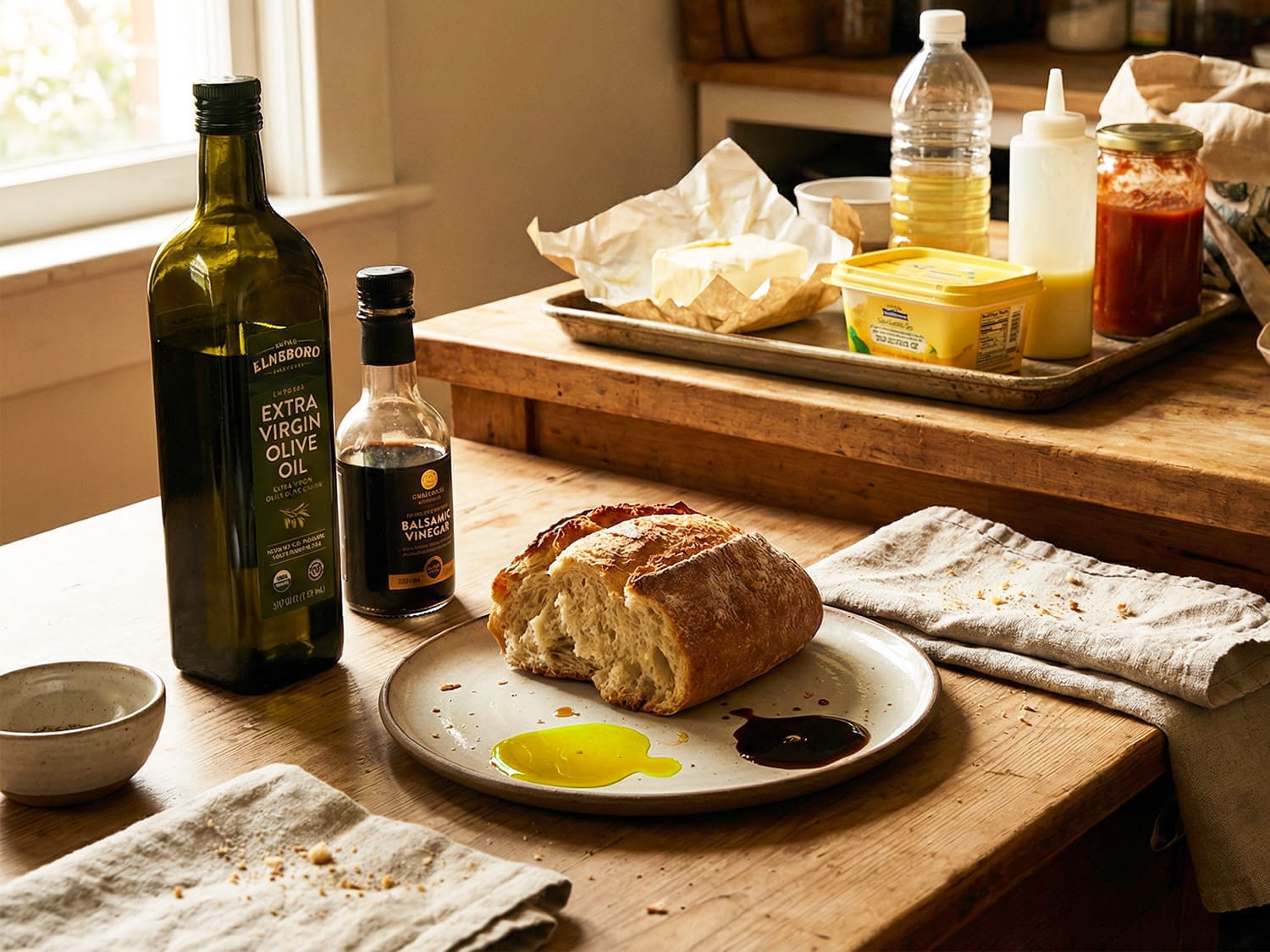
In the US studies, the impressive risk reductions came from replacing butter, margarine, mayonnaise and dairy fat with olive oil, not from simply adding olive oil on top of everything else. Swapping other vegetable oils for olive oil didn’t seem to move the needle much either way.
In PREDIMED, EVOO was the primary added fat in the context of a Mediterranean-style pattern (more legumes, whole grains, nuts and vegetables; fewer processed meats and ultra-processed foods).
So the story is not “the more fat the better”. It’s:
butter, ghee, lard, hard margarines → EVOO
high-omega-6 seed oils for everyday cooking → EVOO
mayonnaise and creamy dressings → simpler olive-oil-based dressings where possible
cream-based sauces and spreads → EVOO stepping into at least some of those roles
I see lots of bloggers and influencers telling people to simply drink 30ml of olive oil at breakfast. That’s not how this works!
And so, switching your fats to use mostly extra virgin olive oil ends up very high on the “worth doing” list. We’re talking about substantial potential health benefits from a simple kitchen switcheroo.
What this means for your health
They key lesson from all this data is:
Make good-quality extra-virgin olive oil your default added fat, and let it gradually displace butter, margarines, mayonnaise, creamy dressings, and refined seed oils from your diet.
For most people, a realistic target is somewhere around 20-30ml per day (roughly 1.5 to 2 tablespoons).
That’s not as dramatic as it sounds. It’s EVOO in the pan, EVOO on vegetables, EVOO as the base for a quick dressing. It’s less about following a protocol and more about making it the thing you reach for automatically.
I do exactly that. EVOO is the only fat I cook with, and it goes into every dressing I make. So on paper I look like I’ve got this sorted. But when I actually tried to estimate my daily intake while writing this, I couldn’t. A drizzle here, a shallow pour in the pan there. My honest guess is that most days I’m probably sitting below that 20-30ml target.
Which is the point. Most of us have a vague sense of our habits, but not actual numbers. And the research is fairly clear that dose matters: the studies seeing the biggest benefits aren’t seeing them from occasional use.
So before next week, the one thing worth doing is getting a realistic picture of where you actually are: how much EVOO you’re genuinely using day to day, and which other fats are still in the picture. Not to judge either answer, just to know. That way, next week’s practical guidance on what to buy and how to close the gap will map onto your real life rather than an imaginary version of it.
HEALTH TWEAK OF THE WEEK: Map your EVOO and meet the competition
Regular use of extra-virgin olive oil, especially when it replaces butter, margarine, and refined oils rather than simply adding to them, is consistently linked with lower risks of dying early, heart disease, type 2 diabetes, dementia, and some cancers. The dose that seems to matter is roughly 20-30ml a day (1.5 to 2 tablespoons). Most of us are probably getting less than that without realising it.
This week’s tweak is deliberately low-friction: before you change anything, find out where you actually stand. How much EVOO are you genuinely using each day, and which other fats is it up against?
1. Measure your baseline (for real, not in your head)
For the next few days, keep a note of every time you use olive oil:
Cooking: teaspoons or tablespoons that go into the pan or roasting tray.
Dressings and drizzles: what you pour onto salad, vegetables, soup.
Baking or other uses: anything where you can reasonably estimate a per-portion amount.
Yes, this means actually measuring. With a spoon. I know.
Use this simple conversion:
1 teaspoon ≈ 5ml
1 tablespoon ≈ 15ml
If you’re cooking for more than one person, just count your share: for example, if you use 2 tablespoons of olive oil for two people, log 1 tablespoon for yourself.
At the end of the week, add up your total and divide by the number of days to get your average ml per day. Then just notice where that sits:
under 10ml?
somewhere between 10 and 30ml?
higher than that?
No judgement, no “should” yet - just data.
2. List the other fats that share the stage
Next, make a quick list of your top five non-EVOO fats that show up regularly. Common ones:
butter or margarine on toast and sandwiches
ghee, lard or dripping for cooking
sunflower, corn, soybean or “vegetable” oil for frying and roasting
mayonnaise, shop-bought salad dressings, creamy pasta sauces
“hidden” fats in pastries, biscuits, ready meals and takeaways
Against each, jot down where it appears most often (e.g. “toast every morning”, “Sunday roast potatoes”, “sandwich at lunch”, “jarred sauce on pasta twice a week”).
What you’re building is a simple map: this is how much EVOO I actually use, and these are the other fats that I eat a lot of.
3. Circle your easiest future swap
Finally, look down your list and circle one or two fats that feel most swappable in principle:
maybe it’s the butter on your evening bread,
or the sunflower oil in your roasting tin,
or the thick creamy dressing you tip onto salads.
Look back at your list and decide which of these sounds like you:
If EVOO is already your main cooking fat, but your daily total is coming up short: you don’t need to wait for next week. Look down your list of competing fats and pick one or two that EVOO could reasonably replace. The sunflower oil in the roasting tin. The butter on your vegetables. Start there.
If you don’t yet have a bottle at home: hold off for one week before you buy. Next week’s issue is entirely about how to choose an olive oil that’s actually worth using, because the gap between the best and worst bottles on a typical supermarket shelf is wider than most people realise. Subscribe if you haven’t already, and you won’t have to guess.
Either way, take a moment to appreciate that one of the most evidence-backed things you can do for your long-term health costs less than a dollar a day and requires no particular discipline. Most health upgrades are considerably less convenient.
This one you can start with dinner tonight.
Need some olive oil inspiration?
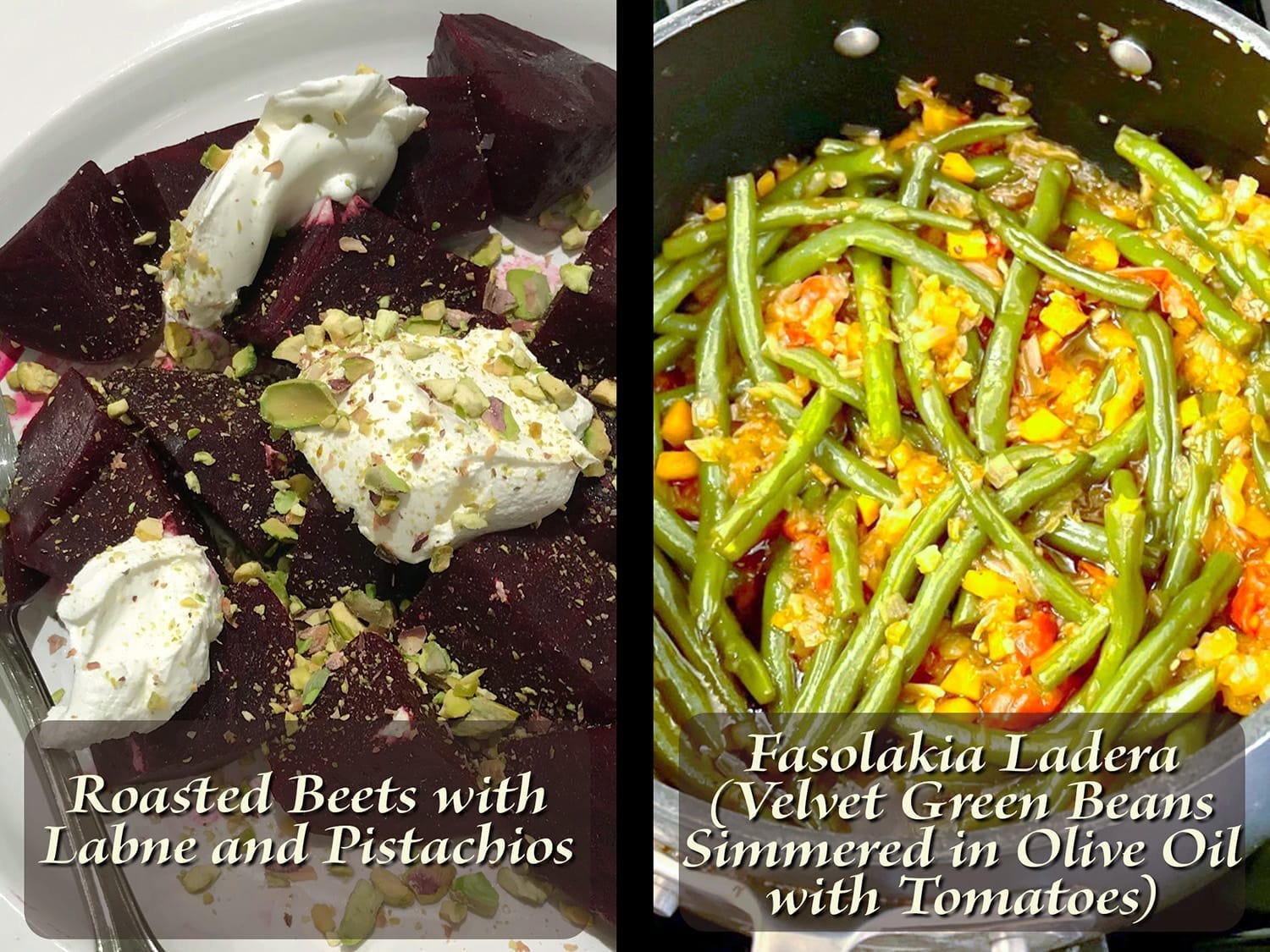
If you’ve treated yourself to an indulgent bottle of single-estate extra-virgin olive oil, you might be looking for a recipe that really lets you taste it. Harvard cancer specialist Dr Ellen Kornmehl has a knack for combining indulgent and healthy - not the easiest brief.
Here are a couple of my favourites where extra-virgin olive oil is a major player:
Fasolakia ladera – velvety green beans simmered in olive oil with tomatoes
I’ll share a couple more of Ellen’s recipes in next week’s second olive-oil edition. In the meantime, I’d whole-heartedly recommend exploring her compendium of temptations for yourself.
🎧 Prefer to listen while working out if you’re drizzling, glugging, or barely touching the olive oil?
🎙️ This week’s One Health Tweak a Week podcast is about why extra-virgin olive oil earns its place in your kitchen - and how much you actually need for it to matter.
You’ll hear:
How regular olive oil use links to lower risk of early death, heart disease, type 2 diabetes, dementia and fractures
Why the 10–30 ml/day “benefit zone” is a great target range, - and why you don’t need to chase Mediterranean-level intakes
Why the real magic is what EVOO replaces (butter, ghee, seed oils, creamy dressings), not just how much you drizzle
👉 Ideal company for your next walk, commute, or while you’re making dinner and realising just how many different fats sneak into a normal day.

(Episodes are free for now. Paid subscribers support the deeper research - and unlock practical tools to help you map your fats, hit the benefit zone, and still enjoy your food.)
🧭 Before you go
💬 When you added up your last few days, where did your olive oil use land - below, in, or above that 10-30 ml/day zone? And which other fats (butter, margarine, seed oils, mayo, creamy sauces) turned out to be doing most of the heavy lifting? I’d love to hear your rough number and the one swap you’re considering.
📤 Know someone who’s still wary of “too much oil”, convinced beef tallow is the healthy option, or paralysed by the seed-oil wars? Forward this to them. A calm look at the evidence beats doomscrolling nutrition takes.
👥 Paid corner - Want another pair of eyes on your 2-3 day “fat map”? Share a short food log or your best estimate of daily olive oil and other fats, and I’ll help you line that up with the benefit zone and your health priorities.

Until next Saturday - your future heart, brain and bones are quietly rooting for that dark green bottle on the shelf 🫒
– Ben
I have started using a mild EVOO in my baking replacing butter. I find my cakes & muffins are more tender & just as moist as using butter. A great swap in MHO.
Fantastic article. And thanks for addressing the issue re cooking at higher temperatures. I’d stopped using evoo for cooking because of the conflicting advice from chefs and self-styled health experts on this issue. I’ll be swapping all oil for evoo going forward ! Keep up the great work -it’s rare to find d such well researched unbiased advice these days.