
Could Your Daily Rhythms Be Undermining Your Health?
Large studies suggest irregular daily routines are linked with higher risks of dementia, stroke and early death.


Most health advice talks to individual habits.
Go to bed earlier.
Get your 7.5–8 hours.
Eat breakfast.
Walk every day.
Have dinner early.
If you have been reading for a while, you’ve probably heard me talk about all of these in the past year.
On the surface, they look like separate jobs on your health to-do list. But last year, as I dug through the science on sleep, meal timing and breakfast, something clicked that I couldn’t then un-see.
Because when I zoomed out, a broader truth emerged. These weren’t isolated good habits. They were all working in service of something deeper and more fundamental - something that doesn’t get talked about nearly enough.
Your body’s internal clock.
It changed how I saw my own routine. And knowing about it doesn’t magically make you good at it.
Over the past month, my own bedtimes have crept later again. I know perfectly well that I function best when I am asleep by about 11.00 pm and up at 7.00 am. Yet somehow I keep finding “one more thing” to do at night. In the morning, my alarm goes off, I hit snooze, and lie there feeling as if my head is full of wet cement.
In an attempt to parent myself, I now have two alarms on my phone: a wake-up alarm in the morning and a go-to-bed alarm at night.
Working with your body clock isn’t just about feeling a bit fresher in the morning. Living out of alignment with your body clock can have serious implications for your health and even age you faster.
Let’s explore why living in synch with your body clock is so important.
Your 24-hour city: one master clock, many neighbourhoods
Inside your brain sits a tiny cluster of neurons in the hypothalamus that keeps time. It is called the suprachiasmatic nucleus. It takes its main cue from light: bright morning light says “daytime”, darkness says “night”.
But that master clock isn’t alone.
Almost every organ you can name has its own local clock: the liver, gut, muscles, pancreas, fat tissue, even many types of immune cell. Those peripheral clocks listen less to light and more to what you do over 24 hours: when you eat, move, rest, feel stressed, or take certain medicines.
Think of your body like a city that runs on a 24-hour schedule.
The brain clock is like city hall, deciding when the streets should be busy and when they should quieten down.
Your liver is the waste-processing plant and logistics hub.
The gut is quality control and intake management, deciding what gets absorbed, what gets modified, and what gets sent straight back out.
Muscles are the transport network.
Fat tissue is long-term storage.
When the city runs well, deliveries turn up in the morning, offices are busy in the day, rubbish is collected at night, and people sleep when the streets are quiet.
When it runs badly, the bin lorry turns up at rush hour, heavy lorries arrive at midnight, and roadworks start just as everyone is trying to get to work.

In biological terms, good health is not just about how much you sleep, or what you eat, or how much you move. It is also about synchrony: your brain clock, your organ clocks and the outside world all roughly agreeing what time it is.
What misalignment really feels like
Circadian misalignment is what happens when those clocks no longer agree.
Sometimes that’s obvious: night shift work, flying across time zones, alternating early and late shifts.
More often, it is subtler. You go to bed at 11 pm one night and 1 am the next. You have dinner at 6.30 pm on Monday and 9.30 pm on Tuesday. You catch up on sleep at the weekend and drag yourself through early meetings in the week.
Inside, your clocks are trying to keep a steady rhythm. Outside, the world is turning the dial forwards and backwards.
The problem isn’t just drift - it’s that your clocks start talking over each other. One says sleep, another digestion, a third stress. The result? Noise and confusion.
It’s like having a cabin on a cruise ship directly above the nightclub. You’re lying in bed, desperate for sleep. Your brain is sending every signal that it’s night. Meanwhile, the bass from the club is thudding through the floor.
The same thing happens when your brain thinks it is time to sleep, but your liver is still processing a heavy late-night meal as if it is midday in the factory.
That mismatch doesn’t just make you feel groggy. Over years, it shows up in hard outcomes. Let’s look at what that actually means.
Fragmented rhythms and the risk of dying earlier
The Rotterdam Study is a good place to start.
Researchers asked 1,734 adults aged 45–98 to wear activity monitors, then followed them for more than 7 years. They looked at how stable each person’s activity was over 24 hours: did they have a clear, regular pattern of daytime activity and night-time rest, or a more chaotic pattern with naps, late nights and variable wake times?
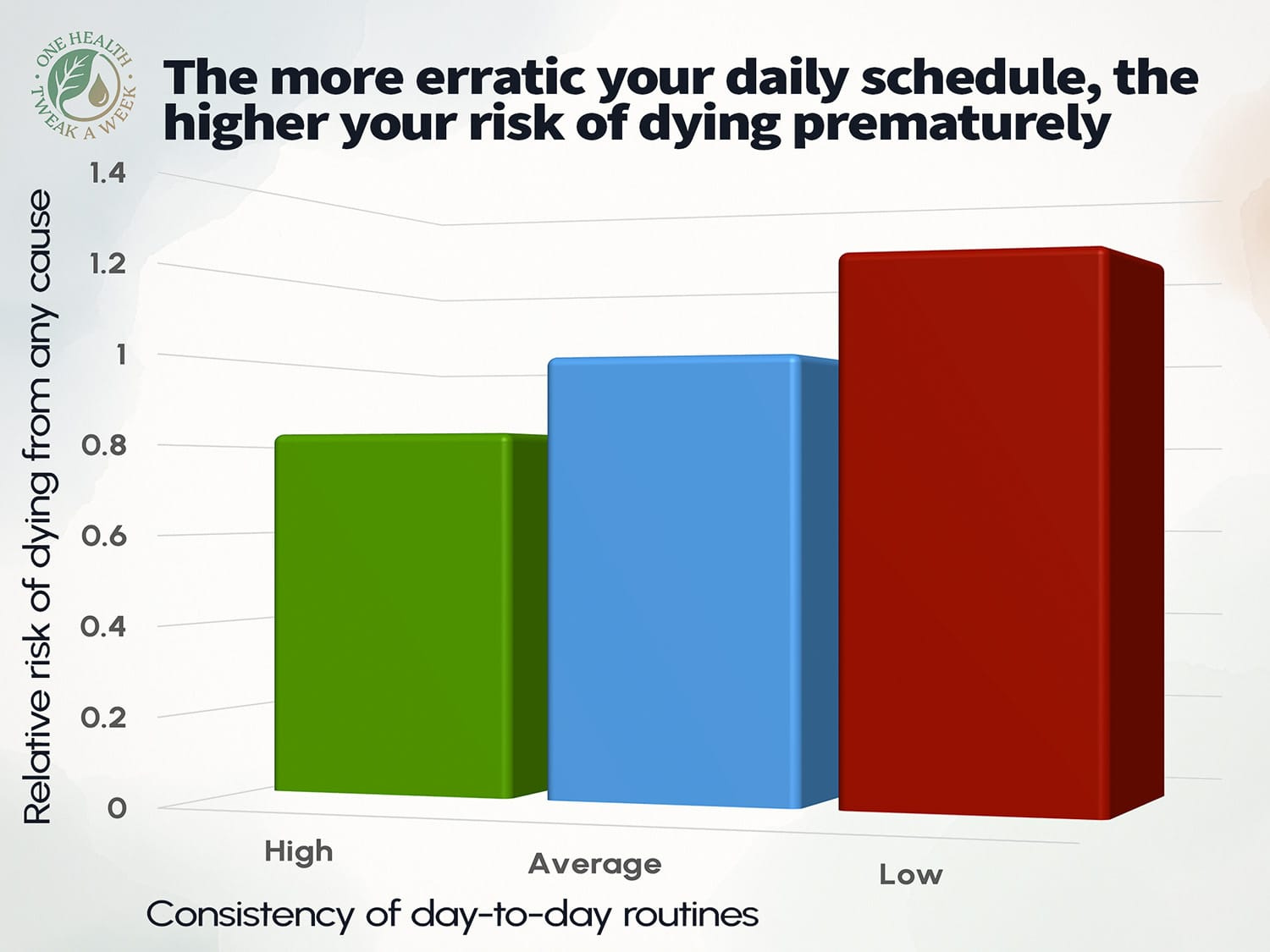
Once they adjusted for classic risk factors and sleep duration, something striking emerged.
People in the most erratic 15% - whose day–night activity pattern was the most fragmented - had about a 22% higher risk of dying during follow-up compared with those around the average.
People in the most stable 15% - whose activity patterns were the most consistent - had about a 17% lower risk of dying than average.
In other words, for longevity, the stability of the rhythm mattered at least as much as how long people were asleep. It was’t that people with erratic patterns were necessarily sleeping less; their 24-hour rhythm was simply weaker and more broken.
Erratic routines and dementia, stroke and Parkinson’s
The same kind of pattern shows up for cognitive health.
In the Rush Memory and Aging Project, 1,401 older adults in their late seventies and eighties wore activity monitors and had detailed annual cognitive testing. Over 15 years, those whose day-night activity patterns were most unstable had about a 22% higher risk of being diagnosed with Alzheimer’s dementia compared with those with average stability, even after taking age and other health factors into account.
A much larger analysis in the UK Biobank looked at 72,242 adults who wore activity trackers for a week. Again, the focus was on how regular their 24-hour activity pattern was, not just steps or hours in bed.
Over about 6 years of follow-up, those with the most erratic rhythms had:
roughly a 23% higher risk of dementia,
a 33% higher risk of Parkinson’s disease,
a 13% higher risk of stroke, and
a 14% higher risk of anxiety disorder,
compared with those whose rhythms were more stable, after allowing for other risk factors.
This group also had more abnormalities on brain scans in areas that previous work has linked to dementia and psychiatric illness.
We can’t say for certain that a fragmented daily rhythm causes these outcomes - but the association is clear. Across large, well-conducted studies, weaker rhythms consistently show up in people who are more likely to develop dementia, stroke and other neurological conditions over time. At the very least, they seem to signal a brain that’s under strain.
Night shifts and faster biological ageing
What about people whose lives are chronically out of sync with their clocks because of work?
One window on that comes from the Sister Study, which followed 2,574 White American women and looked at their “genetic age” based on DNA methylation patterns.
Women who had done long stretches of night shift work - especially those with at least 10 years of nights - had a biological age around 3 years older, on average, than women who had never done night shifts.
So, living out of alignment with your biological clock may even age you faster.
All of this sits alongside a broader body of work showing that evening types forced into early schedules, people with regular “social jetlag” between weekdays and weekends, and those with chronically irregular sleep timing tend to have worse cardiometabolic markers and higher risks of depression and anxiety than people whose lives are more in tune with their innate rhythm.
A quick word on mechanisms and caveats
How might a mistimed daily rhythm translate into disease?
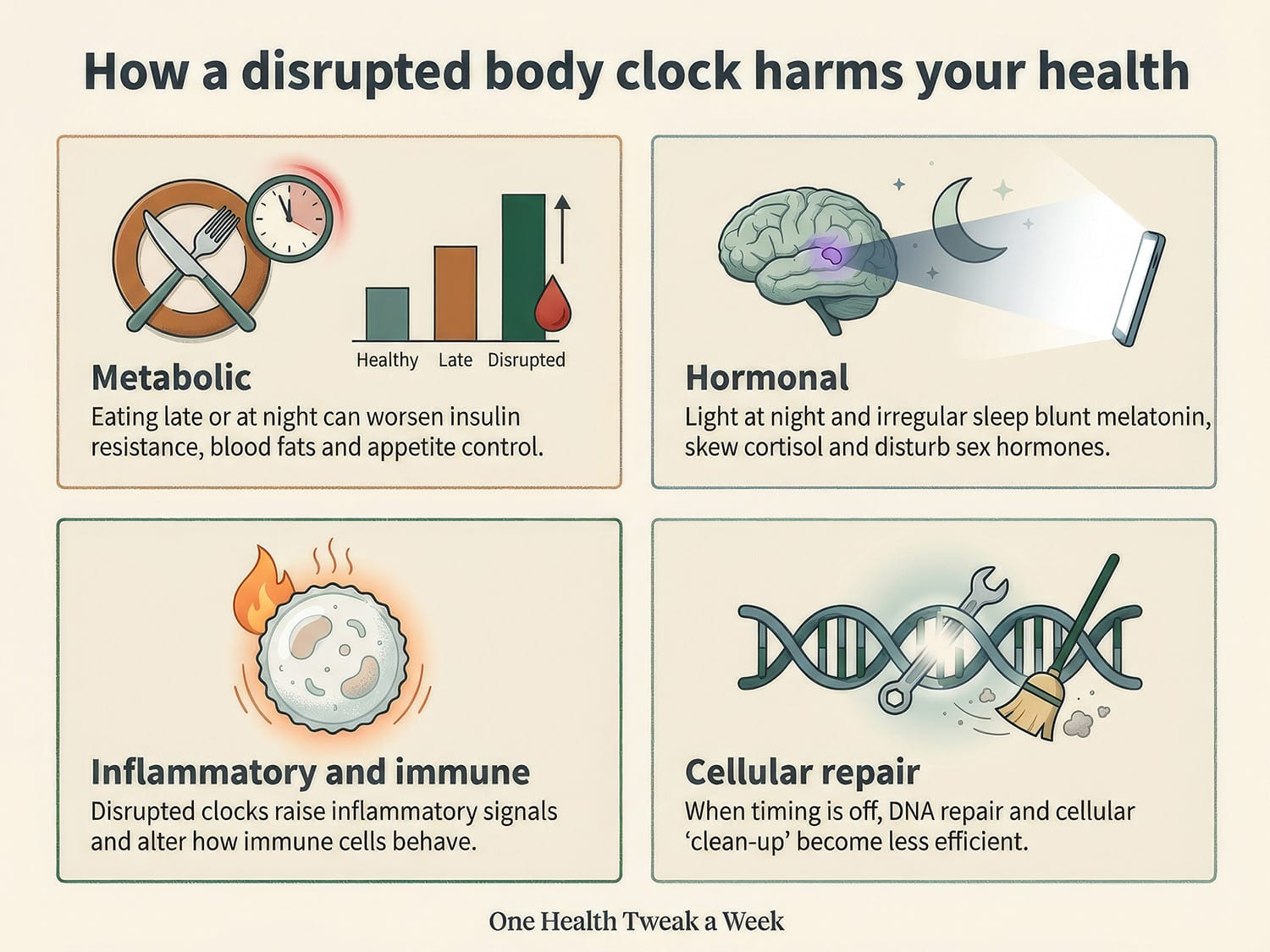
Researchers talk about several plausible pathways:
Metabolic: eating most of your calories when your body “expects” to be resting seems to worsen insulin resistance, blood lipids and appetite regulation.
Hormonal: chronic light at night and irregular schedules can blunt melatonin signals, alter cortisol rhythms and disturb sex hormone patterns, all of which interact with mood, immunity and metabolism.
Inflammatory and immune: clock disruption is linked to higher levels of inflammatory markers and altered immune cell behaviour.
Cellular repair: some DNA repair and housekeeping processes are more active at certain biological times; if the clock is constantly shifted, repairs may be less efficient.
At the same time, we need to be cautious.
Most of the data we have here are observational. That means we are looking at associations: people who live one way versus people who live another. Even with careful statistical adjustment, we can’t completely rule out other explanations.
People with early disease may become less active or develop irregular sleep before a diagnosis is made, which could make misalignment look more harmful than it really is. Socioeconomic factors, stress, diet and access to healthcare all weave into the picture.
However, when researchers control for these factors, the signal usually persists, and short-term experiments suggest that gradually aligning sleep or meal timing with internal clocks can improve metabolic markers.
So we should treat circadian alignment as a powerful, plausible lever, though not a magic switch.
Why our rhythms become more vulnerable in midlife
You might be thinking: “Fine, but I got away with late nights and erratic routines for decades. Why worry now?”
Age is a big part of the answer.
As we move into our forties, fifties and sixties, several things shift at once:
The master clock in the brain becomes less robust. The contrast between “day” and “night” in our internal signals shrinks, and our rhythms tend to fragment.
Sleep changes: lighter, more easily disrupted sleep with more awakenings, especially in the second half of the night.
Hormones move: menopause in women and a gradual decline in testosterone in men can make temperature regulation, sleep and mood more sensitive to timing.
Life gets crowded: work responsibilities, caring for children or parents, and digital devices late into the evening all nudge us away from what our biology would prefer.
The result is that we are both more likely to be misaligned and more sensitive to the consequences.
That ‘s why this issue isn’t just an abstract lecture about clocks. It is the opening of a new pillar in this newsletter: chronobiology as a practical tool for protecting your brain, heart and metabolic health in the decades when those systems start to show strain.
I believe it’s really important, and we’re going to be talking about it more in future issues.
What this adds up to for your health
Put together, the picture looks like this.
Your body doesn’t just care about what you do. It cares about when you do it relative to your internal time.
People whose days have a reasonably regular pattern of sleep, eating, movement and rest - with clear differences between daytime and night-time - tend to have stronger, less fragmented internal rhythms. Across multiple large studies, those people are less likely to die in the next decade and less likely to develop dementia, Parkinson’s disease, stroke or significant anxiety.
People whose days are chronically chaotic - late nights some days, early starts on others, meals and naps scattered across the 24 hours - tend to have weaker rhythms and worse outcomes.
Shift workers and evening types forced into rigid early schedules face the hardest challenge. They have to live most of their lives against their own clocks and the outside world at the same time.
Most of us are somewhere in the middle. We don’t need perfect regularity. We do benefit from a rhythm that is “good enough” and broadly aligned with our personal chronotype.
The decision rule for this new chronobiology pillar is simple: get curious about your own 24-hour rhythm, then gradually tilt your life so that more of the big pieces line up with when your body actually wants to do them.
This week is about the first part of that: seeing your pattern clearly.
HEALTH TWEAK OF THE WEEK: Map your 24-hour rhythm
The big idea this week isn’t to overhaul your life. It is to make your invisible rhythm visible.
Studies following thousands of adults over many years suggest that people with stable, robust day-night patterns are less likely to die early and less likely to develop dementia, stroke, Parkinson’s disease or significant anxiety than those with very erratic routines, even when they sleep similar numbers of hours and have similar risk factors. The greatest risk seems to come when your internal clock and your daily schedule are chronically out of sync.
You can’t fix a pattern you can’t see. So your tweak is to sketch your own 24-hour rhythm and spot where your body and your life are currently disagreeing.
1. Sketch one “typical” weekday
Take a sheet of paper and draw a horizontal line from left to right. Label the left end with the time you usually wake up and the right end with the same time the next morning.
To make it even easier, download and print this tracker:
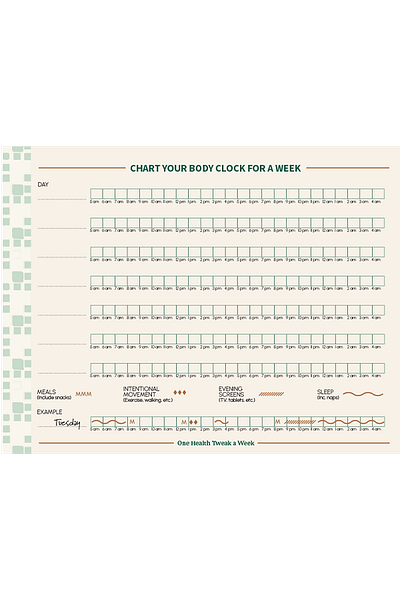
On that line, mark:
when you usually fall asleep and wake up,
when you have your first meaningful calories of the day,
when you have your last meal or substantial snack,
your main focused work block,
any intentional movement (walks, workouts, classes),
your heaviest evening screen time.
Don’t aim for perfection. Roughly “around 7 am” or “between 9 and 11 pm” is fine.
2. Mark what feels natural versus forced
Next to each element, add a quick symbol:
a tick for “this is when my body likes to do this”, and
an exclamation mark for “this is mostly when my life forces me to do this”.
3. Repeat on a few days and keep the map
The problem comes with chronic misalignment, so repeat the process for a week. Is your routine similar or quite different at the weekend?
This week, your job is observation only. You are not trying to fix anything yet. You are simply building a picture of how your internal clock and your external schedule currently interact.
Keep your 24-hour map somewhere you’ll find it again. In upcoming issues, we’ll turn that scribble into a simple “body clock profile” and use it to decide which small timing tweaks are likely to give you the biggest long-term health return.
You don’t need a perfect rhythm. You just need one that works with your biology - not against it.
🎧 Prefer to listen while making coffee, walking the dog, or negotiating with your body about what time it really is?
🎙️ This week’s One Health Tweak a Week podcast is about circadian rhythms, daily routines, and why your body cares what time it is.
You’ll hear:
Why your body isn’t just powered by what you do, but when you do it
How fragmented 24-hour rhythms are linked with higher risks of dementia, stroke, anxiety, and early death
One simple way to map your current routine - and see where it’s quietly working against you
👉 Perfect for your next morning walk, late-afternoon slump, or while setting your new bedtime alarm.

(Episodes are free for now. Paid subscribers support the deeper research - and unlock practical tools to help you shift your routine without turning your life upside-down.)
🧭 Before you go
💬 Did your 24-hour sketch reveal any unexpected mismatches? I’d love to hear what felt out of sync - or what already works.
📤 Know someone whose sleep, meals, and energy are all over the place? Forward this to them - fragmented rhythms are common, invisible, and fixable.
👥 Paid corner - Want help tweaking your timing for better sleep, energy or brain health? Drop me a message in our private chat - I’ll help you line things up.

Until next Saturday - your body clock is watching. Try not to gaslight it. ⏰
– Ben
Dr. Jones, I had to laugh at your description of having a cabin on a cruise ship above the nightclub. I once stayed at a Vegas casino and later found out the room was above the late night club so we had to switch rooms late at night.
That aside, this was another fascinating piece with analogies that made your points vivid. I've definitely heard about chronobiology in relation to night shift workers, but hadn't heard of the connection to longevity for the rest of us. I'm definitely going to check out my own rhythms and see what I can adjust as another tool in my "aging well" toolkit.
Thanks Ben for another practical article. My wife and I are both in our 70's, retired, with quite regular patterns of sleep, eating, movement and rest, and yes, with clear differences between daytime and night-time. As a result we feel very in synch with our internal body clocks. I did notice seasonal variations in these patterns though. When we lived in southern Canada with darkness descending at 4:00 pm in mid Winter it felt 'natural' to go to bed at about 10 pm and to get up at 6 or 7 am. On the other hand in mid summer when we had daylight until 10:00 pm it felt natural to go to bed at Midnight and to wake at about 8:00 am. I was self employed with a flexible work schedule so I never had to rush off to work or fight traffic. Meal times didn't vary between winter and summer but movement/exercise definitely did because in the summer the days were so much longer it felt natural to be more active outdoors, for much longer periods.
We've now lived in Mexico for 14 years with only a minimal 2 1/2 hour difference between mid-winter (11 hours of daylight) versus mid Summer (13 1/2 hours of daylight). What feels natural for both of us is to go to sleep at about Midnight or 12:30 am and to wake up at about 7:30 am all year round. Without work schedules or other "must do" activities at certain times, yes, life is much easier for us than for people still working and for those with young children.
My point is simply that the physical environment, especially if there is a large seasonal difference between daylight and darkness can, at least for some people, like myself, shift their internal clock seasonally to change their regular patterns a bit.
I've never been an "early morning person" but I also noticed that when I lived n Canada and had to get up earlier than normal to drive to a ski resort for a day of downhill skiing, which I absolutely loved doing, it never seemed to throw off my internal body clock. Maybe it was the adrenaline and all the extra activity that compensated?