

Years of nights on call as a junior doctor have trained me well: if my head touches a pillow, I’m out, so I told myself I didn’t have any sleep problems… until I started digging into the background for this issue.
I learned a new phrase: “revenge bedtime procrastination.” Staying up far later than planned, not because you’re not tired, but because it’s the only time in the day that feels like it belongs to you. 💡Lightbulb moment: that’s me!
When I asked you about your sleep, only about 1 in 5 readers said they sleep well most nights, and a survey from the American Academy of Sleep Medicine found that 72% of adults struggle with daytime sleepiness - every day or almost every day.
Maybe that’s you at 3:17 am, staring at the ceiling. Or lying there at 11:45 pm, shattered, but as soon as the light goes off, your brain runs a highlight reel of everything you’ve ever worried about.
We’re not short of advice. There are thousands of articles telling you to cut caffeine, darken your bedroom and get off your phone. Yet three-quarters of adults are still tired, waking in the night or both.
So this issue isn’t another list of “sleep hygiene” tips. It’s a joined-up, science-based protocol for the two moments that cause most misery: getting to sleep, and those 3-4 am wake-ups where you lie there stewing and watching the clock.
By the end, you’ll have a simple 7-night plan - an evening buffer and a 3 am corner - designed to give you the best possible chance of falling asleep, staying asleep, and coping with early-morning awakenings without getting so frustrated that you sabotage your chances of dropping off again.
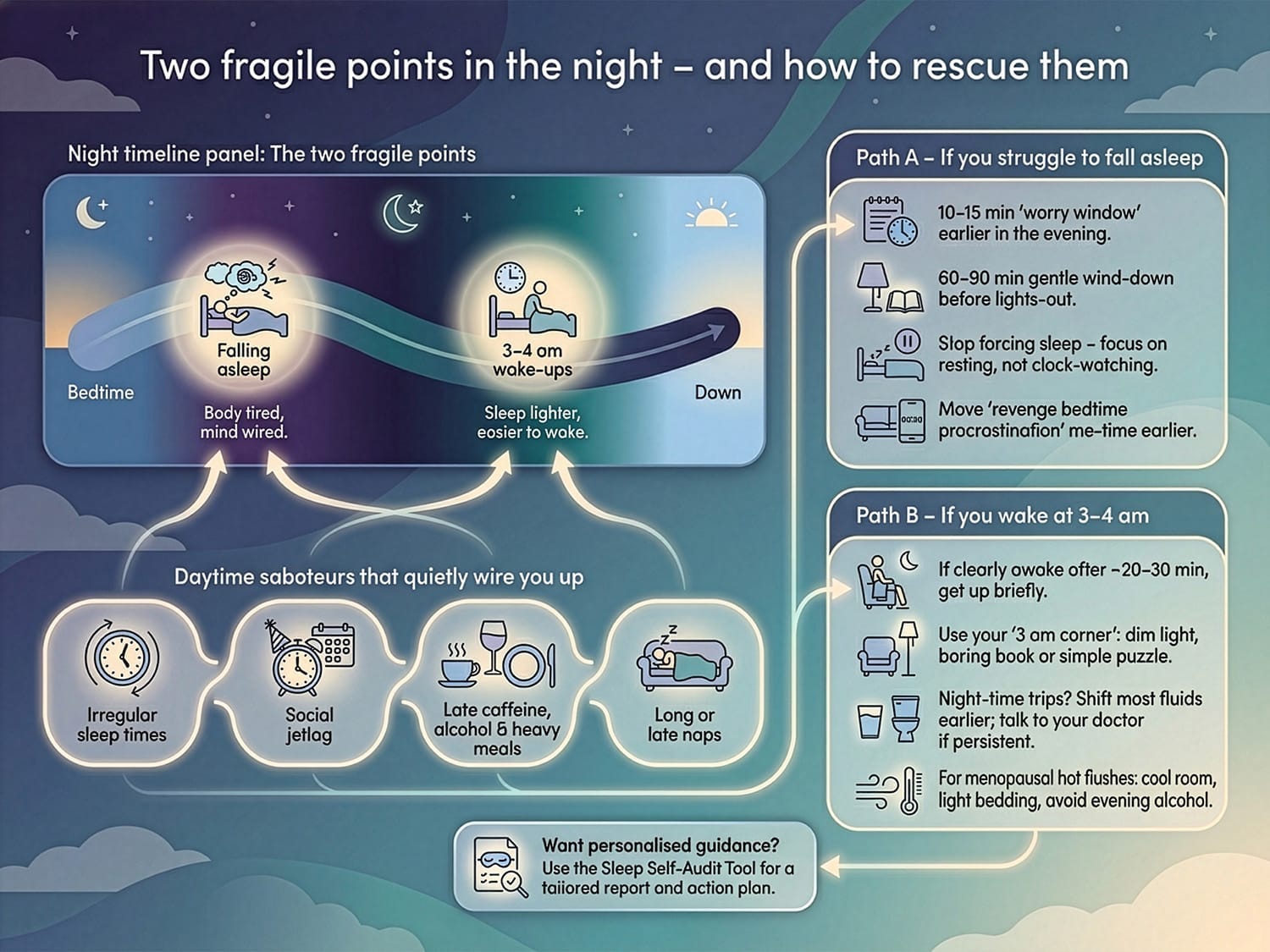
Two fragile points in the night
“Insomnia” sounds like one big, mysterious monster. In practice, there are two main weak spots.
Getting to sleep: tired but wired: Here, your body feels done for the day, but your mind is still in fifth gear. The mismatch keeps you hovering in that uncomfortable “almost sleepy, but not quite” zone.
Staying asleep: the 3-4 am window: By the early hours, you’ve already had several hours of sleep, so sleep naturally becomes lighter and easier to disturb. Once disturbed, it’s harder to fall back asleep.
We’re going to build a plan for both, but before we do, let’s briefly review the small daily habits that can wreck our best-laid plans.
The daytime saboteurs that quietly wire you up
A few familiar patterns quietly make both problems worse:
Irregular sleep times and social jetlag: late nights and lie-ins at the weekend, then early alarms in the week. A fairly steady wake time is still your best anchor.
Late caffeine, alcohol and heavy meals: they hang around into the night, fragment sleep and nudge you towards 3-4 am wakefulness.
Long or late naps: anything over ~30 minutes, or after mid-afternoon, burns off too much sleep drive.
The more of these you can dial back, the better your chances of any evening routine actually working. We covered these in more detail in an earlier issue.
Build your evening wind-down
Your body does best when it’s lulled into sleep by a predictable wind-down: a gentle slope into sleep, not a cliff-edge at bedtime.
Set the time frame
Pick a realistic lights-out time for the next week. Then work backwards 60-90 minutes. That’s your wind-down time when you stop asking your brain for high performance.
Dim the world and take work off the table
During your wind-down:
Swap bright overhead lights for lamps or softer lighting.
Dim screens and switch on night mode.
Set a curfew: no work email or messaging, no big life admin, no breaking-news rabbit holes.
You’re gently telling your nervous system that the “doing” part of the day is over.
Create a predictable wind-down
Pick two or three low-key activities you can repeat most nights, in roughly the same order - for example:
Warm shower or bath.
A chapter of non-gripping reading.
A short, simple journal entry about the day.
Over time, this little sequence becomes a cue: “We’re heading for sleep now”.
Stage the bedroom
You don’t need a magazine-ready bedroom, but a few details matter:
Keep it cool, dark and as quiet as reasonably possible.
Have your book ready by the bed.
If you can, charge your phone outside the bedroom.
Next, we add different tools depending on whether your main struggle is falling asleep or waking at 3-4 am.
Path A - If you struggle to fall asleep
Give your brain a “worry window”
If the first time your mind is allowed to think about tomorrow is when your head hits the pillow, it will oblige - loudly.
Instead, give it a short, scheduled slot earlier in the day:
Set a 10-15-minute timer for late afternoon or early evening.
Dump out tomorrow’s tasks and current worries into a notebook.
For each, jot down the next small step rather than the perfect solution.
The goal isn’t to solve everything; it’s to reassure your brain that tomorrow’s problems have been noted.

Stop trying to force sleep
The harder you try to force sleep, the more awake you get.
Your job is to show up for the routine and let biology decide when sleep arrives, not to micromanage the exact minute. Tell yourself, “I’m just going to lie here and rest; sleep will come when it’s ready.” Turning the clock away also helps.
Notice revenge bedtime procrastination
Revenge bedtime procrastination is staying up too late, even when you’re exhausted, because it’s the only time that feels like yours.
This was an eye-opener. It’s something I do regularly, yet I had no idea it was ‘a thing.’ It’s such a common experience that I felt it should have a name. Turns out it does, but only in Chinese (報復性熬夜), which is why we’re lumbered with the cumbersome term ‘revenge bedtime procrastination.’
It might look like:
A parent, finally off duty at 10 pm, who then falls into a Netflix hole until midnight.
Finishing work emails at ten-thirty, then reading online magazines for a couple of hours.
The “revenge” isn’t against sleep; it’s against the rest of your day. The practical fix is to move some of that me-time earlier on purpose, and make the bedroom somewhere you actually want to go - lights dimmed, comfortable bed, book waiting.
Path B - If you wake at 3-4 am
At 3-4 am, you’ve already had several hours of sleep, so the pressure to sleep has eased and you’re spending more time in lighter, REM-heavy sleep. Cortisol is starting to rise to get you ready for morning. That combination makes it easy for a noise, a hot flush or a full bladder to tip you into full wakefulness - and once you’re awake, your brain is already drifting towards “time to get up”, not “drop back into deep sleep”.
Understanding the science is all very well, but what we need are strategies to deal with that dreaded 3 am wake-up.

If you’re clearly awake, get up (temporarily)
If you’ve been awake in bed for about 20-30 minutes and you’re clearly not drifting off, get up.
Not to clean the kitchen or answer email. Just to break the increasing frustration of trying to will yourself back to sleep. That’s where your pre-prepared 3 am corner comes in.
Prepare a 3 am corner
Before bed, set up a quiet spot: a chair and blanket in dim light, a deliberately boring book or puzzle, and (if you like) a simple breathing exercise or short calm audio you know how to start without faffing.
If you’re stuck awake in bed, you go to the chair, do something gently dull until you feel properly sleepy again, then head back to bed.
If the problem is your bladder
One wake to pee is common; two or more most nights is a sign to pay attention. For a week, try drinking most of your fluids earlier in the day, and easing off evening caffeine and alcohol.
If you have persistent night-time trips - especially if you’re also very thirsty, losing weight, have known heart or kidney disease, or snore heavily and are very sleepy in the day - talk to your doctor.
When hormones or life events are driving the bus
A couple of situations deserve their own mention.
Menopause and perimenopause
If you’re in your 40s or 50s and find yourself sweating through the sheets at 3 am, heart racing and mind replaying conversations from decades ago, hormones are likely tugging on temperature, mood and sleep at the same time.
The general tools still help, but it’s worth paying extra attention to temperature (cool room, lighter bedding, breathable sleepwear) and to evening alcohol, which is a double hit for hot flushes and fragmented sleep. If night sweats or flushes are severe or near-nightly, it’s worth talking with your doctor about treatment options, including HRT and non-hormonal approaches.
High-stress periods and grief
When something big hits - a bereavement, a serious diagnosis, a breakup, losing work - your brain doesn’t simply switch off because the clock says it’s nighttime. Waking at 3 am and replaying events or worrying about what comes next is a natural response.
The ideas in this issue can still help: a simple wind-down and a clear 3 am plan mean you’re not improvising on top of everything else. But if, weeks to months in, you’re still lying awake for long stretches most nights, that’s a sign to talk with your doctor, a therapist or a counselling service. At that point, the main problem isn’t the sleep routine - it’s the sheer load you’re carrying, and that deserves proper support.
A quick word on safety and scope
Some of the ideas here borrow from cognitive behavioural therapy for insomnia, but in simplified form. They’re not a full treatment for long-standing anxiety or depression, trauma-related nightmares, heavy sedative or alcohol use, or clear signs of sleep apnoea or another medical cause.
If any of those ring true, self-help isn’t the final answer; it’s a prompt to ask your doctor or a sleep specialist for a proper assessment.
Long-standing sleep problems can feel like a fixed part of who you are. The reality is different: most of the trouble clusters around two weak spots - getting to sleep and staying asleep - and both are shaped by patterns you can change. You don’t need a perfect routine; you need a simple plan you can still follow when you’re tired.
Don’t forget you can use my Sleep Self-Audit Tool to analyse your sleep habits, get a personalised report, and discuss the results.
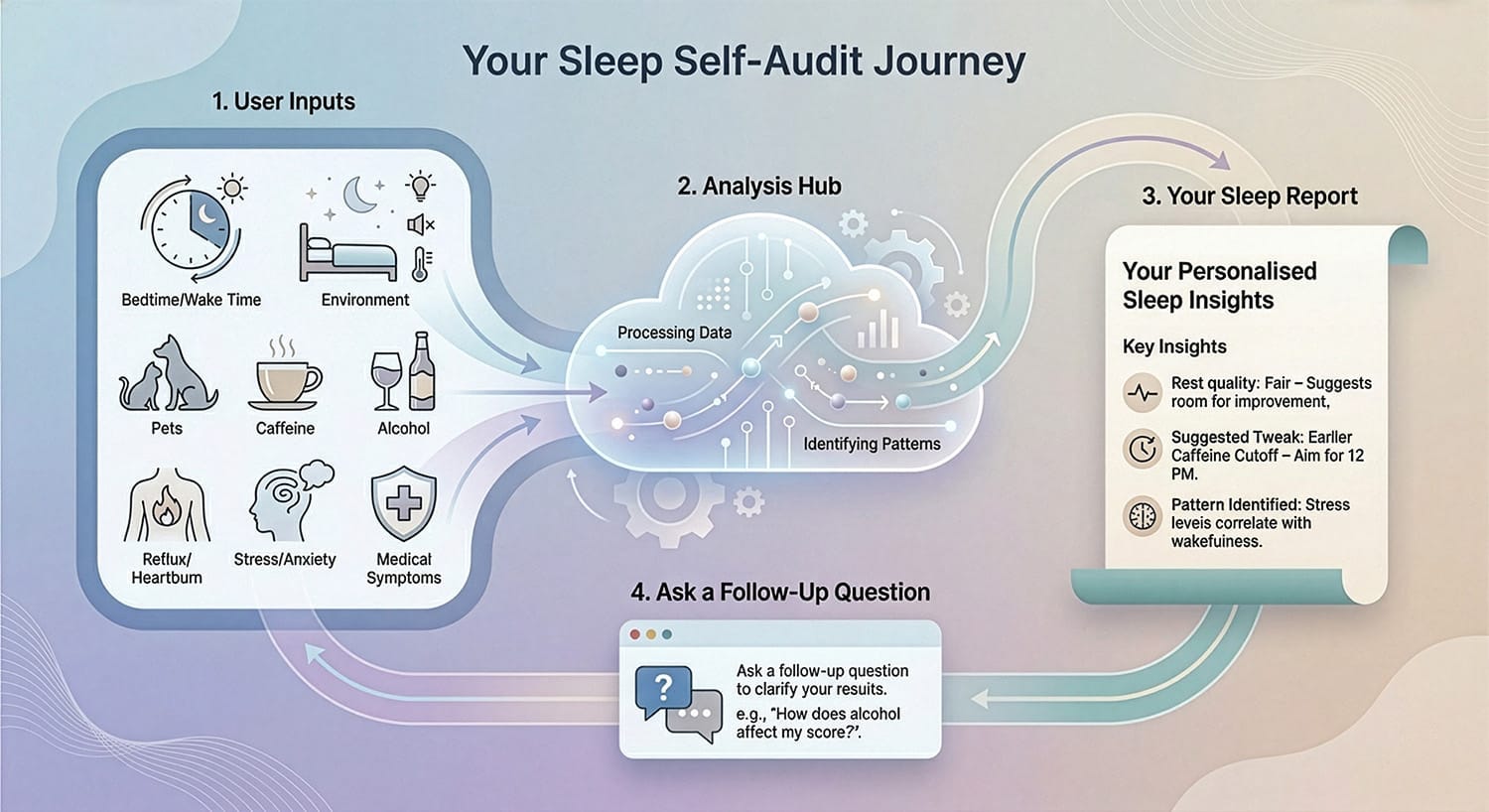
This week’s tweak is to stop improvising your way through bad nights and give yourself a concrete, kind plan.
HEALTH TWEAK OF THE WEEK
At least three-quarters of us struggle with falling asleep, staying asleep, or daytime tiredness. It’s miserable in the moment and, over time, it chips away at long-term health.
It’s easy to shrug and decide you’re just “not a good sleeper” any more. Don’t accept that. For most people, a small set of evidence-based routines makes nights more predictable and much less punishing.
For the next seven nights, run one simple experiment:
A repeatable evening wind-down, and
A clear 3 am plan you can follow without thinking too hard.
Think of it as drafting yourself a protocol so your half-asleep brain doesn’t have to.
1. Build your foundation
1. Clear the big tripwires.
For this week, do what you can to limit the usual culprits: irregular bedtimes, caffeine after mid-afternoon, evening alcohol, long or late naps, and heavy late meals.
2. Set your timeframe.
Pick a realistic lights-out time for the coming week and give yourself 60-90 minutes of wind-down time beforehand.
3. Choose 2-3 wind-down anchors.
For example: a warm shower or bath, gentle stretching, a chapter of light reading, brief journalling. Make these your default “last hour” every night.
4. Set one hard boundary.
Choose a single rule you can actually keep, such as:
“No work email or messages after 9 p.m.” or
“My phone charges outside the bedroom.”
2. Add strategies for your biggest problems
If you mainly struggle to fall asleep:
Schedule a 10-15-minute worry window in the late afternoon or early evening and get niggling thoughts out of your head and onto paper.
Don’t try to force sleep. Set the conditions, then remind yourself: “I’m just resting; sleep will come when it’s ready.”
If you mainly wake at 3-4 am:
Set up your 3 am corner. Decide where you’ll go if you’re wide awake (chair, sofa, quiet corner) and set it up with a boring book or puzzle and a blanket.
Commit to the 20-minute rule: if you’re awake in bed for around 20-30 minutes, you’ll get up and go to your 3 am corner, however little you feel like it.
If you have both problems:
Combine the two: worry window + “I’m just resting” and the 3 am corner with the 20-minute rule.
Then add what fits your situation:
If you’re having menopausal symptoms, add a simple temperature plan (cool room, layered bedding, lighter sleepwear), and avoid alcohol in the last 3-4 hours before bed.
If you’re in a period of high stress or grief, keep the list gentle: focus on the wind-down, the worry window and the 3 am routine rather than trying to optimise everything at once.
If you wake to pee two or more times most nights, experiment with reducing fluids after mid-afternoon and easing off evening caffeine and alcohol. If it continues or is severe, mention it to your doctor.
Keep a simple log for seven nights: bedtime, wake time, your main issue (falling asleep vs 3-4 am), and which parts of the plan you actually used.
At the end of the week, ask yourself one question:
Which changes helped the most?
Those are the ones to keep repeating. The goal isn’t perfect sleep; it’s fewer awful nights and more “good enough” ones - along with the quiet confidence that you’re now running your evenings and 3 ams on a plan, not on hope.
👥 Interested in a small Sleep Reset group?
P.S. From your poll answers and comments, a lot of you sound stuck in the same loop: you have a pretty good idea what’s wrecking your sleep, but real life keeps winning. You wake at 3-4 am, promise yourself you’ll sort it “after this busy week”, and then nothing really changes.
That’s why I’m toying with a small “Sleep Reset” group - 6-10 readers, over three weeks, with one weekly audio call plus a private chat for check-ins and ongoing support.
The idea is to stop just reading about sleep and actually make real changes, with some structure, accountability and support materials so you’re not trying to figure it all out on your own in the middle of the night.
This would be a pilot rather than a polished program. I’d bring the science and structure; you’d bring your real life and your honest feedback on what actually helps.
If that sounds like something you’d seriously consider joining, hit reply with SLEEP RESET and (in a line or two) tell me what you’d most want help with.
🎧 Prefer to listen while you wind down?
🎙️ This week’s One Health Tweak a Week podcast walks through a strategy to get to sleep, and deal with 3 am wake-ups, and why tiny, repeatable routines beat one-off sleep “hacks”.
You’ll hear:
Why “tired but wired” happens - and how an evening wind-down helps
What to do after a 3-4 am wake-up
How to design a 7-night experiment that fits your real life
👉 Ideal listening for your next evening wind-down or commute home.

(Psst: Episodes are free for now. Paid subscribers keep the lights on - and unlock bonus content, private chat, and exclusive tools.)
🧭 Before you go
💬 Which sleep pattern sounds most like you?
Which of these strategies do you think will be most useful to you?
📤 Know someone who’s always awake at 3 am?
Forward this to the friend who jokes about “joining the 3 am club” or turns up to work permanently shattered. It might give them a different way to approach their nights.
💡 Keep seeing wild claims about sleep hacks, supplements or gadgets?
Magnesium gummies that “guarantee” 8 hours, miracle pillows, blue-light gizmos… if something sounds dubious, hit reply. I’ll happily dissect the most suspicious claims in a future issue.
👥 Paid corner - Our private chat is open. It’s where the sleep nerds hang out: comparing notes on what actually helps, sense-checking tweaks, and getting early access to tools I’m building.

Until next Saturday - be kind to your evenings, and give your 3 am self a better plan.
This is F A N T A S T I C !!!!! Thank you!!!
This will be really interesting to try but I am at that age where the 3AM is the call of nature. ;~)