

Many people treat lifestyle change like a major renovation project.
They wait for the perfect moment. They tell themselves they’ll “do it properly” - join a gym, switch to plant-based, overhaul their sleep schedule. All at once. On a Monday. In January. With the optimism of a Labradoodle.
And until that happens? Well, it’s not worth doing anything at all.
But, as a One Health Tweak a Week reader, you’re not most people.
You’re already making better choices than the average person - walking more, eating better, keeping an eye on your sleep. Which means you’re probably in the top half for health habits already.
And that’s exactly why it’s easy to assume that any further gains will be hard won - that you’d have to make bigger, more disruptive changes to move the needle.
A Lancet study out this week says otherwise.
In fact, it offers one of the most validating pieces of evidence we’ve seen for this newsletter’s entire ethos - that small, doable changes, especially when combined, aren’t just symbolic gestures. They’re life-lengthening. Quite literally.
Another powerful finding? The steepest part of the benefit curve comes right at the beginning - which means that even the smallest nudge in the right direction could be life-changing for someone with a lower starting point. Maybe not you. But someone you know.
Let’s walk through what the data shows.
Small improvements across the board add up
A team of Australian researchers recently modelled what happens when people make small lifestyle improvements in not just one, but three areas: sleep, exercise, and diet.
Their data came from more than 59,000 adults aged 40-69 in the UK Biobank study, all of whom wore wrist accelerometers between 2013 and 2015 to objectively track sleep and physical activity. Diet quality came from a food questionnaire they’d completed earlier at recruitment.
The study used a nickname of the SPAN study as they looked at the effects of Sleep, Physical Activity and Nutrition on lifeSPAN and healthSPAN.
Each participant was scored in three categories - sleep, diet, and movement - and grouped into low, middle, or high bands for each. The researchers then looked at how combinations of those scores and bands correlated with predicted life expectancy and disease-free years.
You can see the headline results in the graph below.
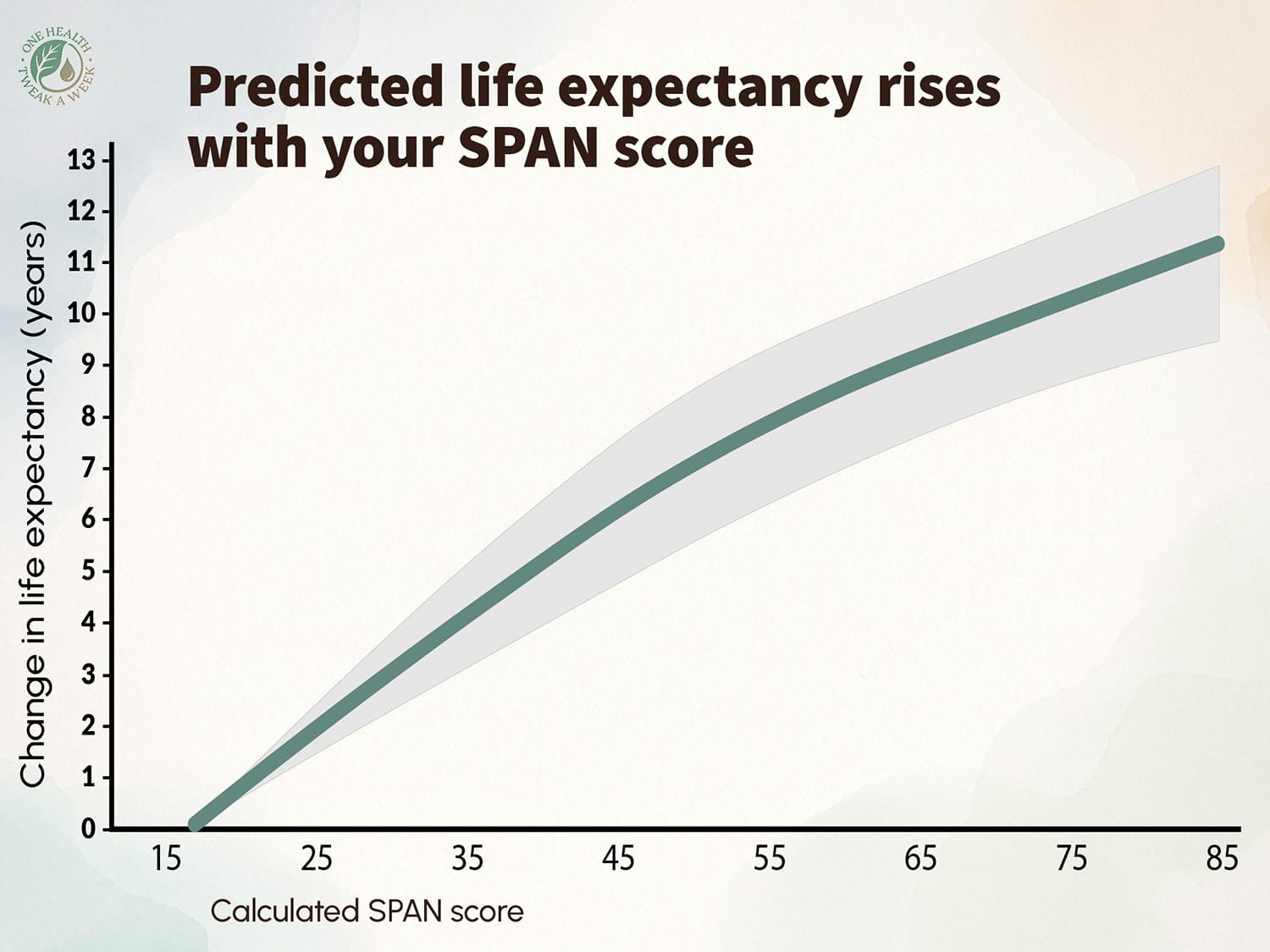
The graph shows just what you’d expect: as your sleep, physical exercise and nutrition all improve, so does your life expectancy.
What makes this study different is that typically we just look at one factor, sleep duration, the amount of exercise or aspects of the diet. Here, the researchers combined the effects of all three health dimensions.
Another important point to note is that the graph is steepest at the beginning. That means that for someone starting out with poor sleep, exercise, and diet, just getting started reaps outsized benefits. It’s remarkable how large those benefits can be from the smallest beginnings.
For example, just 5 extra minutes of sleep, 2 minutes more moderate-to-vigorous activity per day (MVPA), and ½ cup more vegetables per day - for someone starting from a poor baseline - was associated with an extra year of predicted life expectancy.
An extra year!
From a little extra sleep, just two minutes of effort and half a cup of vegetables.
That’s astounding.
A larger but still realistic upgrade - +1 hour sleep, +9 min/day of MVPA, and a cup of vegetables daily plus fish 2×/week - was linked with 5 extra years of life.
So we’re on the same page, moderate-to-vigorous activity (MVPA) is movement that makes talking difficult but not impossible - think brisk walking uphill, cycling, swimming laps, or jogging.
Of course, these estimates aren’t guarantees - they’re modelled associations based on real-life patterns. But they reflect something profoundly encouraging: that changes don’t have to be big to be meaningful - one tweak a week works!
Even healthy baselines still have headroom
You might be wondering: what if I’m already doing fairly well?
That’s a fair question. And the study has an answer.
The average SPAN score (the combined score for sleep, physical activity, and nutrition) in this cohort was 52. That level was associated with an expected 7 years and 5 months of extra life compared to the lowest scoring group.
But go back and look at the graph. There’s still plenty of headroom to increase life expectancy. Moving from that average score of 52 to a high score of 85 was linked with another 4 years of predicted life expectancy. And don’t forget that these results are from people already aged 40-69. Their average age was 64.
It suggests that even if you’re already “above average,” you still have a lot to gain - especially if you make small, repeatable improvements across more than one domain.
It’s worth noting that these are predictions for a relatively health-conscious cohort - the UK Biobank sample tends to skew slightly healthier and wealthier than the general population, so real-world results may vary. That said, One Health Tweak a Week readers are, in general, also healthier than average, which makes these results particularly relevant.
Two-lane upgrades beat all-or-nothing efforts
There’s a pattern here worth noticing.
Doing a lot in one area doesn’t beat doing a little in two. Health, it turns out, prefers a diversified portfolio.
The life expectancy gains were bigger when people made modest improvements in multiple areas than when they made a large improvement in just one. In other words, the benefit isn’t linear - it’s stacked.
Why might this be? Likely because health behaviours reinforce one another - better sleep improves exercise recovery; movement deepens sleep; both can sharpen dietary self-control.
As always, results are anonymous, and they really help me target future issues to what you’d find most useful. Please take a moment to click one of the buttons.
We can see that stacking effect in this next graph.
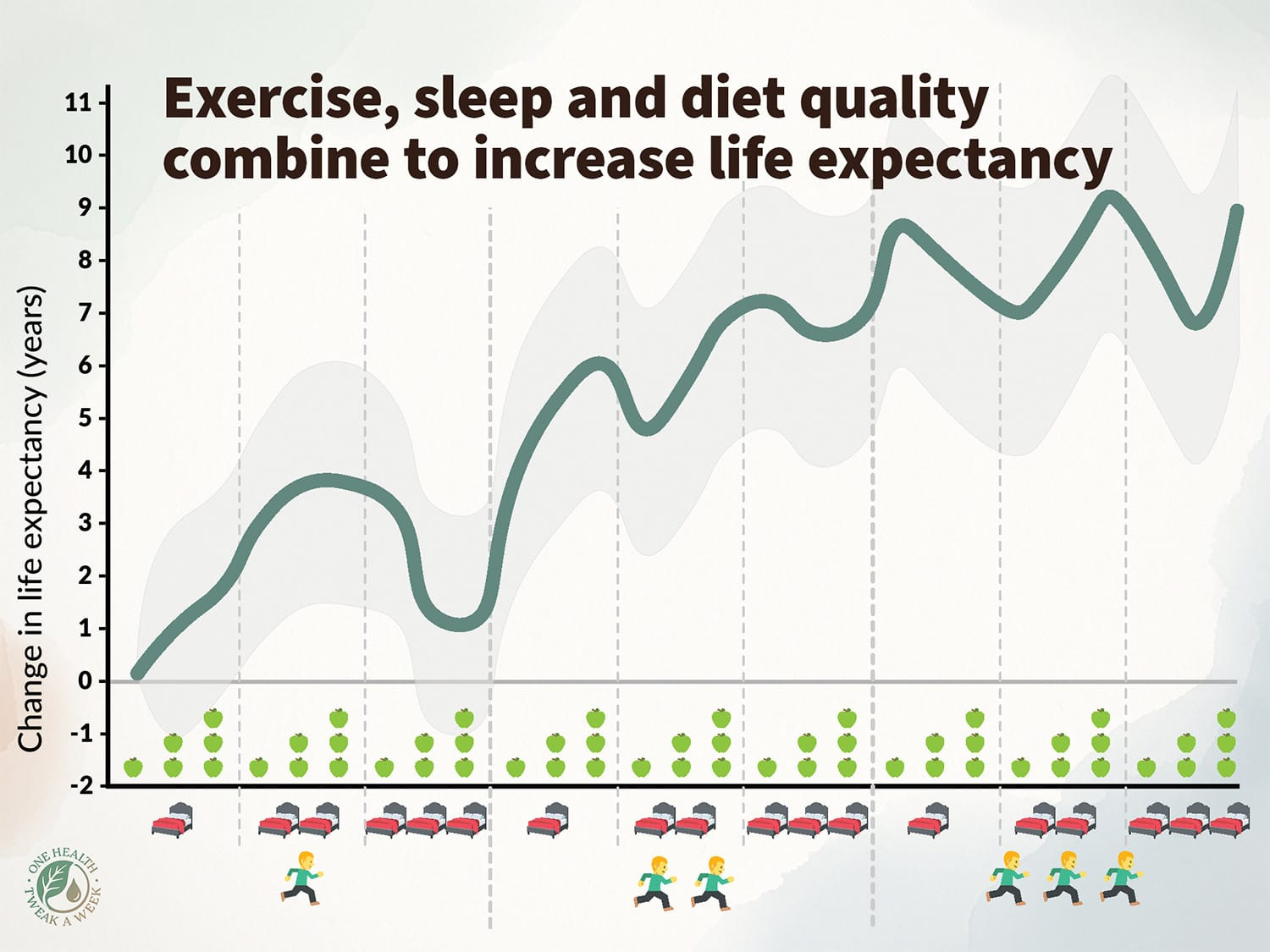
There’s a lot going on in this graph, so let’s just be clear on how it’s set up.
In the first instance, the graph is divided into thirds representing the lowest, middle and highest moderate to vigorous exercise groups.
Each of those blocks is then divided into thirds again, this time representing the amount of sleep.
And finally, each of those sleep blocks is again divided into thirds, representing their diet quality.
These divisions explain why it’s such a wavy line.
Without getting lost in the details here, there are several interesting things to be seen:
The overall trajectory of the curve is upward, as increasing amounts of exercise, sleep, and diet quality accumulate, so does life expectancy.
The curve is steeper at the beginning, again indicating that those starting from the lowest levels of exercise, sleep, and diet quality have the most to gain from small improvements.
Sleeping too much can outweigh the benefits of a good diet and even of getting more exercise. You can see this most prominently in the first third, where there’s a big drop in increased life expectancy for those who sleep more than eight hours.
That last point needs a little explaining.
Sleep and movement have sweet spots
Before we get to this week’s tweak, a couple of important caveats:
First, the benefits of sleep and movement aren’t endless. There’s a sweet spot.
For sleep, the best outcomes were seen around 7.5 hours per night. Beyond 8 hours, life expectancy began to drop. We talked about this in the newsletter quite a bit last year. Multiple studies suggest perhaps 7-7.5 hours per night is the sweet spot.
For movement, the greatest benefit was seen with 45–55 minutes of moderate-to-vigorous physical activity (MVPA) per day, with no significant gains beyond that.
Diet was a weak spot for this study. It was assessed only once when participants joined the study, several years before this phase. The conclusions, therefore, assume that the assessment was representative and that their diet remained constant throughout the follow-up period.
The authors acknowledge this and suggest that this is why the effects of diet are less than expected.
My take on this is that if diet had been assessed more rigorously, we might have expected the life expectancy improvements associated with diet to be stronger, and the graph would be even steeper.
This is why your tweaks matter
If you’re a long-time OHTaW reader, the message might sound familiar - but this time, it comes with a particularly compelling set of numbers.
If you’re starting from a low baseline: don’t be intimidated. The biggest returns come early. A little movement, a bit more veg, and a nudge towards better sleep may together be enough to shift your odds substantially.
If you’re already doing “pretty well”: don’t assume you’re done. There’s likely still good headroom, especially if you identify your two weakest areas and make modest, targeted improvements.
The main point isn’t perfection. It’s progression - in more than one domain.
And - forgive the moment of personal satisfaction - it’s hard to read this paper without smiling.
Almost every study focuses on one factor in isolation. This one doesn’t. It looks at sleep, diet, and exercise together - and it finds that modest improvements in all three add up to big gains.
That’s the whole point of this newsletter.
One Health Tweak a Week exists for exactly this reason: not to push fads or demand perfection, but to help you build a better future by nudging the dial in more than one area, a little at a time.
So if you’ve ever wondered whether your small changes are adding up to anything, this is your answer.
They are.
Which is reassuring. Not least because it means I can stop worrying I’ve been running a newsletter-length placebo.
That ever-rising curve in the SPAN graph? That’s exactly what we’ve been doing. Every Saturday.
HEALTH TWEAK OF THE WEEK
Even if you’re already doing quite a bit, there’s likely still room to grow - especially if you make small improvements across two or three domains instead of trying to perfect one.
Here’s how to apply this week’s tweak:
1. Do a 2-minute diet-quality self-check.
This isn’t about precision - just a quick score across food groups. Then choose one “anchor upgrade” (e.g., add one veg daily, or fish twice this week).
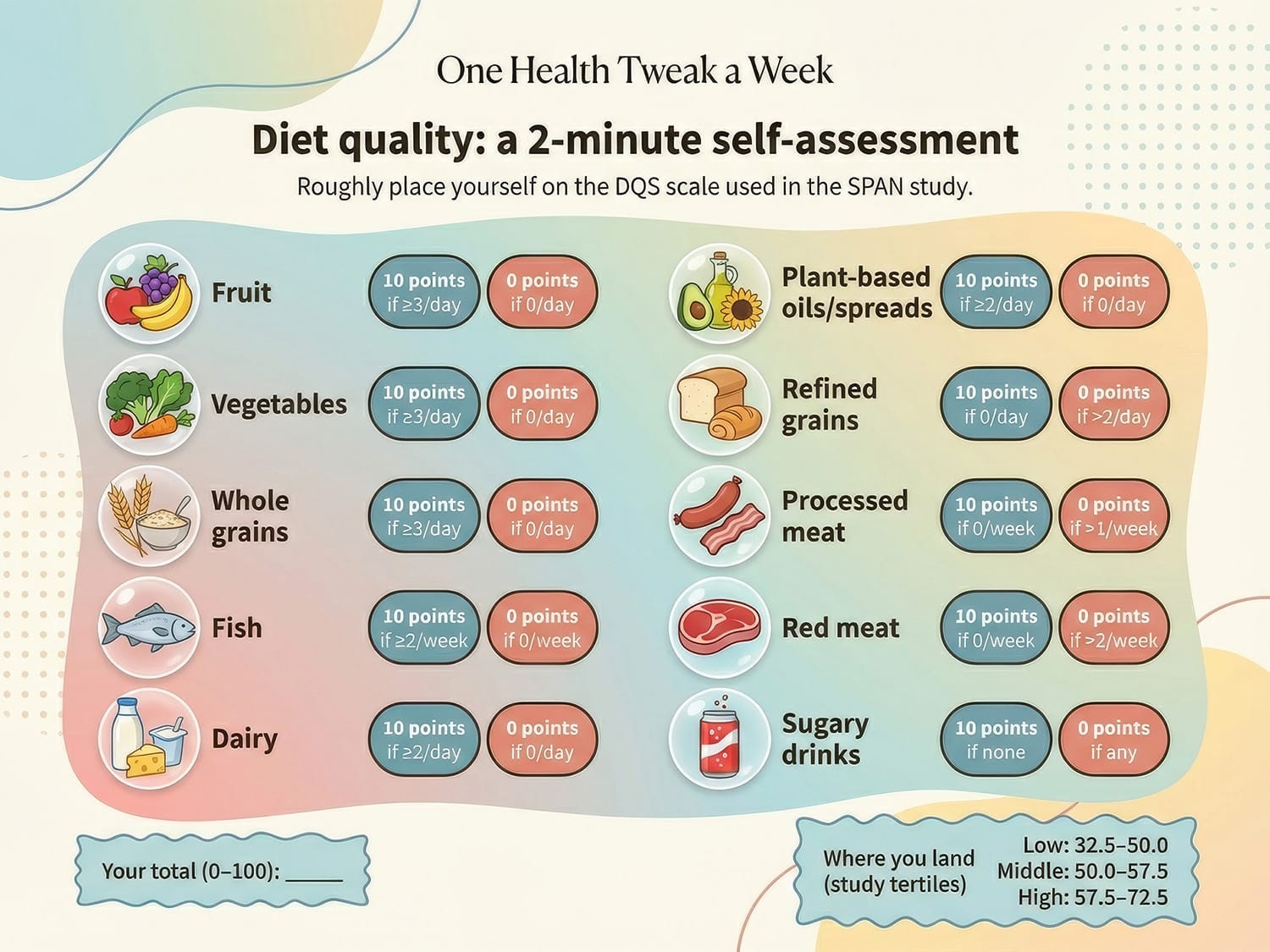
2. Place yourself on the SPAN spectrum.
Use the chart below to identify whether your current habits for sleep, movement, and diet fall in the low, middle, or high band.
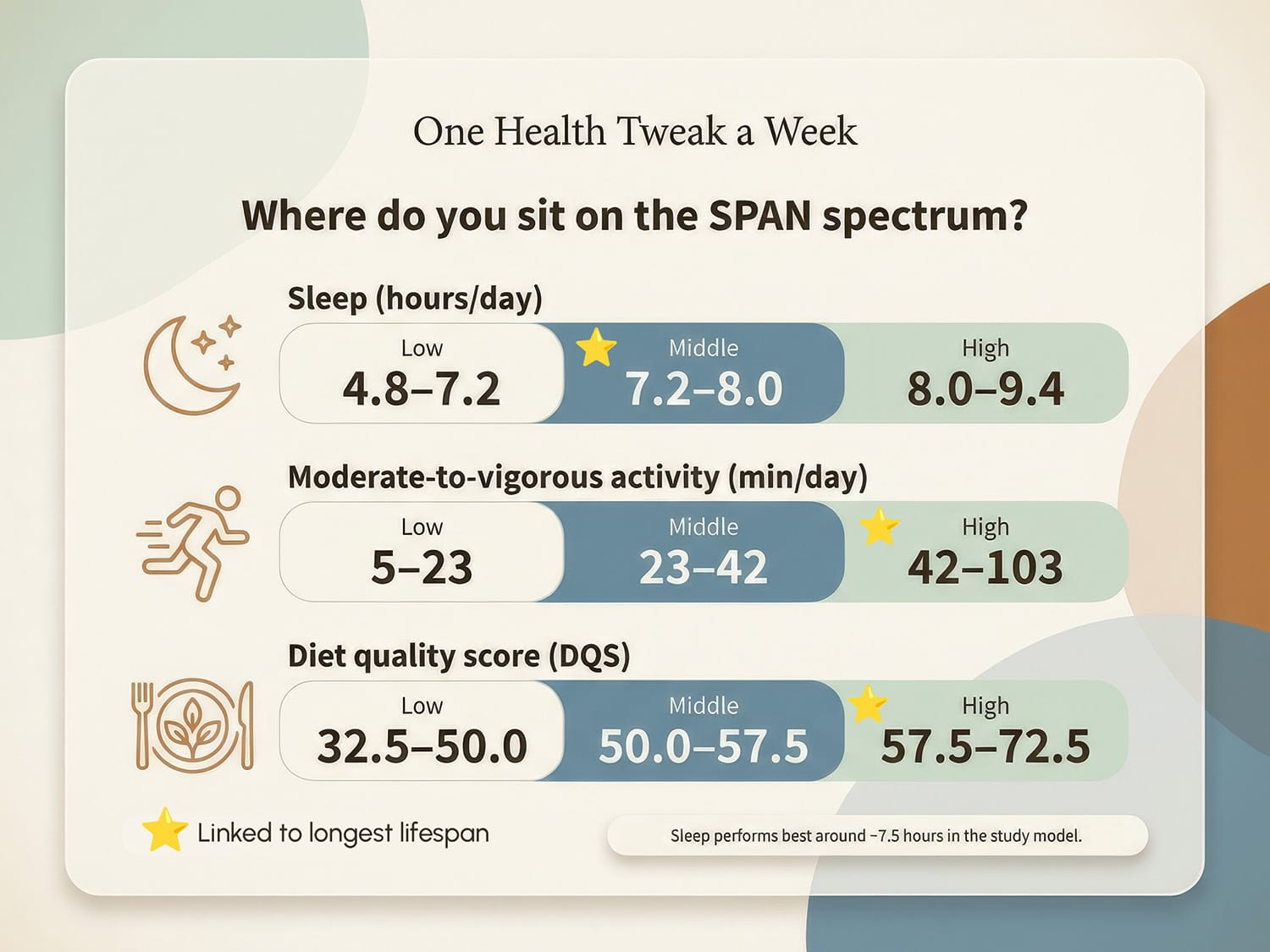
3. Choose two lanes and nudge them each up by one notch.
Sleep: Add 10–20 minutes to your time in bed, or shift your wind-down slightly earlier (but don’t exceed 8 hours)
Movement: Add 5–10 minutes of brisk walking per day (moderate-to-vigorous = can’t talk comfortably).
Diet: Add an extra ½–1 cup of vegetables per day, or include oily fish 2× this week.
4. Build repeatability with “if-then” planning.
If it’s after lunch, then go for a 7-minute brisk walk.
If I’m cooking dinner, then I’ll add one extra veg.
If I want a snack, I’ll have fruit or nuts.
Tiny changes, stacked together, is how I’ve been doing this - not overnight, but week by week. That’s what makes this study so encouraging. It proves what we’ve suspected all along: the dial turns best when we turn it gently, often, and in more than one place.
You don’t need to change everything. But changing a little - in more than one area - might be enough to change everything that matters.
🎧 Prefer to listen while stacking the dishwasher?
🎙️ This week’s One Health Tweak a Week podcast explores the surprisingly powerful science behind stacking small improvements in sleep, movement, and diet.
You’ll hear:
Why doing a little in two areas beats doing a lot in one
What the latest SPAN study says about life expectancy
How to find your “two-lane upgrade” this week - with minimal effort
👉 Great for your next walk… ideally a slightly breathless one.

(Psst: Episodes are free for now. If you’re a paid subscriber, thank you - you’re essentially funding the research rabbit holes and the weekly distillation.)
🧭 Before you go
📤 Got a friend who thinks it’s not worth starting?
This might be the nudge they need - especially if they’re starting from scratch. The biggest benefits show up early, not later. Send this their way.
💬 Did the life expectancy chart surprise you?
I’d love to know where you found yourself on the spectrum - and how that felt. Drop a comment below.
👥 Paid corner – Our private chat is open - it’s a small group of people who actually do the tweaks. No noise. Just practical experiments, quiet accountability, and a friendly corner of the internet.

Until next Saturday – keep the dials turning, and be kind to Future You.
– Ben
Perfect article for me. Thank you. This is me.
I discovered this post a bit late. Thanks for condensing such an important research findings. I started to exercise regularly 2 months ago and I already feel a difference. I guess my next step is to lower red meat amount and switch to fish.