

For a few years, I worked at a hospital in Central London. Popping out at lunchtime to run a few errands meant sharing the pavement with a multitude of tourists from all around the world, leisurely taking in the sights and changing direction unpredictably.
The short time I had available and my Type A personality combined to make this a genuinely stressful experience. I’d take lengthy detours just to have a free path ahead of me and be able to walk at a brisk pace. One thing I’m not is a dawdler.
My London days are behind me now, and I live in the countryside. I still walk every day, but field edges, mud, gates and an endless supply of things worth looking at have slowed me down considerably.
The walks are lovely, I’m still getting my steps in, and I’m not weaving around selfie sticks any more. But it got me wondering: am I actually getting the same health benefit at this gentler pace?
Most of us who track our walking think of step count as the number that matters. But 6,000 slow steps and 6,000 brisk ones are very different cardiovascular workouts. The evidence suggests that how fast you walk may matter at least as much as how many steps you accumulate.
Steps are the starting point, not the whole story
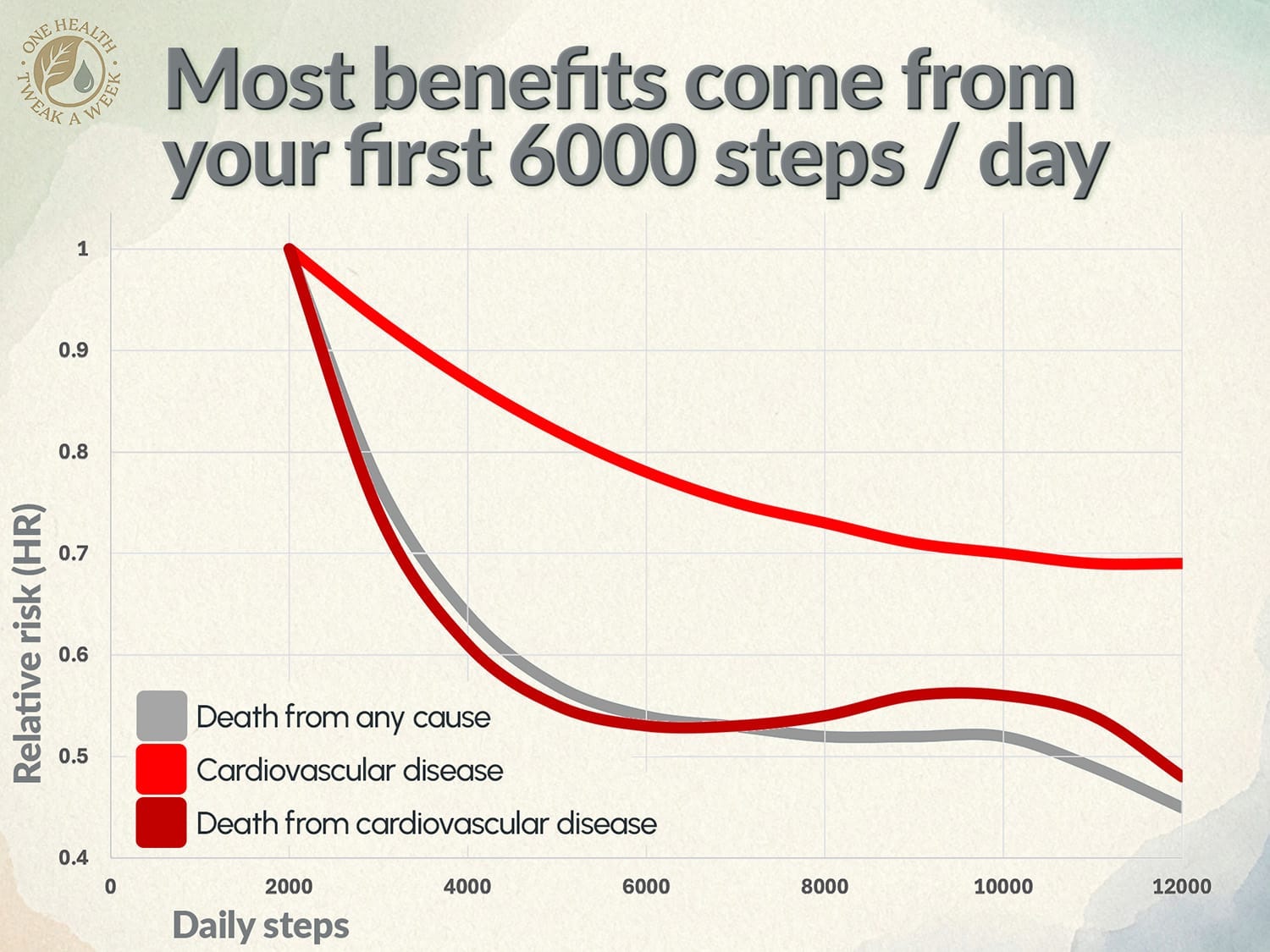
Long-time readers may remember an earlier article where we looked at the relationship between daily step count and long-term health. The 10,000-step target is still everywhere, but a meta-analysis of 88 studies tells a more useful story - most of the reduction in all-cause and cardiovascular mortality accumulates within roughly the first 6,000 daily steps.
That makes 6,000 a sensible minimum target, but not the finish line. Additional steps are associated with further reductions in cardiovascular disease, cancer, diabetes, falls and depression. But the steepest part of the curve is behind you once you’re regularly hitting that range.
Step count captures volume: how much walking you accumulate over the course of a day. But it says nothing about how demanding that walking is. A thousand steps at a gentle amble and a thousand steps at a brisk, purposeful pace ask very different things of your heart and lungs.
So once you’re already getting a reasonable daily step count, is there something to gain from walking some of those steps faster?
Faster walkers, lower risk
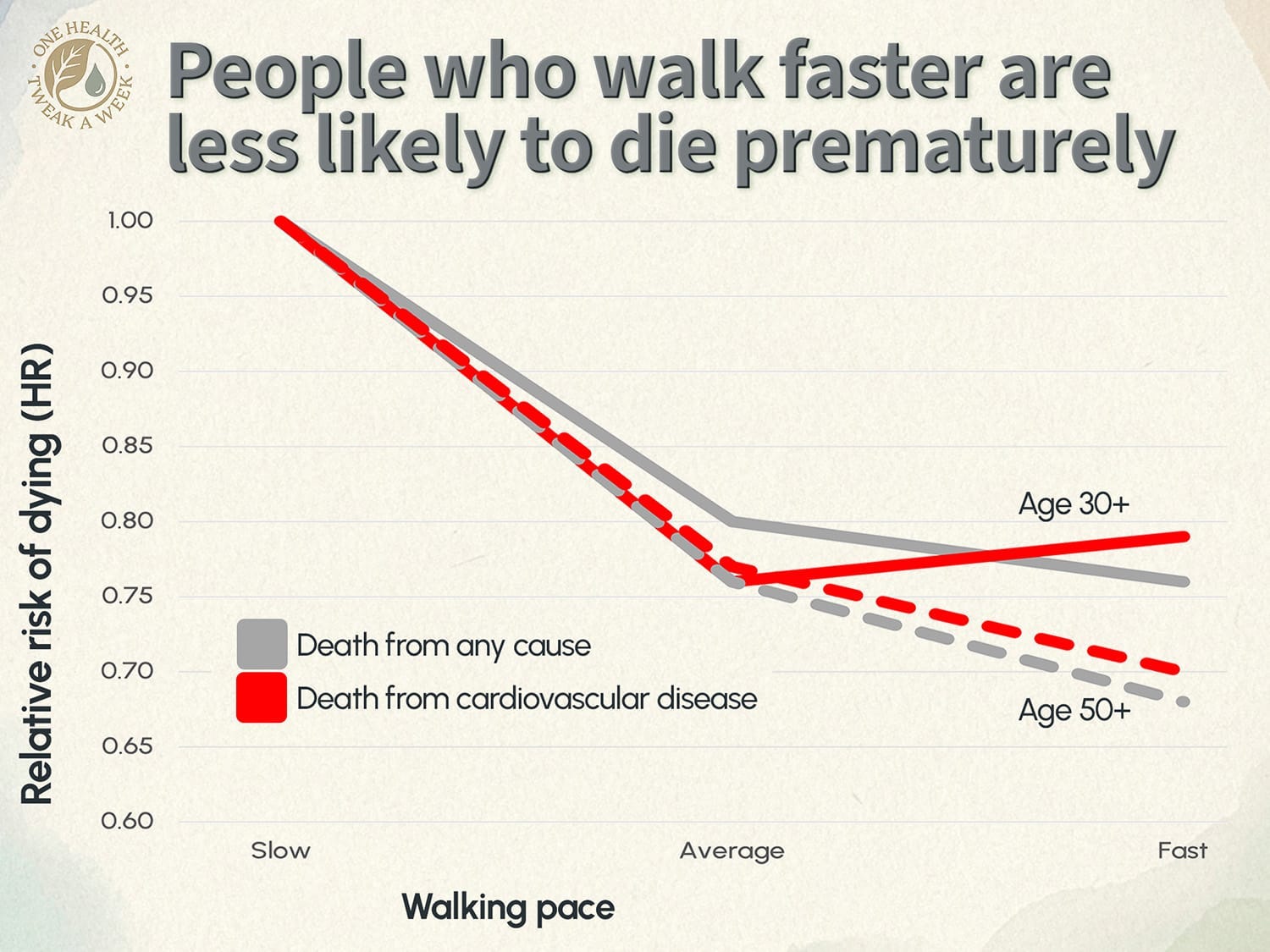
Researchers followed more than 50,000 British walkers for an average of 9 years. Compared with slow walkers, those walking at a normal pace had a 20% lower risk of dying from any cause and a 24% lower risk of dying from cardiovascular disease.
The association appeared even stronger for those aged 50 and over: 24% less likely to die from any cause and 23% less likely to die from cardiovascular disease.
Increasing the pace further was associated with additional risk reductions. At a fast pace, those aged thirty and above were 24% less likely to die from any cause, and those aged fifty and above were 32% less likely to die prematurely.
Encouragingly, walking faster was associated with lower mortality even among people not meeting recommended physical activity guidelines, though the gains were greater in those who did.
Another study of almost 22,000 male American physicians, average age 68, followed for nearly 10 years, found a strikingly similar pattern.
Compared with those who didn’t walk regularly, those walking at 2–2.9mph were 28% less likely to die from any cause and 12% less likely to develop cardiovascular disease. At 3–3.9mph, those figures were 37% and 25%. At 4mph or above, 37% and 30%.
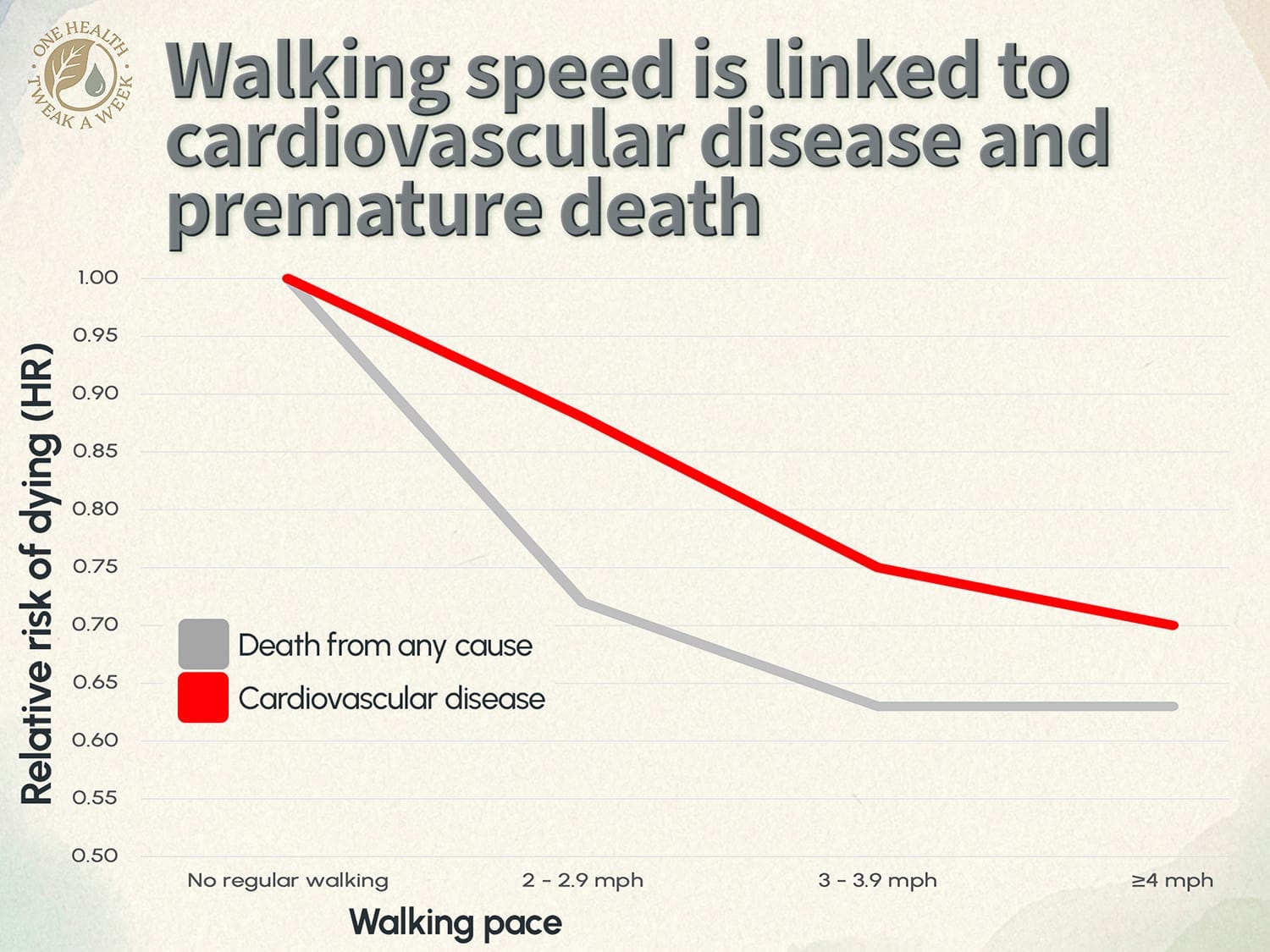
Two large studies, in different populations on different continents, land on essentially the same dose-response pattern - those two graphs look very similar. The biggest practical gain is between slow and purposeful walking. The further gains from brisk to fast are smaller. You don’t need to start overtaking joggers.
How much faster?
A meta-analysis of 48 studies involving almost 102,000 older adults (average age 72), followed for about five and a half years, helps put some scale on this. Each 0.1m/s slowing in walking speed was associated with 12% higher all-cause mortality and an 8% increased risk of cardiovascular disease.
This doesn’t prove that simply walking 0.1m/s faster will produce those same reductions in risk. Some of the difference will reflect the fact that slower walkers are often less fit or less healthy to begin with. But it does tell us that fairly modest differences in walking speed are associated with meaningful differences in outcome. In everyday terms, 0.1m/s is roughly equivalent to covering a familiar route about 10% faster.
If your usual loop takes 30 minutes, aim for around 27. That gives us a useful sense of what “pick up the pace” actually means - not speed-walking, just moving with noticeably more purpose.
Are healthier people just faster walkers?
There’s an obvious problem with all this.
Walking speed is unusual because it’s both a behaviour and a health marker. To walk quickly, your heart, lungs, muscles, joints, balance and nervous system all have to work well together. Frailty, arthritis, neurological disease, heart or lung disease and simple loss of fitness can all slow you down.
So part of the association almost certainly runs in the opposite direction: people aren’t healthier simply because they walk faster; they may walk faster because they’re healthier.
So is there evidence that intentionally walking faster actually does something useful? A large British commuting study offers a clue.
Researchers followed more than 263,000 mostly midlife adults for an average of 5 years, comparing health outcomes by how they got to work.
Those who walked to work were 27% less likely to develop cardiovascular disease and 36% less likely to die from it. But despite being more physically active than drivers and public-transport users, walking commuters didn’t have greater cardiorespiratory fitness. And they didn’t see reductions in all-cause mortality or cancer risk. The cardiovascular benefits in walkers only appeared in those walking more than about six miles a week - equivalent to roughly two hours at a typical pace.
Cyclists told a different story. They were 46% less likely to develop cardiovascular disease, 52% less likely to die from it, 41% less likely to die from any cause, and 45% less likely to develop cancer. Ninety per cent of cycling commuters met recommended weekly physical activity levels; only 54% of walking commuters did.
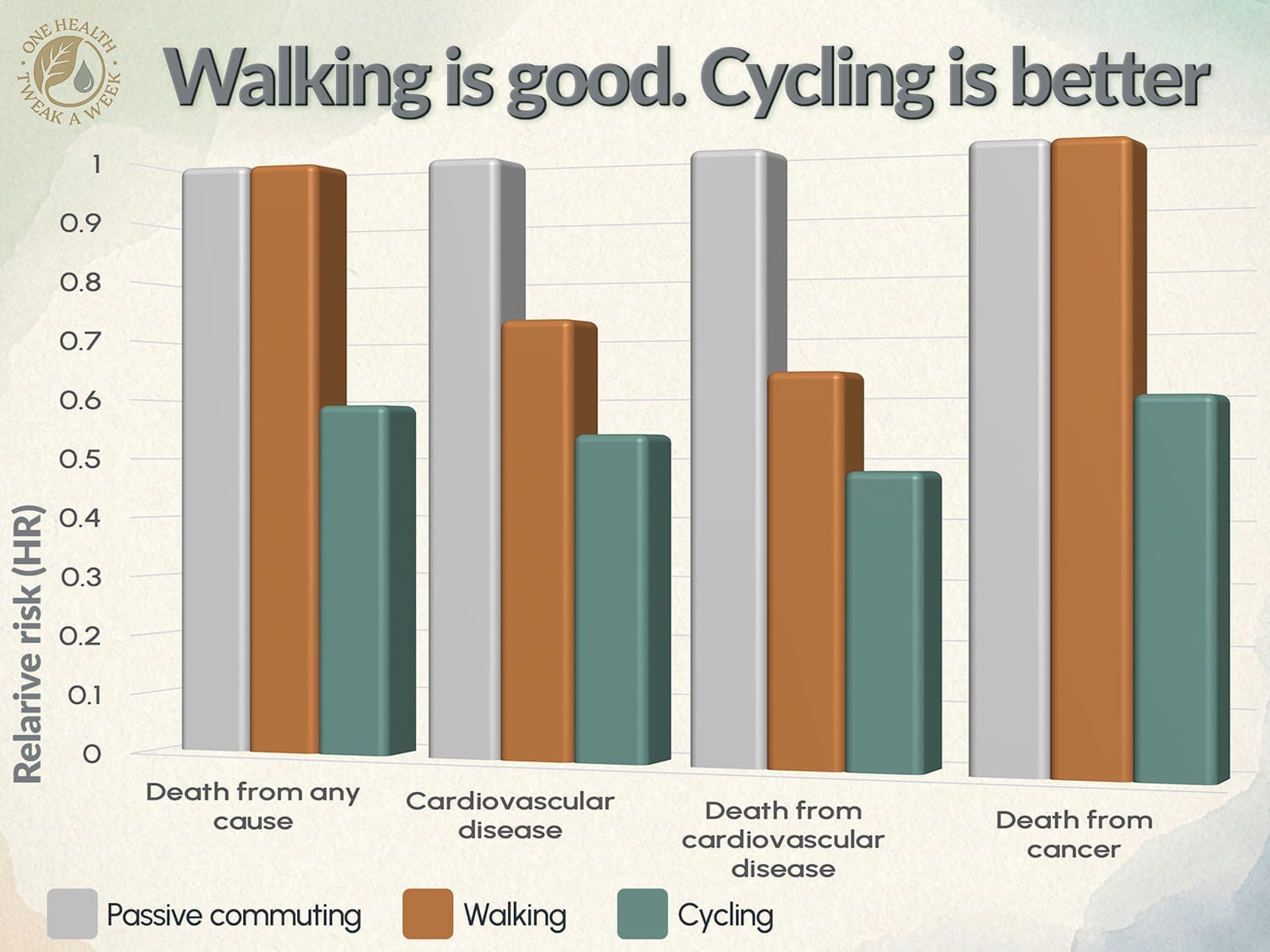
This isn’t proof that intensity is the key factor, but it’s a suggestive clue. Cycling generally demands more from the cardiovascular system than a typical walking commute, and the walkers and cyclists also differed in total activity amount, so the study can’t isolate intensity on its own.
But the pattern is consistent with a broader idea. You can accumulate quite a lot of movement without necessarily giving your cardiovascular system much of a training stimulus.
A gentle walk is still movement, but with a brisk walk, your heart and lungs have to work harder, and over time that provides a stimulus to adapt and build reserve.
What happens when you deliberately speed up?
The observational studies leave us with a strong association, but the intervention studies get closer to answering whether deliberately increasing pace actually changes anything.
Researchers randomly assigned 246 people, average age 63, to one of three groups for five months: no added walking programme, regular moderate walking of at least 8,000 steps a day on four or more days a week, or a programme alternating three minutes of easier walking with three minutes at a much brisker pace.
Aerobic fitness barely changed in the first two groups. That’s notable because the steady walkers were doing 8,000 steps a day on four or more days each week: a substantial amount of walking. By contrast, the group adding repeated three-minute brisk intervals increased walking aerobic capacity by about 9%, improved leg strength by 13–17%, and lowered blood pressure further.
A Japanese study strengthened that finding and gave us a useful dosing target. Among 679 participants doing different proportions of fast and slow interval walking over five months, peak aerobic capacity improved progressively with the amount of fast walking, up to about 50 minutes a week, after which it tended to plateau. Neither slow-walking time nor total walking time was associated with the improvement.
So, simply accumulating more walking wasn’t what predicted better aerobic fitness; it was the time spent walking fast enough to challenge the cardiovascular system. Put together with the previous trial, the implication is that easy walking can give you plenty of movement, but improving cardiorespiratory fitness requires enough intensity to give your heart and lungs a reason to adapt.
Now, these trials measured intermediate outcomes: aerobic fitness, leg strength and blood pressure, not mortality or cardiovascular events. But they address the central weakness of the observational studies by showing that when intensity is deliberately increased, real physiological change follows.
What this means for your health
Ordinary walking remains valuable, and nobody should come away from this thinking their daily stroll has been a waste of time. A slow walk still gets you moving, outdoors and, if you’re lucky, somewhere pleasant. Walking of any kind is associated with many benefits.
But if you’re already walking regularly and want to maintain or improve cardiovascular fitness as you get older, the next useful lever is probably pace rather than simply adding more easy steps.
That doesn’t mean every walk needs to feel like exercise. A slow countryside meander or a long conversation with a friend serves purposes that a brisk session doesn’t: enjoyment, connection, time in nature. But those purposes aren’t interchangeable with cardiovascular training.
A reasonable target from the intervention evidence is about 50 minutes of brisk walking accumulated over the week: enough to make your heart and lungs notice.
As always, your responses are anonymous, but they really help me tailor future content to what’s most helpful to you. Please take a moment to click a button.
HEALTH TWEAK OF THE WEEK
Walking regularly is a strong foundation. But the evidence suggests that pace matters alongside step count.
Large observational studies link faster walking with lower cardiovascular and all-cause mortality, while intervention trials show that brisk walking can improve aerobic fitness, leg strength and blood pressure in ways that steady, easy-paced walking may not.
1. Make some of your usual walking brisk. Aim to accumulate about 50 minutes of brisker walking over the course of the week: enough to make your heart and lungs noticeably work harder, but not so much that you can’t hold a (slightly breathless) conversation. You don’t need to do it all at once. Short bursts of three to five minutes scattered through your regular walks add up. Shift from “I’m out for a stroll” to “I’m going to miss the bus.”
2. Prefer something measurable? Pick a familiar route and try to cover it in roughly 10% less time. If your usual loop takes 30 minutes, aim for around 27. That gives you a concrete benchmark to gauge whether you’re pushing the pace enough.
3. Keep your leisurely walks too. This isn’t about turning every walk into a training session. Countryside rambles, conversation walks and time in nature all have their own value. The point is to make sure that some of your weekly walking is vigorous enough to challenge your heart and lungs.
If walking is already part of your routine, you’ve done the hard part. Now make some of those walks brisk enough to give your cardiovascular system something to adapt to
Enjoyed this? There’s more to explore.
If today’s article has made you rethink your daily walk, you might enjoy some of my earlier newsletters exploring how much movement we really need, whether exercise can offset a day of sitting, and why strength training is so important for healthy ageing.
Paid subscribers can explore these and the entire One Health Tweak a Week archive, covering everything from nutrition and exercise to sleep, metabolic health and longevity, with newsletters and podcast episodes to read or listen to whenever you like.
Unlock the full archive →
🎧 Prefer to listen while deciding whether your next walk needs a little more urgency?
🎙️ This week’s One Health Tweak a Week podcast takes a closer look at walking pace: why step count is only part of the story, what changes when you start walking briskly, and how much faster you may need to go to improve your cardiovascular fitness.
You’ll hear:
Why 6,000 slow steps and 6,000 brisk ones aren’t the same cardiovascular workout
Why faster walkers have lower risks of premature death and cardiovascular disease
Why some of that association reflects the fact that healthier people can simply walk faster
What happens when researchers ask people to speed up their walking
Why 8,000 steady steps may do surprisingly little for aerobic fitness
How about 50 minutes of brisk walking a week could be enough to make a meaningful difference
👉 Good company for your next walk, commute, or while testing whether “I’m going to miss the bus” is a more useful pace than “I’ve got nowhere particular to be”.

(Episodes are free for now. Paid subscribers support the deeper research - and unlock practical tools to help you improve your health without turning it into a second job.)
🧭 Before you go
💬 When you go for a walk, what usually determines your pace: fitness, habit, company, terrain, the dog, or simply whether you’re in a hurry?
📤 Know someone who proudly hits their step target but rarely gets out of strolling mode? Forward this to them.
👥 Paid corner - If you try adding some brisk walking this week, drop me a message in our private chat. I’d be interested to hear whether the “miss the bus” cue or the 10%-faster route works better for you.

Until next Saturday - keep the leisurely walks, but give your heart and lungs something to do as well.
– Ben
Great article, thank you for the info!