


In a recent issue, we looked at who might benefit from a protein supplement.
The most likely beneficiaries are older adults struggling to reach 30 to 40g of protein per meal, plant-based eaters fighting food volume, people trying to preserve muscle while losing weight, and anyone recovering from illness or surgery.
Of course, whole foods should always come first, but there’s undoubtedly a place for a protein supplement to top up any remaining gap.
However, if you’ve ever walked into a sports nutrition store, you’ll know how intimidating those places can be. The shelves are stacked with tubs so large they look like you’d need a 3-month weights program just to lift them. Neon labels and shouty fonts promise lean muscle, fat loss, and peak performance.
Confused, you look around for help. An assistant with bulging biceps steers you toward a tub called AnaboCore Maxx. He carries it to the till for you, and that’s where you discover it costs enough for a fancy dinner for two. You take it home, not quite sure what you just bought, or what to do with it.
Or was that just me!
Thankfully, it’s almost all hype and marketing in what is, after all, a huge industry. Choosing a protein supplement to meet your needs is pretty simple, and that’s what we’re looking at today.
We’re only looking at protein powders. Ignore protein bars and things like high protein breakfast cereals, snacks and puddings. They’re just ultra-processed foods with a little whey and a price hike.
By the end of this article, you’ll know exactly what to look for, what to avoid, and how to choose a protein powder that actually fits your goals, not the store assistant’s commission.
Your first decision: animal or plant protein?
Milk whey protein is by far the most common protein supplement. It’s popular for good reason: it’s absorbed fast, well tolerated by most, and has a relatively high leucine content (around 11%). As we’ve discussed before, leucine is the key amino acid that flips the muscle-building switch.
There are other animal-derived protein supplements, including:
Casein, another milk protein that’s absorbed more slowly than whey.
Beef protein and egg white powders, which are quite uncommon.
Collagen, the darling of wellness influencers.
You may also have seen collagen supplements promoted as miracle powders for skin, joints, gut health, even muscle. But collagen is a bit of an outlier in the protein world.
Collagen is a poor choice if your aim is to build or maintain muscle. It lacks the essential amino acid tryptophan, but more importantly, it contains very little leucine and has a much less favourable essential amino-acid profile than whey, soy or pea protein. In studies comparing them directly, collagen stimulates muscle protein synthesis much less effectively.
While whey is quickly digested to produce a short, high spike of amino acids in the bloodstream, casein is digested much more slowly. It’s sometimes taken at night to prevent the body from breaking down muscle to release amino acids for overnight repair and maintenance.
For most people, the straightforward option is whey.
If whey works well, why might someone choose a plant protein instead?
Firstly, of course, you may not want to use animal products, or you may avoid dairy.
If you have IBS, lactose intolerance, or general digestive issues, plant proteins can be easier to tolerate.
Because plant proteins are digested more slowly, they can keep you fuller for longer and help with appetite control.
Plant proteins are produced with less environmental impact. Less CO2, less water, and no cows.
And, very importantly given the current cost of living, they’re cheaper.
The most common plant protein options are pea protein, soy protein, and plant protein blends, like pea and rice.
You may hear people say that plant proteins are ‘incomplete’, (meaning they don’t contain all of the essential amino acids we must get from the diet because our body can’t manufacture them) as though that makes them second-rate. In practice, that only matters if you’re getting most of your protein from that single source, which we’re not.
Soy protein is complete. You’ll get the same amino acids as in whey, just in slightly different ratios.
Pea protein is low in methionine, but methionine is abundant in nuts, seeds, and whole grains. If you’re eating a decent diet and topping up with a pea protein supplement, you’ll get plenty. A recent trial showed that pea protein stimulated muscle growth just as effectively as whey.
Many plant protein blends (like pea + rice) are designed to complement each other and provide all essential amino acids in sufficient amounts.
So, once you’ve decided on whey or a plant protein, how do you decide which pack to take home?
If whey, which whey?
You may have confidently decided that whey is right for you. That confidence may ebb away once you walk into the store and are faced with yet another decision tree: do you want whey concentrate, whey isolate or whey hydrolysate? Or maybe a combination?
This is the unnecessary upsell that drives extra spending you don’t need.
Whey protein concentrate: This is the best choice for most of us. It’s typically around 80% protein. It’s often creamier and better tasting than purer forms, and it’s the cheapest whey option. It does contain some lactose, fat and carbs, so if you need to avoid those, then it’s not the best choice for you.
Whey protein isolate: This typically contains about 90% protein and is usually very low in lactose and fat. It mixes to a thinner consistency, and some are designed to resemble juice. It usually costs 25-30% more than whey concentrate. It’s a good option if you’re lactose intolerant or get bloated from concentrate.
Whey protein hydrolysate: This is also about 90% protein, but it’s been processed to be absorbed slightly faster. It’s often bitter-tasting, so usually mixed with flavourings and sweeteners or blended with other forms. It’s almost twice the price of whey concentrate. You only need hydrolysate if your doctor or elite athletic coach says so; otherwise, it’s pointless.
You’ll often see blends of these three. These are usually more about marketing than meaningful nutritional advantage. It’s a reason to price the product higher.
For most of us, then, whey concentrate is the sensible choice; pay extra for isolate if lactose intolerance gives you a reason to, and ignore hydrolysate unless you have a very specific need for it.
Now let’s see how the different supplements stack up against one another, and how you can choose between them.
Do some supplements give you more protein?
Since the principal reason to take a protein supplement is to get extra protein, you want to be sure that supplement delivers.
In reality, they’re much the same.
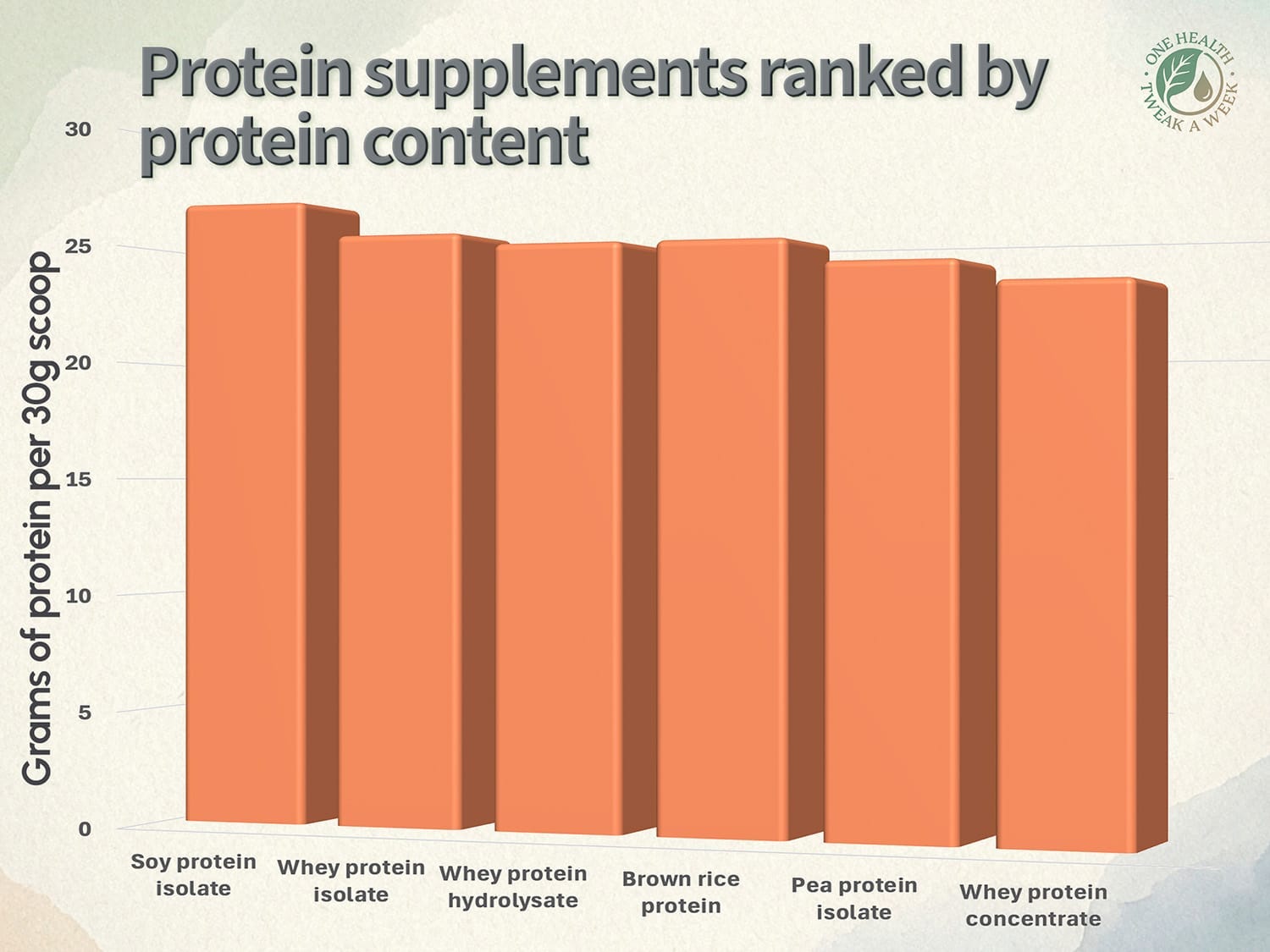
The graph above should reassure you that, despite what the marketing might suggest, there’s little to choose between them when it comes to protein content. A 30g scoop (there’s nearly always one in the pack) delivers 23-27g of protein.
Most of the time, you’re not trying to replace an entire meal with a scoop of powder - you’re just topping up to hit optimal protein targets for muscle building.
Here’s what the science suggests we need:
For younger and middle-aged adults: 20–25g of protein per meal
For adults around 60 and above: 30–40g per meal
If, for example, your breakfast provides 14g of protein, you’d need:
6–11g more if you’re under 60
16–26g more if you’re over 60
That’s where a protein supplement comes in handy: not as a full meal, but as a simple top-up that ensures you’re hitting the sweet spot for muscle protein synthesis.
Leucine: the spark for muscle protein synthesis
Leucine is the spark that lights the fire of muscle protein synthesis.
It’s not just another amino acid - it’s the key trigger that tells your body: “Time to build muscle.” To get the full benefit from your protein, you need to hit the per-meal leucine threshold:
Around 2g for younger adults
3–4g for those in their sixties and beyond
Here’s how different supplements compare.
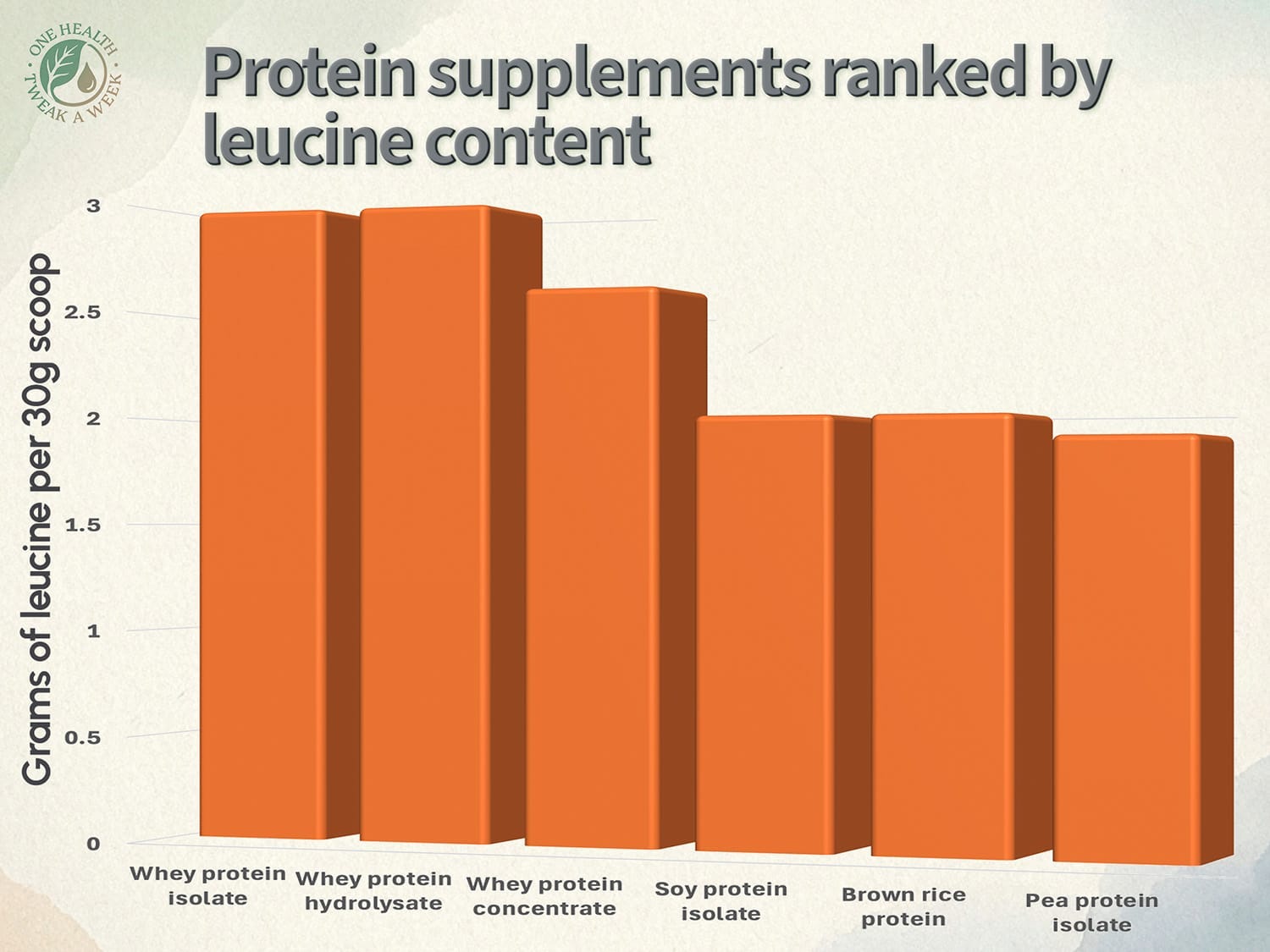
Whey protein comes out on top here. Plant proteins contain around a third less leucine.
If you’re under 60, you’ll get the 2g of leucine you need from a single 30g scoop of any of these protein supplements.
If you’re over 60, you’ll need a bit more: One heaped scoop of whey (35-40g), or 1.5 to 2 scoops of a plant-based protein.
But remember, we’re topping up, not replacing a meal. Those figures assume the powder is providing the leucine all by itself. In real life, we’re topping up a meal, so the leucine already in your food counts too.
Making sure you get value for money
While most of us are, of course, happy to invest in our health, we also want to be sure we’re getting value for money. There’s certainly a risk here of spending more than you need to.
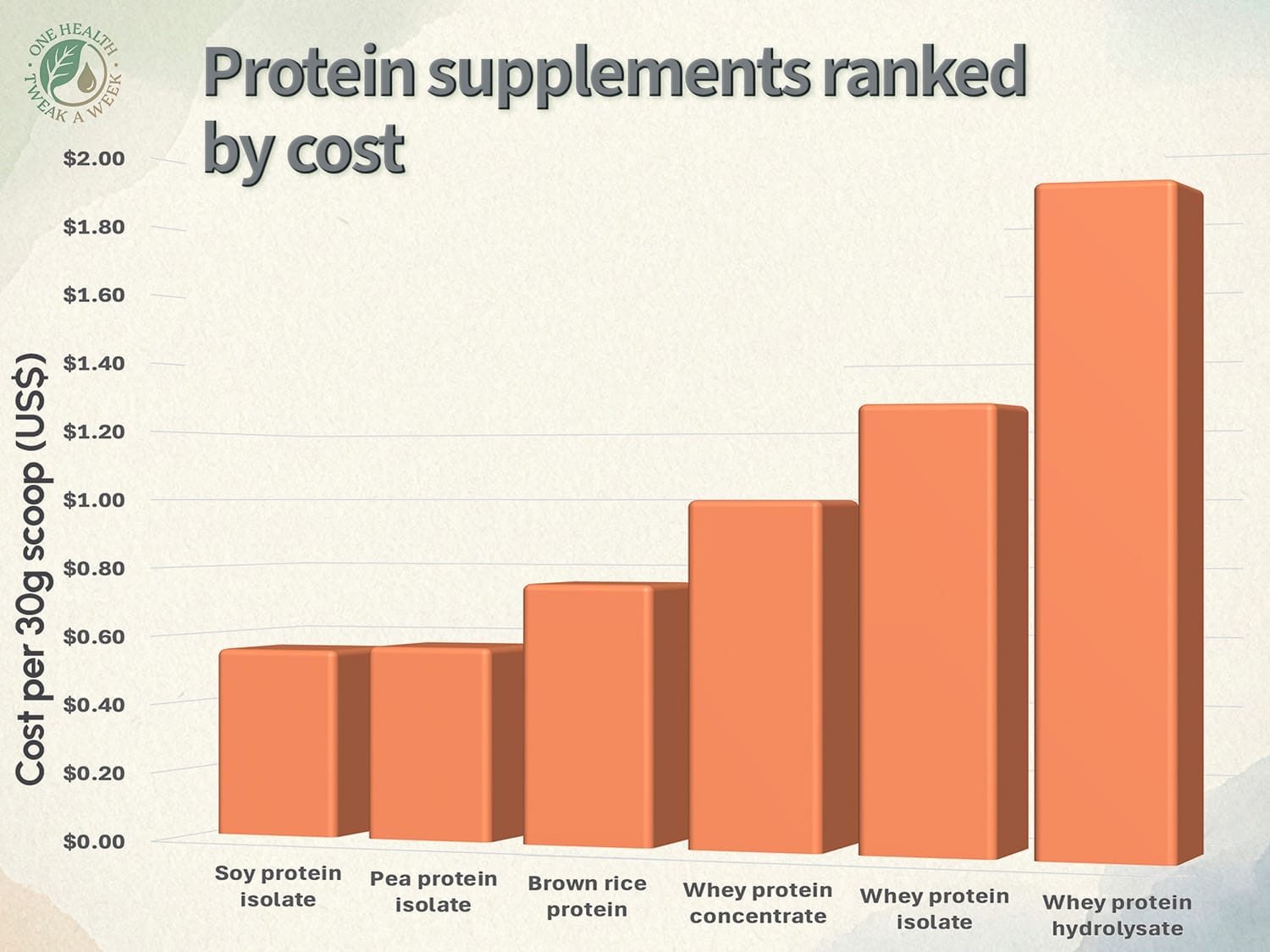
As the graph shows, there’s a three-fold difference in price between the cheapest and most expensive formulations - and that’s before we compare generic vs prestige brand prices.
Plant protein clearly has the advantage here, and you can also see the contrast between whey concentrate (ideal for almost everyone) and the more processed isolate and hydrolysate forms.
What else is in there?
There’s no escaping the fact that protein powders are ultraprocessed food, so ideally we want to avoid any unnecessary additives.
Here’s what we often find on the ingredients panel, and my take on them:
Artificial sweeteners: For those of you who’ve been reading One Health Tweak a Week for a while, you’ll know I’m not a fan of artificial sweeteners. Many have been variously linked to higher risks of premature death, cardiovascular disease and some cancers. The strength of evidence varies between sweeteners and outcomes, but taken together I think there’s enough concern to avoid consuming them unnecessarily.
And in this context, they’re unnecessary. If you’re going to rely on a protein powder regularly, perhaps for years, why choose one containing artificial sweeteners when you can simply buy an unflavoured or stevia-sweetened version instead?
That greatly restricts the available flavours, but then if I have a craving for lemon meringue pie, I’ll make a real one.Salt: Soy protein is the standout here. Many soy powders contain much higher levels of salt/sodium. In some cases, a single scoop can contain 800mg salt / 320mg sodium. That’s a lot. If you have high blood pressure or if you’re taking multiple scoops of powder throughout the day, this is something to be aware of. Brands differ, so check the nutrition label of the one you’re considering.
Maltodextrin: This is essentially a high-calorie filler. You mostly see it in the mass gainer brands - designed to provide protein and calories - or as a filler in cheaper brands.
Stabilisers: Lecithin is an emulsifier that helps the powder mix more easily. Silicon dioxide and calcium silicate absorb moisture to prevent clumping. These are widely used, well-studied, and not associated with health risks.
Gums: These are added to give that thick, milkshake-like texture people expect. Examples are guar gum, xanthan gum, or carrageenan. They’re generally considered safe, but if you’re prone to bloating or digestive sensitivity, they may be worth avoiding.
I often get asked about heavy metals in protein powders. Testing has repeatedly found trace amounts of lead, cadmium, arsenic and mercury in some products, and recent US surveys have reported surprisingly high levels in a minority of them.
But interpreting those results is much harder than the headlines suggest.
For one thing, these metals occur naturally in soil and therefore turn up in much of our food. What matters is how much extra you might get from a protein supplement.
Studies also disagree about which powders are most affected. Large US surveys have found considerably more lead and cadmium in plant-based powders than in whey, while studies from other countries haven’t replicated that or even shown the opposite.
Even the definition of an “unsafe” amount varies enormously. Consumer Reports uses an exceptionally stringent threshold for lead, then reports that some supplements contain levels many times higher than this. There is no safe level of lead intake, but we ingest it from food and the environment every day, which makes some of the more alarming headlines difficult to translate into actual health risk.
At the same time, for older adults in particular, there are significant risks to health and longevity from not getting enough protein.
So my approach is very practical. Don’t use more protein powder than you need. Work out roughly how much protein your meal already contains and use enough powder to close the gap. You don’t need to automatically take a full scoop just because there’s one in the tub.
And I’d avoid high-dose mass-gainer or bulking products. These involve taking far larger quantities of powder, and they’ve often had higher levels of heavy metals.
For someone adding half a scoop or a scoop to breakfast every day because they’re falling short on protein, I don’t think the evidence currently justifies giving up a useful protein supplement because of heavy-metal fears.
Where protein supplements fit
For some people, getting enough protein from food is easy. For others, it’s more of a challenge.
Older adults need more protein per meal at the same time as appetite starts to fall. People losing weight are trying to preserve muscle while eating fewer calories. Those recovering from illness or surgery may also struggle to eat enough.
Maintaining muscle as we age is about much more than looking strong. It helps preserve mobility, reduces the risk of frailty, and makes it more likely that we can continue living independently.
In those situations, a protein supplement can be genuinely useful. Adding 10 or 20g of protein to a meal can help close a gap that would otherwise persist day after day.
There are sensible reasons to pay attention to the type of protein you choose, what else is in the powder, and how much you use. But if your usual meals are consistently falling short of the protein you need, a supplement can be a practical way to bring them up to target and help protect the muscle you’ll rely on later in life.
As always, your responses are anonymous, but they really help me tailor future content to what’s most helpful to you. Please take a moment to click a button.
HEALTH TWEAK OF THE WEEK
Ideally, you’d meet all your daily protein requirements from whole foods, but sometimes that’s easier said than done.
The people most likely to struggle are older adults trying to eat 30–40g of protein per meal in the face of declining appetites, those eating a plant-based diet who may need formidable volumes of food to reach those targets, people trying to lose weight without losing muscle, and anyone recovering from illness or surgery.
In these situations, a protein supplement can be a quick and easy way to top up a meal. You don’t necessarily need a full scoop: work out roughly how much protein your usual meal provides, then add enough powder to close the gap. Do that a few times, and you’ll soon have a good feel for how much your regular meals need.
If you’re not sure how much protein is in a typical meal, free tools like Cronometer help you work that out easily.
First, choose your protein
If you’re comfortable with dairy and want a good all-round choice: whey concentrate.
If lactose is a problem: whey isolate or a plant protein.
If you prefer plant protein: pea, soy, rice or a blended plant protein can all work well.
If you’re looking for the lowest cost: pea, rice, soy or a blended plant protein.
Don’t use collagen as your main protein top-up: it’s low in leucine and doesn’t provide all nine essential amino acids.
Then check the label
Look beyond the promises on the front of the tub.
Compare how much protein you’re actually getting. I use a standard 30g serving when comparing products, but double-check as some products have a different scoop size.
If you have high blood pressure or are restricting salt, check the sodium or salt content, particularly with soy powders, which can sometimes contain surprisingly large amounts.
If you’d rather avoid artificial sweeteners, choose unflavoured or stevia-sweetened products.
Avoid mass gainers or bulking powders.
Don’t assume expensive means better. For most people, there’s little reason to pay extra for whey hydrolysates or elaborate “performance” formulations.
Once you’ve found a protein you tolerate, enjoy and can afford, there’s very little reason to keep shopping around. You just need the one that reliably helps you hit your protein target when food alone falls short.
🎧 Prefer to listen while inspecting the back of a protein tub with new suspicion?
🎙️ This week’s One Health Tweak a Week podcast is about how to choose a protein supplement without getting buried in marketing, jargon, or tubs too big to fit in your shopping cart.
You’ll hear:
Why whey concentrate is usually all most people need, and when isolate or plant protein may make more sense
Why whey, plant proteins and the various forms of whey are less different than the marketing suggests
What to look for in the ingredients list, including salt, sweeteners, mass-gainer fillers and heavy-metal concerns
Why the smartest approach is usually to top up the protein already in your meal, rather than automatically taking a full scoop
👉 Good company for your next walk, commute, or while wondering how something called “Ultra Anabolic Matrix” managed to make it into your shopping basket.

(Episodes are free for now. Paid subscribers support the deeper research - and unlock practical tools to help you improve your health without turning it into a second job.)
🧭 Before you go
💬 If you use a protein supplement already, what did you end up choosing - whey, pea, soy, a blend, or something else? And was that a deliberate choice, or simply the one that happened to be on the shelf?
📤 Know someone staring blankly at a wall of protein powders, wondering whether isolate, hydrolysate or “maximum anabolic performance” is worth paying extra for? Forward this to them.
👥 Paid corner - If you’re unsure whether you actually need a protein supplement, or how much would make sense alongside your usual meals, drop me a message in our private chat, and I’ll help you think it through.

Until next Saturday - get enough protein, ignore most of the marketing, and make the supplement fit your diet rather than the other way around.
– Ben
I've been using an unflavored pea protein powder as a supplement in my breakfast protein shakes and was very pleased with it. Even before I read your article, I had decided I'd switch to whey protein concentrate in my breakfast shake and a casein protein powder in the evening to help maintain muscle (because I have a genetic condition which makes it harder for me to gain muscle).
The main reason for my switch is that I live in Mexico and all the protein powders available here are imported from the US and I was shocked to learn that, on average, most plant protein powders from the US contain about 10 times more heavy metals like lead, arsenic, cadmium, mercury, etc. than the whey and casein powders.
I was also surprised that I can buy a whey protein concentrate from a Mexican wholesaler that costs considerably less than the pea protein powder but that was secondary to my decision to switch.
I never liked heavy metal music and I sure as Hell don't want excessive amounts of heavy metals in my food.
I’m using a plant protein supplement called VEDGE… let me know your preference