

Over the last few years, my diet has shifted. I used to eat meals that included vegetables. Now I eat meals built around them. I have oily fish two or three times a week, dairy most days, the odd egg, and red meat only rarely - mostly when I’m eating at someone else’s house.
Since we love putting each other into labelled boxes, I tried to work out which one I belong in.
Am I a pescatarian: someone who eats fish and seafood, perhaps dairy and eggs, but no meat? A flexitarian: predominantly plant-based but with animal foods, including meat, occasionally? Or simply an omnivore who eats a lot of vegetables?
As I looked at the research for this issue, it turns out I could be any of these, depending on which study’s classification you apply. On the one hand, that’s a little unsatisfying. On the other, I’ve never been one for putting people in boxes, so perhaps it doesn’t matter.
We know eating more plants is associated with better health and a longer life. But how far do we need to go? Is eating mostly plants enough, or would eliminating fish, eggs and dairy and committing to veganism help us live even longer?
I wasn’t sure of the answer, so that’s what I’ve been trawling through this week.
Does giving up more animal foods mean living longer?
It’s tempting to imagine dietary patterns forming a neat health ladder: omnivore at the bottom, vegetarian in the middle, vegan at the top. Each rung you climb, the longer you live. It’s a tidy idea, but it doesn’t match the data.
American researchers followed more than 30,000 Seventh-day Adventists for almost six years and compared rates of death from any cause across dietary groups. Compared with regular meat-eaters, mortality was:
19% lower among pescatarians, who ate fish but not meat.
15% lower among vegans, who excluded all animal foods.
9% lower among lacto-ovo vegetarians, who ate eggs and dairy but no meat or fish.
8% lower among occasional meat-eaters, who ate meat or fish less than once a week.
The associations were stronger in men than in women.
Notice the order. Pescatarians, not vegans, came out on top.
Seventh-day Adventists tend to have healthier lifestyles overall: they smoke and drink less and have lower rates of obesity. So does this pattern hold in broader populations?
A meta-analysis of 12 prospective studies involving more than half a million participants found that those with the highest adherence to plant-based diets were 10% less likely to die from any cause.
When the researchers broke this down by dietary pattern, those following a healthful plant-based diet were 8% less likely to die prematurely, while pescatarians were 19% less likely. The same pattern again.
So, diets emphasising plants are associated with better survival, and regular fish consumption appears to be linked to particularly favourable outcomes. There’s little evidence that going fully vegan offers an additional longevity advantage over an otherwise healthy, predominantly plant-based diet that includes some animal foods.
Of course, these studies are observational, so they can’t establish causation, and definitions of dietary groups vary between studies. But the case for fish doesn’t rest solely on pescatarians doing well. A meta-analysis of 39 prospective studies found that those eating the most fish had a 5% lower risk of dying during follow-up than those eating the least.
Do we see the same pattern in other populations?
A recent analysis of almost 155,000 UK Biobank participants living with obesity provides another useful comparison.
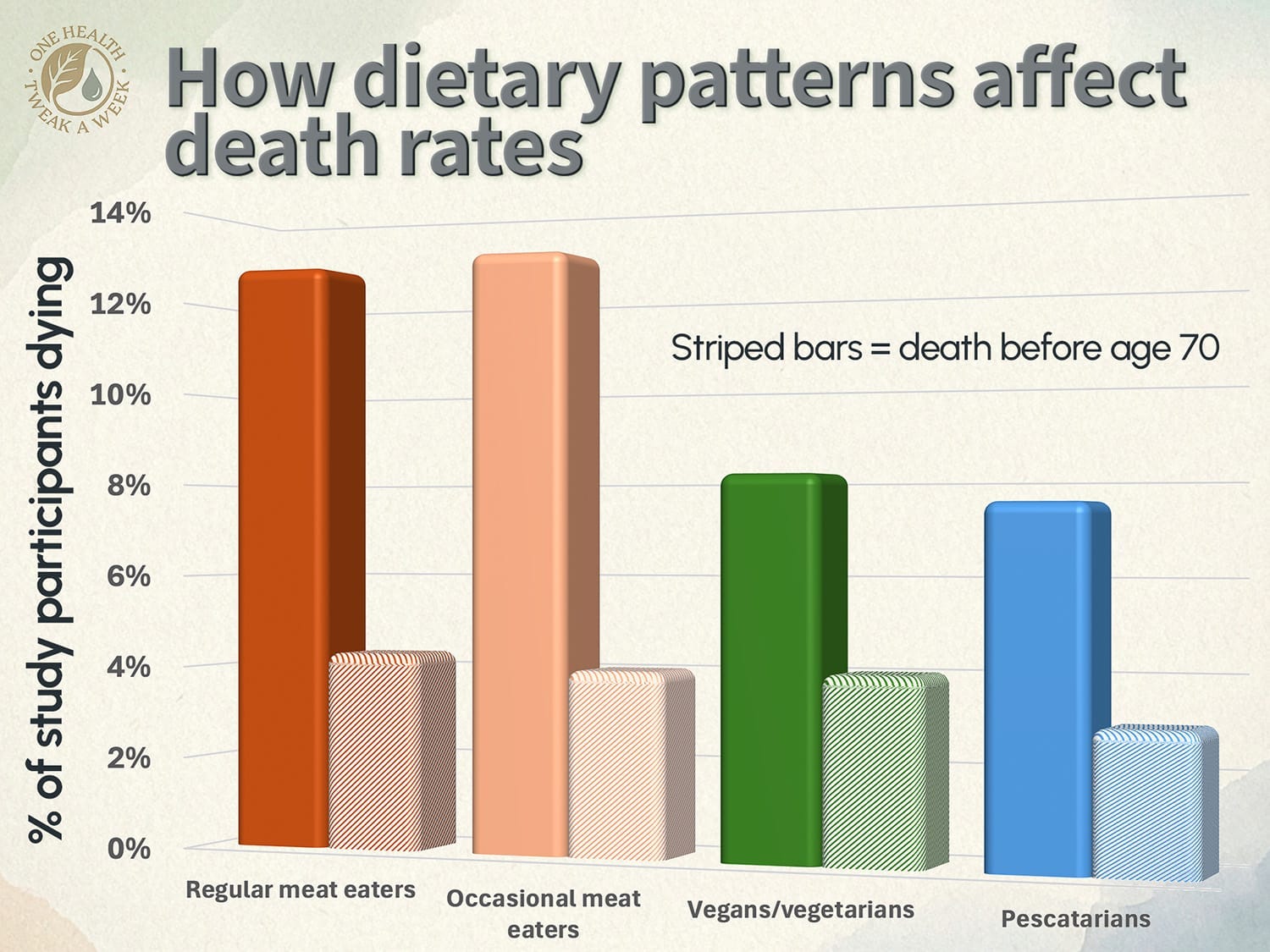
During follow-up, 12.8% of regular meat-eaters died, compared with 13.0% of occasional meat-eaters, 8.2% of vegetarians and vegans, and 7.6% of pescatarians.
That’s approximately 128 deaths per 1,000 regular meat-eaters versus 76 per 1,000 pescatarians. But these are crude, unadjusted rates. Differences in age, health or lifestyle might help explain the contrast. Still, the consistency of this pattern across studies is notable.
In a separate US study, researchers followed almost 118,000 participants of a cancer-screening trial for an average of 18 years. After adjusting for measured differences between participants, the estimated mortality risks relative to omnivores were:
Pescatarians: 19% lower (hazard ratio 0.81; 95% confidence interval 0.64–1.03)
Lacto-ovo vegetarians: effectively unchanged (0.99; 0.81–1.22)
Vegans: 27% higher (1.27; 0.99–1.63)
This study has a problem that makes it unwise to draw firm conclusions: 99.3% of participants were omnivores, so only 0.7% followed other dietary patterns. With so few participants in the pescatarian and vegetarian/vegan groups, the estimates are imprecise, reflected in their wide confidence intervals. Both narrowly missed conventional statistical significance, although the point estimates were quite different. Larger groups might have given us a clearer answer.
My reading of this study is that it’s aligned with other studies finding the greatest benefits from a pescatarian diet. The higher risk associated with veganism is an outlier and may be linked to the fact that vegan participants also had more pre-existing illness. Some might have adopted their diet because they were unwell, an example of reverse causation.
Not all plant-based diets are created equal
Consider someone living on fish and chips and cans of Coke. Technically, that meets the definition of a pescatarian, but so does someone eating grilled salmon with lentils and roasted vegetables. I think we’d all agree that those two meals aren’t nutritionally equivalent.
What matters is which plant-based foods you’re eating.
A meta-analysis of 11 studies involving almost a million participants examined this difference. Using a plant-based dietary index, the researchers found that participants in the highest fifth for overall plant-based eating had 15% lower mortality than those with the lowest adherence.
But when the researchers separated healthy and unhealthy plant foods, they found diverging associations. Those in the highest fifth for eating unhealthy plant foods had approximately 20% higher mortality, as the graph below illustrates.
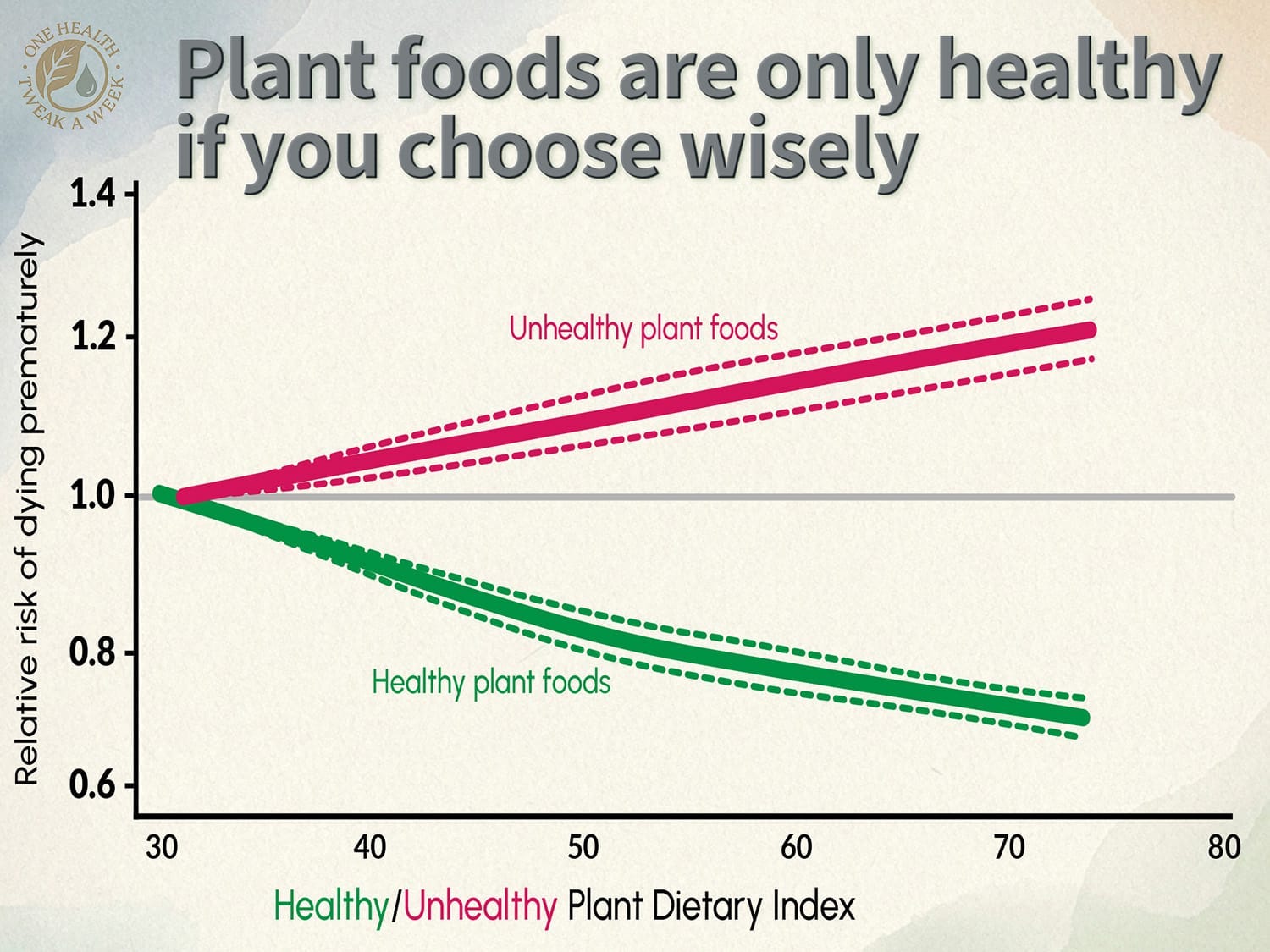
Labelling someone’s diet as omnivorous, vegan or vegetarian tells you very little about nutritional quality. A thoughtfully constructed omnivorous diet can be nutritionally superior to a poorly constructed vegan one.
Could the best diet at 75 be different from the best diet at 45?
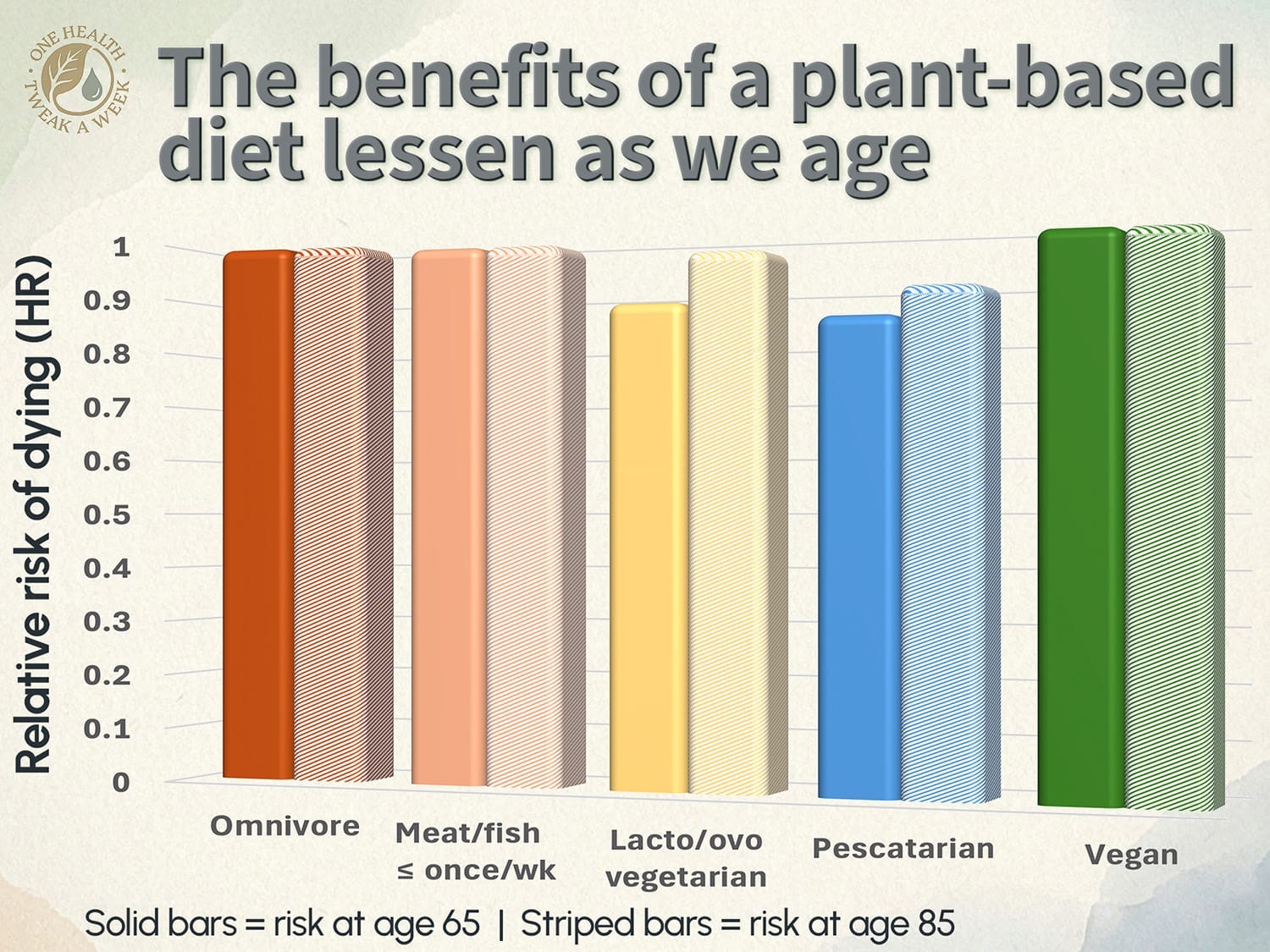
In a later study of Seventh-day Adventists, researchers followed more than 88,000 participants for around 11 years and examined how the associations between dietary patterns and mortality changed with age.
At age 65, lacto-ovo vegetarians had a 12% lower modelled mortality risk than omnivores, and pescatarians a 15% lower risk.
By age 85, those advantages had substantially weakened: to just 3% for lacto-ovo vegetarians and 10% for pescatarians. Vegans showed essentially no mortality difference from omnivores at any age.
This isn’t a one-off finding. Researchers looking at almost 13,000 adults aged 65 and over in China and the US found that vegetarians had a 19% higher risk of dying from any cause in China and a 52% higher risk in the US, compared with meat-eaters.
Why might this happen? I suspect it’s because the balance of health risks shifts as we age.
In younger adulthood, preventing cardiovascular disease, diabetes, and cancer contributes substantially to longevity, and plant-rich diets are associated with lower rates of all three. But in our seventies and beyond, sarcopenia, frailty, falls and impaired recovery from illness become increasingly important threats to survival. Meeting these challenges requires adequate protein and energy.
Think of the same person at two points in life. At 45: a generous appetite, plenty of food intake, and long-term cardiometabolic risk as the primary concern. At 75: a smaller appetite, perhaps unintentional weight loss, and preserving muscle and resilience now competing with chronic disease prevention as priorities. At this point, the diet may need greater protein and nutrient density.
That’s where a predominantly plant-based diet can become more challenging. Many plant foods contain less protein per unit weight than concentrated animal sources. And the fibre that brings so many health benefits can also fill you up before you’ve eaten enough protein, at the exact point in life when appetites are declining and protein needs are rising. Fish, eggs, dairy and meat make meeting these needs easier, although well-planned vegetarian and vegan diets can achieve it too.
There are some important caveats here. The Adventist age-specific estimates are modelled from population data, not a direct measurement of what happens when an individual ages from 65 to 85. Survivor selection may contribute - the more vulnerable omnivores may have died earlier, leaving a comparatively resilient older group. And the Chinese and US findings may also reflect differences in baseline health and confounding, even though the researchers tried to account for these.
Protein or energy inadequacy wasn’t established as the cause of the mortality findings in these studies, but the nutritional challenge is real, including for omnivores. A diet that meets your needs at 45 may need adjusting at 75.
What this means for your health
I think three priorities emerge from the evidence.
First, choose nutritious foods before worrying about dietary labels. The most useful distinction isn’t vegan versus vegetarian versus pescatarian; it’s the quality of the foods dominating your diet. Make whole or minimally processed plant foods the foundation, rather than making avoidance of meat the sole objective.
Second, don’t eliminate all animal foods simply because you think it must be healthier. Pescatarian diets repeatedly show some of the most favourable longevity outcomes, making a good case for eating fish regularly, particularly oily fish. Dairy, the occasional egg (I’d suggest no more than two a week) and modest amounts of lean meat can also be part of a healthy, predominantly plant-based diet.
Third, give increasing attention to protein and nutritional adequacy as you get older. From your sixties onwards, nutrient density becomes increasingly important as appetite and food intake decline. Vegetarians and vegans can meet these needs, but doing so requires more deliberate planning.
As always, your responses are anonymous, but they really help me tailor future content to what’s most helpful to you. Please take a moment to click a button.
HEALTH TWEAK OF THE WEEK
The evidence consistently links predominantly plant-based diets with better longevity, with pescatarian patterns frequently performing particularly well. Fish consumption itself is also associated with better cardiovascular outcomes and lower mortality.
But the quality of those plant foods matters enormously: unhealthy plant-based diets are associated with worse, not better, outcomes. And as we get older, maintaining sufficient protein and energy becomes increasingly important.
1. Make nutritious plants the foundation of your diet. Build meals around vegetables, beans, lentils, whole grains, fruit, nuts and seeds. Replace some refined carbohydrates and less nutritious processed foods with more nutrient-rich alternatives.
2. Include fish regularly, especially oily fish, if you eat animal foods. Aim for at least two portions a week, including one of oily fish such as salmon, sardines, mackerel or trout. Fish provides high-quality protein, while oily fish is particularly rich in EPA and DHA, omega-3 fats that most of us don’t get enough of. Consider replacing some red meat meals with fish. Dairy and occasional eggs and lean meat can also contribute valuable nutrients.
If you’re vegetarian or vegan, you can still meet your nutritional needs through carefully chosen protein-rich foods, particularly soya products and pulses, with algal sources of EPA and DHA worth considering.
3. Reassess your nutritional needs as you get older. From your sixties onwards, include a substantial protein source at each meal, rather than leaving nearly all of it until supper. For many older adults, around 30–40g per main meal is a useful target, adjusted to individual needs. If you’re unintentionally losing weight, eating less or losing strength, reassess whether you’re getting enough food, not just whether it’s ‘healthy’.
By the time I’d finished reviewing these papers, I found myself feeling content with the diet I’ve grown into: definitely plant-based, but including dairy, fish and the odd egg, with red meat occasionally on high days and holidays.
I still can’t decide whether that makes me a pescatarian, a flexitarian or an omnivore. Given that the researchers can’t agree on the definitions either, I don’t think I’ll lose much sleep over it.
What does this mean for your own kitchen?
You don’t necessarily need a different diet. You might just need a clearer picture of what’s already working and what’s missing.
That’s what my Kitchen Snapshot Audit offers. Send me photographs of your fridge, freezer and cupboards, along with a few answers about how you eat, and I’ll give you a personalised, evidence-based second opinion: the strengths to build on, the gaps worth addressing and the changes I’d prioritise.

Find out more about the Kitchen Snapshot Audit
🎧 Prefer to listen while wondering whether you really need to give up cheese to live longer?
🎙️ This week’s One Health Tweak a Week podcast explores a surprisingly complicated question: how far towards plant-based eating do we need to go to maximise our chances of living a longer, healthier life?
We look at the evidence comparing omnivores, vegetarians, pescatarians and vegans, including some findings that challenge conventional wisdom.
You’ll hear:
Why pescatarians repeatedly show some of the lowest mortality rates, sometimes outperforming vegetarians and vegans
Whether going fully vegan offers any additional longevity benefits, and what the research actually tells us
Why not all plant-based diets are healthy, with some associated with a substantially higher risk of premature death
The unexpected finding that some vegetarian longevity advantages diminish as we get older, and why our nutritional priorities may need to change
How to build a predominantly plant-based diet that supports long-term health, including the role of fish, other animal foods and adequate protein
👉 Good company for your next walk, commute, or while contemplating whether your dinner makes you a pescatarian, flexitarian or just an omnivore who likes vegetables.

🧭 Before you go
💬 Has the way you eat changed as you’ve got older? Perhaps you’ve shifted towards a more plant-based diet, started eating more fish, or become more conscious of getting enough protein. What prompted those changes? Have you noticed any difference in how you feel?
📤 Know someone who’s wondering whether they should become vegetarian or vegan to live longer? Or someone who’s been eating mostly plants for years? Share this week’s article with them. The findings might challenge a few assumptions and help them make more informed choices about what goes on their plate.
👥 Paid corner – If you’re trying to improve your diet but aren’t sure how far to go, join us in the private chat. We can discuss ways to eat more nutritious plants, include fish if you wish, and make sure you’re getting enough protein as you get older, without turning every meal into a nutritional calculation.

Until next Saturday – eat well, keep an eye on your protein, and leave the dietary labels to the researchers.
– Ben
If you’d like to know more about getting sufficient protein on a plant-based diet, you might find this recent issue helpful:
Eating Mostly Plants? Could Protein Powder Help You Stay Strong?

Lena’s friends call her the Green Goddess. Most of her spare time is spent digging, hauling, planting and generally transforming her garden into something spectacular. She’s been vegan for decades, eats well, and gets plenty of strength work without stepping inside a gym.
I've a 70 year old man, vegan for 40 years, and plan to remain so for ethical and environmental reasons. After reading this piece, however, I will focus on eating more quality plant foods and increase my protein intake. Thanks for this.
Studying American Seventh Day Adventists, who are vegetarian and do not smoke or drink, seems useful. As Americans' longevity decreases, we know it's a product of multiple societal and environmental factors -- so comparing vegetarian Americans to nonvegetarian Americans to try to understand the role of diet in longevity makes sense. At the same time, non-American clusters of long-lived people show all kinds of dietary preferences, like the Blue Zone pescatarians, the vegetarian Buddhists in parts of Asia, the vegan Sikhs of western India, and the heavy meat eaters of the tundra. As for me, I try to eat a balanced, plant-based diet and hope to extend the "healthy middle" of my life.