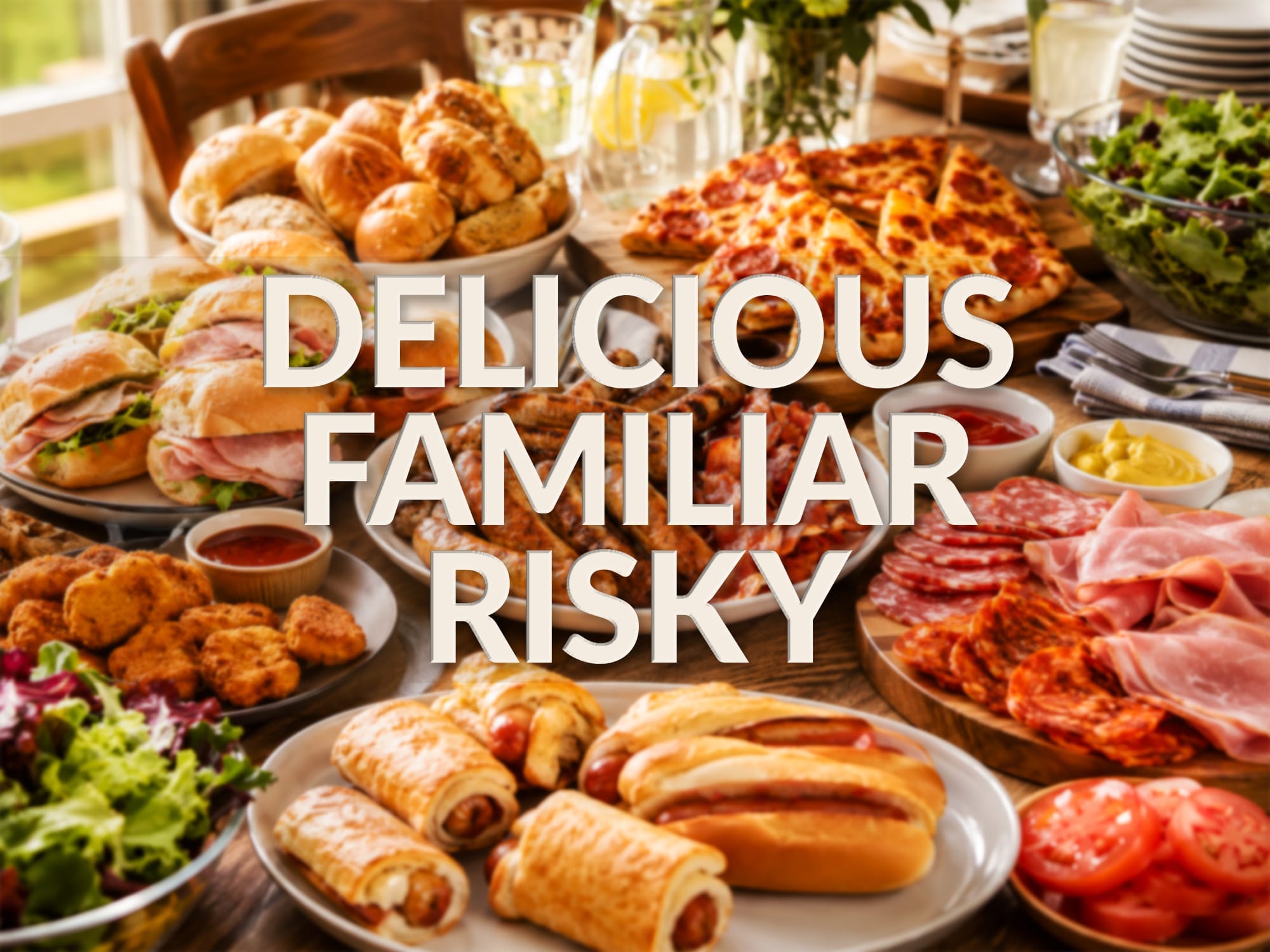
The Processed Meat You Don’t Realise You’re Eating May Be Harming Your Health
Processed meat isn’t just bacon, sausages and hot dogs - and it takes less than you might think for the health risks to rise.
One of the great small pleasures of staying in a British bed and breakfast is the full English breakfast.
Bacon, sausage, black pudding, a fried egg, toast, and a cup of strong tea, with the promise of a day’s adventures waiting outside the door. I’m not going to pretend it isn’t one of life’s genuinely wonderful meals.
But I eat maybe two or three a year. And that frequency is intentional.
Because the research on what regular processed meat consumption does to your long-term health has become increasingly hard to set aside. And some of the supposed “healthy” alternatives aren’t what they seem.
If you’re reading this, chances are you already eat a pretty healthy diet. You may well believe you don’t really eat processed meat. But when you look at what actually qualifies: sausages, bacon, ham, chorizo, salami, pepperoni, hot dogs, chicken nuggets, most beefburgers, deli meats: one or two of them probably crop up on your plate more often than you’d expect.
It’s the quiet creep. The ham in the weekday sandwich. The bacon with breakfast. The salami in the fridge. The pepperoni pizza. The sausages for an easy dinner. The chicken nuggets because everyone is tired and it’s 6:30 pm.
So how much does this actually matter? And if you’ve switched to turkey bacon or “naturally cured” salami, have you solved the problem?
Let’s look at the evidence.
What counts as processed meat
Processed meat is meat that’s been altered by salting, curing, smoking, fermenting, or industrial heat-treatment to improve its shelf life, flavour, or both. The key distinction isn’t whether it’s red meat or white: it’s what’s been done to it.
The list is longer than most people expect: sausages, frankfurters, hot dogs, bacon, ham, gammon, chorizo, salami, pork pies, sausage rolls, chicken nuggets, most beefburgers, corned beef, Spam, and many ready-to-eat meat products.
From survival food to “high-protein” staple
We’ve likely been smoking and drying meat for millennia: a practical way to preserve nutrients when fresh food was scarce.
Salting and fermenting were documented in Roman times, and people noticed certain salts improved the colour, flavour, and shelf life of preserved meat, without realising it was the nitrates in those salts doing the work. The ability of nitrites to preserve meat more effectively wasn’t discovered until the early 20th century, and that gave rise to industrial-scale meat processing.
In other words, processed meat began as a food-preservation technology. It helped people eat nutrient-dense food when fresh food wasn’t available.
The modern problem is different.
Most of us aren’t trying to keep the village alive through winter. We’re eating industrial preserved meats in a world where the fridge works, the supermarket is open, and “high-protein” has become one of the most useful marketing stickers in the food industry.
The cancer signal
In 2015, 22 scientists from 10 countries convened at the International Agency for Research on Cancer to review the evidence. Their conclusion: processed meat is a Group 1 carcinogen, meaning there’s sufficient evidence it causes cancer in humans. The strongest link is with colorectal cancer, with a possible link to stomach cancer.
A word on what Group 1 means. It classifies the strength of evidence that something can cause cancer, not the degree of risk it carries. Processed meat shares Group 1 with tobacco and asbestos, but that doesn’t mean a bacon sandwich carries the same individual risk as a pack of cigarettes. It means the evidence that processed meat can cause cancer is similarly well established.
Beyond cancer

The concern extends well past colorectal cancer. A major review of epidemiological evidence found that each daily 50g (1.8oz) serving of processed meat was associated with:
42% higher risk of cardiovascular disease
32% higher risk of type 2 diabetes
13% higher risk of stroke
8–19% higher risk of heart failure
22% higher risk of death from any cause
8% higher risk of death from cancer
If you’re more of a visual person, you can see those increased risks in the graph above.
Fifty grams, by the way, is not a lot. It’s roughly two slices of deli ham, a couple of rashers of bacon, or a single sausage. Many people eat that much in a single sandwich without giving it a second thought.
These are relative risks based on observational evidence. Nobody randomised large groups of people to live on bacon and sausages for decades just to see what happened. On any given day, the absolute increase in risk from one serving is small. But processed meat tends to be habitual, and the concern is the cumulative pattern, not a single sandwich.
The findings are also remarkably consistent across populations, outcomes, and geographical regions, supported by plausible biological mechanisms and laboratory evidence.
What modest reductions could mean
It’s instructive to look at the consequences at the population level.
A recent modelling study projected that, in the US alone, a 30% reduction in processed meat consumption (think of it as eating two sausages or rashers of bacon instead of three) could mean:
353,000 fewer cases of type 2 diabetes
92,500 fewer cases of cardiovascular disease
53,300 fewer cases of colorectal cancer
16,700 fewer deaths from any cause
over a 10-year period. When they modelled complete elimination, the projected numbers were dramatically larger: 2.7 million fewer type 2 diabetes cases, 1.8 million fewer cardiovascular disease cases, 107,300 fewer colorectal cancer cases, and nearly 181,000 fewer deaths over the same timeframe.
Those are modelled estimates, not trial results. But the scale gives you a sense of how much processed meat may be contributing to preventable disease and deaths.
That doesn’t mean you personally need to live in a bacon-free universe.
But it does show why this category matters. The harm signal isn’t just about the person eating an extravagant fry-up on holiday. It’s about millions of small, repeated, fairly forgettable servings.
The lunchbox ham. The weeknight sausage. The deli slices eaten standing by the fridge.
Why processed meat carries these risks
It would be convenient if processed meat had one simple problem. Remove the villain, fix the food, carry on.
Unfortunately, that’s not how this works.
Processed meats come bundled with a collection of compounds and processes that, together, create a particularly unfavourable risk profile:
Nitrites, nitrates, and nitrosamines: Nitrites are added during curing and preservation. In the body and during cooking, they can form nitrosamines, which damage DNA, promote cancer, generate free radicals, and are toxic to the pancreatic beta cells that regulate blood sugar.
Salt: Processed meats contain, on average, around 400% more sodium than equivalent unprocessed meat.
Smoking and cooking by-products: Polyaromatic hydrocarbons (PAHs), heterocyclic amines (HCAs), advanced glycation end products (AGEs), and sometimes acrylamide, particularly at temperatures above ~130–140°C (266-284°F). All are linked to increased inflammation and a heightened cancer risk. In a lab, most of these must be handled in a safety cabinet.
AGEs in perspective: A few numbers show the effects of processing meat. Raw beef contains roughly 707,000 AGE units per 100g. Boiled beef frankfurters: around 7.5 million. Grilled frankfurters: over 11 million. That’s a whopping increase. AGEs promote inflammation and oxidative stress, contributing to accelerated vascular ageing.
Other concerns: Aflatoxins and ochratoxin A (potentially cancer-causing fungal toxins), reduced gut microbiome diversity, gut-lining inflammation, saturated fat, and occasional Listeria all add to the risks from processed meat.
Processed meats arrive with this risk profile before they even reach the frying pan. Cooking them compounds the problem, generating additional pro-inflammatory and cancer-causing compounds at temperatures comfortably below that of a typical frying pan or barbecue grill.
It means that processed meat becomes even more risky when it’s crispy, charred, smoky and frequent.
Which is annoying, because that’s exactly how many of us like it.
The “healthy” alternatives trap
If you’ve switched to “uncured” bacon, “naturally cured” salami, or anything labelled “no nitrates or nitrites added,” you might reasonably believe you’ve made a safer choice. The labelling is reassuring. The chemistry is not.
These products typically use celery powder, celery juice, or vegetable extracts as their nitrate source. The powder is combined with a bacterial starter culture that converts the nitrates into nitrites: exactly the same chemistry as conventional curing.
Your body doesn’t care whether the nitrate came from organic celery powder or an industrial chemical supply. The downstream nitrosamine formation is the same. And residual nitrite and nitrate levels in organic, uncured salami have been found to be similar to those in conventionally cured salami.
It’s important to clarify that this is about the chemistry of cured meat, not about eating vegetables. Celery, beetroot, and spinach, as whole foods, are perfectly healthy. The concern arises when plant-derived nitrates are concentrated and used to cure meat.
What about white-meat alternatives? Turkey bacon, chicken sausages, and chicken nuggets feel healthier because poultry has a better health reputation.
But the primary concern appears to be the processing itself: the brining, curing, smoking, fermenting, and high-temperature cooking. When white meat undergoes these treatments, it can produce the same potentially harmful compounds. A large observational study found that meat, poultry, and seafood-based ready-to-eat products showed strong associations with mortality, though poultry wasn’t examined as a separate category.
The practical translation, then, is simple: “uncured” bacon, “naturally cured” salami, and celery-powder ham still belong in the processed-meat category, and there’s no good evidence that processed white-meat alternatives are meaningfully safer enough to treat them as everyday staples.
If they’re processed, keep them in the occasional box.
If someone came to mind while you were reading this, please forward it to them.
These tweaks may be small, but practised consistently they can genuinely change long-term health.
A useful nudge at the right moment can make all the difference.
How to spot processed meat on a label
Processed meats often masquerade as healthier alternatives, or wear a health halo - likely emblazoned with ‘high-protein’ right now! Recognising them is half the problem.
The practical test: has this meat been cured, smoked, salted, fermented, reconstituted, or industrially preserved? If yes, it’s processed meat.
On the label, the giveaways include sodium nitrite, sodium nitrate, potassium nitrate, celery powder, celery juice powder, vegetable extracts, smoke flavouring, and curing salts.

(I have to say, I was a little perturbed to see that the meat in the example second from the bottom is pork salivary glands, lymph nodes, and fat. That’s a remarkable degree of candour - and not very appetising!)
This is where the “I don’t really eat processed meat” story often starts to wobble. This category is genuinely sneaky.
It lives in sandwiches, salads, pizza toppings, children’s dinners, pub lunches, party food, fridge snacks and quick work-from-home meals. It is often sold as protein. Sometimes it’s sold as heritage. Sometimes it’s sold as lean, natural, nitrate-free, or high-welfare.
But now, you’ll be able to sniff it out.
What this means for your health
Processed meat isn’t just “meat with a bit of salt.” The curing, smoking, fermenting, and preserving change its health profile in ways that consistent evidence links with colorectal cancer, type 2 diabetes, cardiovascular disease, stroke, heart failure, and premature death.
The useful move isn’t searching for a “healthy” processed meat or a “clean” salami. It’s a category correction. Bacon, ham, sausages, salami, pepperoni, chicken nuggets, and deli meats belong in the occasional-treat box, not the everyday-protein box.
Your first targets are the everyday staples: the ham sandwich at lunch, the weekend bacon, the midweek sausages, the pepperoni pizza, the chicken nuggets. These are the servings that compound over years and decades.
And frequency is the central lever. A full English breakfast two or three times a year is simply not the same pattern as processed meat several times a week.
As always, your responses are anonymous, but they really help me tailor future content to what’s most helpful to you. Please take a moment to click a button.
HEALTH TWEAK OF THE WEEK
Processed meat has been consistently linked with higher risks of colorectal cancer, type 2 diabetes, cardiovascular disease, stroke, heart failure, and premature death. “Naturally cured” and white-meat versions carry the same processing concerns. But processed meats are typically quick, cheap and convenient, which is why they’ve become everyday staples.
This week’s tweak: stop treating processed meat as a protein staple and start treating it as an occasional indulgence.
1. Audit your default week. For one week, notice every time processed meat shows up: breakfast bacon, sandwich ham, pepperoni pizza, sausage dinners, chicken nuggets, deli-meat snacks. Most people find it turns up more often than they’d expected. That’s your baseline.
2. Replace the routine servings. Swap the forgettable processed meats (the ones you eat from habit rather than genuine pleasure) with staple alternatives:
Tinned tuna, salmon, sardines, or mackerel
Leftover roast chicken or turkey
Hummus with roasted vegetables
Cheese with tomato, chutney, or salad
Cottage cheese or cream cheese with cucumber
Bean, lentil, or chickpea pâté
Peanut butter or other nut butters
Avocado with egg, fish, beans, or cheese for protein
Tofu, tempeh, or falafel
3. Save it for the versions you love. Don’t spend your processed-meat ‘budget’ on forgettable supermarket ham. Save it for the bacon sandwich from a proper butcher, real Parma ham on a cheeseboard, the pepperoni pizza you’ve been looking forward to, or a full English at a B&B on holiday. Treat it as a treat. Savour it. Just don’t make it Tuesday’s lunch.
The win here comes from the unglamorous swaps. If you replace the processed meats you barely notice with foods that still give you protein, convenience and pleasure, you lower the background exposure without making your diet feel joyless.
And the occasional processed meat you keep may even become better for it.
The bacon sandwich, the Parma ham, the pepperoni pizza, the full English: these are much more enjoyable when they’re chosen, anticipated and savoured, rather than quietly absorbed into the weekly routine.
That’s the upgrade: fewer forgettable servings, better defaults, and more pleasure from the ones that genuinely earn their place.
🎧 Prefer to listen while scrutinising ingredient panels?
🎙️ This week’s One Health Tweak a Week podcast is about why processed meat is more than bacon, sausages and hot dogs.
You’ll hear:
Why many foods that feel like ordinary staples, including ham, salami, pepperoni, nuggets and deli meats, still count as processed meat
How regular processed meat intake has been linked with colorectal cancer, type 2 diabetes, cardiovascular disease and premature death
Why “uncured”, “naturally cured”, celery-powder and white-meat versions aren’t the escape hatch they appear to be
How to keep the processed meats you genuinely love while replacing the forgettable ones that quietly creep into your week
👉 Ideal for your next walk, commute, or while making lunch and quietly interrogating the ham.
(Episodes are free for now. Paid subscribers support the deeper research - and the practical tools I’m building to help you act on what you learn, not just collect another interesting health fact.)
🧭 Before you go
💬 Which processed meat quietly turns up most often in your week: ham, bacon, sausages, salami, pepperoni, nuggets, or something else?
Or are you already firmly in the “proper bacon sandwich only occasionally, but make it worth it” camp?
📤 Know someone who thinks they don’t eat much processed meat, but lives on ham sandwiches, turkey bacon, pepperoni pizza, or “uncured” deli slices? Send this their way.
👥 Paid corner - Want help replacing your default processed meats without making lunch joyless? Drop me a note in our private chat, and we’ll map out a few realistic swaps for your sandwiches, breakfasts, quick dinners, or snack habits.
Until next Saturday - may your bacon be occasional, your sandwiches more interesting, and your Tuesday lunch slightly less processed.
– Ben


My daily breakfast is multigrain toast with farmers cheese and 2 oz smoked salmon, and a hard boiled egg. I am a 70 yo man.
Does smoked salmon present any of the same issues as processed meat? Because of my heavy cardio routine and low blood pressure, I actually need to add sodium to my diet so that is not an issue.
Save me a plate 😄 The sodium-scale connection is also very important to be aware of. A single American submarine sandwich put me 3,000mg over my 6-month sodium average. Scale spiked the next morning of course.
One bad data point shouldn't end a fitness journey, but it does for many people.
Those who stay in this long-term aren't more disciplined. They just learned to read the signal beneath the noise.