


You’ve decided a protein supplement might be useful. You’ve done battle with the wall of tubs in the nutrition shop, resisted the one promising some sort of “maximum anabolic matrix”, and finally made it home with something that looks as though it belongs in Arnold Schwarzenegger’s gym locker.
Now what?
How much are you actually supposed to take? Should you have a full scoop every day? With breakfast? After exercise? Before bed? And are you adding protein because you genuinely need it, or simply because you now own 5lb of the stuff?
When I first checked the protein in my supposedly exemplary breakfast of muesli, Fruit ’n’ Fibre, nuts, seeds and milk, I found I was getting just 14g. Adding enough yoghurt, toast and peanut butter to bring it up to target worked, but also turned breakfast into rather more food (and calories) than I wanted. A small amount of protein powder solved the problem neatly.
That’s the sort of use we’re looking at today.
We’ve already covered how much protein you need at different stages of life, when supplements might be useful, and how to choose one without getting buried in marketing. This time, we’re getting practical.
We’ll work out where your normal diet is actually short, how much protein you need to add, and when food, part of a scoop or an occasional extra serving makes the most sense.
Start with what you actually need, not what the tub tells you
Meet Elsa and Carl.

They’re both retired. Most days you’ll find them out hiking or planning their next travel adventure. But recently, a few creaky knees and morning aches have made them pause. If they want to keep living the life they love, staying strong needs to become more intentional.
They’ve been reading about sarcopenia: the gradual loss of muscle mass and strength that accelerates as we age. One reason it accelerates is something called anabolic resistance. As we get older, our muscles become less responsive to the same protein stimulus. The amino acids are still arriving, but the signal to build muscle gets weaker. That means older adults generally need to be more deliberate about both the quantity and distribution of their protein intake.
Elsa and Carl have seen several articles suggesting they should aim for about 1.2g of protein per kilogram of body weight each day, spread across meals containing roughly 30–40g of protein each.
There’s good evidence behind that number. In a US study of adults aged 70–79, those consuming around 1.2g/kg/day lost about 40% less muscle over three years than those eating around 0.8g/kg/day. That’s an observational finding, so we can’t assume protein intake alone caused the difference, but it’s consistent with a wider body of evidence pointing in the same direction.
A quick bit of arithmetic makes their targets concrete:
Elsa weighs 65kg (143lb). At 1.2g/kg, she needs about 78g of protein a day.
Carl weighs 78kg (172lb). For him, the target is about 94g a day.
You might notice that these numbers don’t line up perfectly. Elsa’s daily target is about 78g, yet 30–40g at each of three meals would add up to 90–120g.
That’s because the two recommendations are answering slightly different questions. The 1.2g/kg figure is a guide to how much protein you need across the whole day. The 30–40g figure is about getting enough protein at a meal to stimulate muscle protein synthesis effectively. A more technical way of expressing the latter is around 0.4g/kg per meal, but I wouldn’t suggest getting the calculator out before every meal.
Think of 1.2g/kg as your daily target and 30–40g as a useful meal-sized target, particularly when you’re trying to protect muscle as you get older. They’re guides, not numbers that have to reconcile perfectly.
The couple think they eat a pretty healthy diet. But they have no idea whether the arithmetic actually works. So before changing anything, they download the free Cronometer app and log their normal meals for three days.
Breakfast was the weak spot
Breakfast comes as an unpleasant surprise.
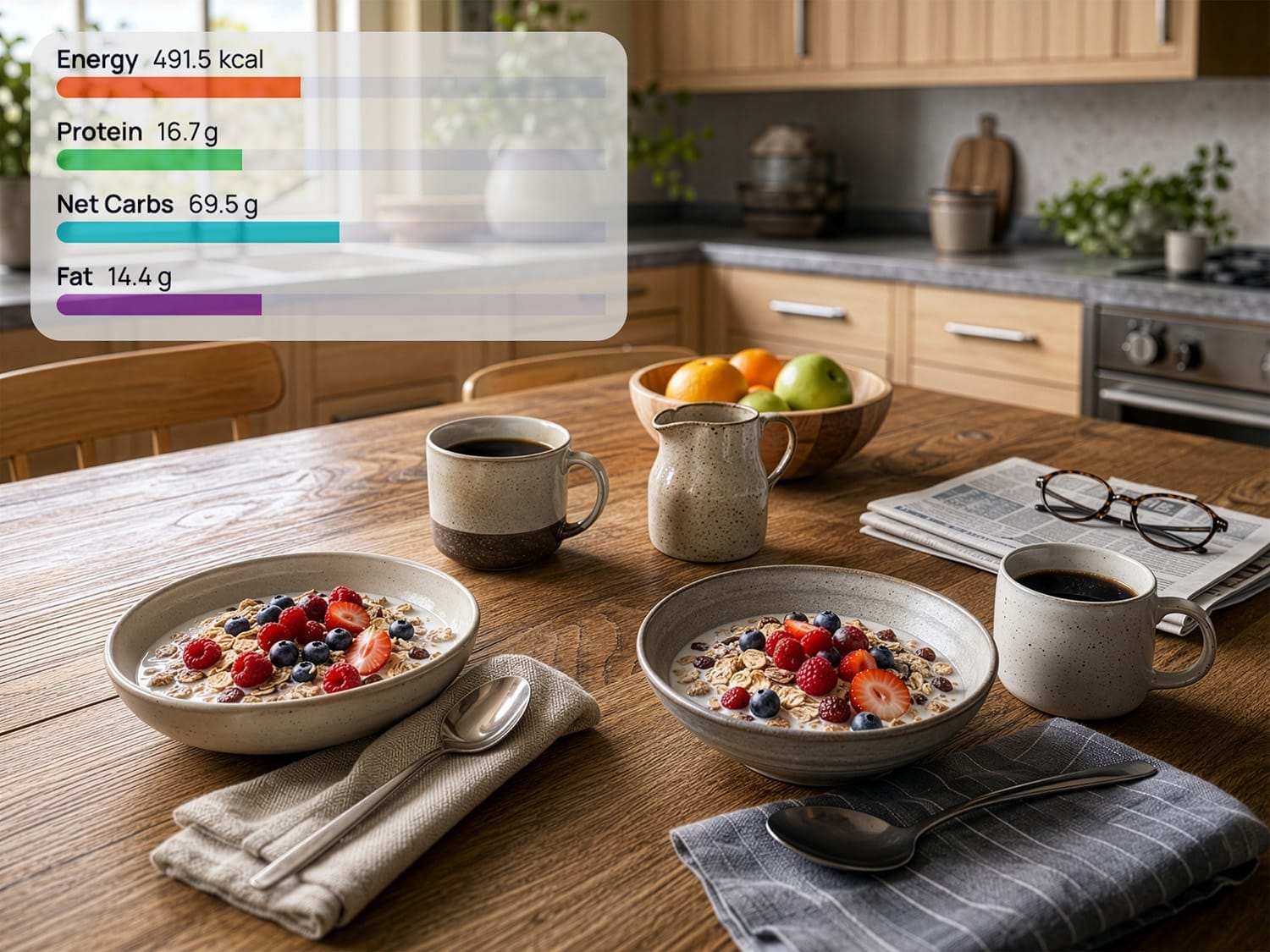
Their generous bowl of muesli with berries and milk looks like a textbook healthy breakfast. Their grandchildren horrify them by starting the day with Pop-Tarts, and Elsa and Carl have always felt just a little superior.
But Cronometer tells a different story. Their breakfast gives them less than 17g of protein and just 0.8g of leucine. That’s a long way from 30–40g of protein, especially at breakfast, after an overnight fast when muscles have been broken down to supply amino acids for the body’s repair processes.
Why does leucine matter?
Leucine is one of the essential amino acids that make up protein, and it plays a particularly important role in muscle because it helps switch on muscle protein synthesis. In younger adults, around 2–2.5g of leucine at a meal is usually enough to produce a strong response. But once we get into our mid-sixties and beyond, anabolic resistance means it takes more.
A review of 38 studies found that in older adults, approximately 3–4g of leucine was associated with a doubling of muscle protein synthesis. That’s a useful range to aim for.
Adding a couple of spoonfuls of Greek yoghurt helped, but getting breakfast all the way to 30–40g would mean adding a substantial bowlful. They liked their breakfast as it was. This seemed like exactly the sort of gap a protein supplement was designed to fill.
Carl chose an ordinary whey concentrate. Whey is particularly rich in leucine, as animal proteins generally provide more leucine per gram of protein than plant proteins, making it easy to increase both their protein and leucine intake without needing a large serving. They considered a plant protein, but whey seemed the simpler choice here.
They found a 2lb tub of chocolate-flavoured whey concentrate for $38. The store assistant tried to upsell them to a fancy “pro” formula at more than sixty dollars, but they knew what they had would work just as well.
Here’s how the numbers work:
One 30g scoop of their whey provides 25g protein + 2.5g leucine.
200ml (7oz) of milk adds 6.7g protein + 0.7g leucine.
Their existing breakfast contributes <17g protein + 0.8g leucine.
A full scoop plus milk would take breakfast to roughly 49g of protein and 4.1g of leucine, which was more than they needed. They settled on two-thirds of a scoop, bringing breakfast to about 40g of protein and 3.2g of leucine - right on target.
Once you measure the gaps, different meals need different solutions
Once they both retired, Elsa and Carl made lunch their biggest meal of the day. Not only is this better metabolically than a big dinner, but they both found they slept better with a lighter evening meal. Their lunches usually hit their protein targets already, or were easily nudged there:
Salmon, potatoes and green vegetables: around 28g of protein. Some Greek yoghurt and fruit for dessert pushes it comfortably over 30g.
Chicken breast, quinoa and vegetables: already around 30g.
Tuna and bean salad with wholegrain bread: again, around 30g.
There’s no useful role for protein powder when ordinary food already does the job.
Dinner is deliberately light. Typical meals include:
Lentil soup and bread: 21–22g of protein.
Baked potato and cottage cheese: 18–20g.
Soup with cheese on toast: 20–21g.
These dinners could do with about 10g more protein. But rather than reach for another shake, Elsa and Carl made a list of ordinary foods providing roughly 10g of protein and stuck it on the inside of a kitchen cabinet door. Now they simply pick something from the list to boost dinner when it needs it.
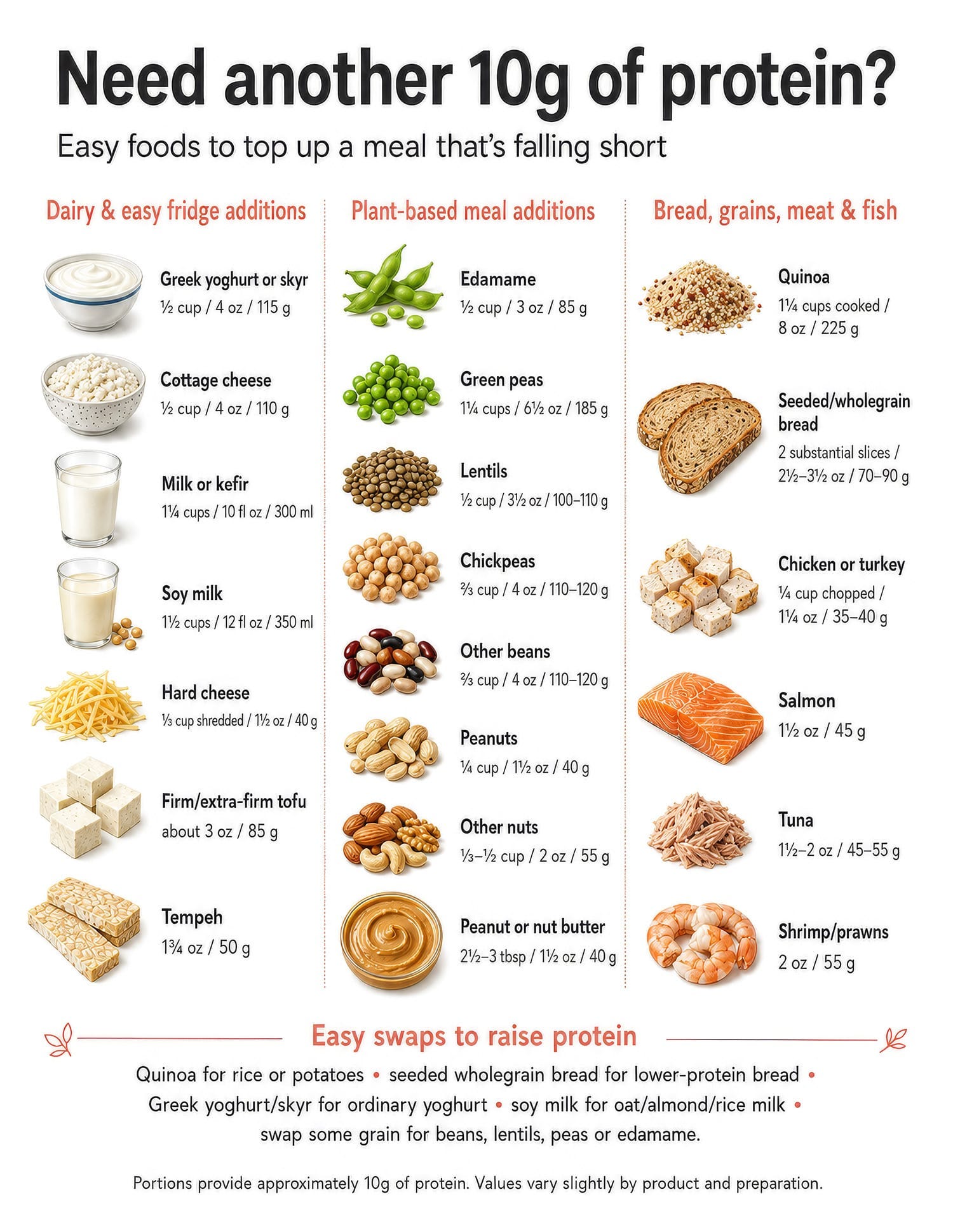
If you’d like the 10g protein top-up cheat sheet for inside your kitchen cabinet door, you can download it here as a printable PDF:
Elsa usually manages to reach her 78g a day without too much difficulty. Carl sometimes struggles. His appetite isn’t always what it used to be, and since they eat broadly the same meals, he often doesn’t get the extra 16g he needs to hit his higher target.
Carl read about a small study in men aged around 60, in which a bedtime dose of 25g milk protein concentrate cut overnight net protein loss by 99% compared with controls.
That sounds dramatic, but it was a small study looking at what happened overnight, not whether the men preserved more muscle over months or years.
Even so, the finding fits with other research showing that protein before bed can increase overnight muscle protein synthesis. Carl uses that evidence pragmatically. On days when he’s still short of his daily protein target, he has half a scoop of casein (a slowly absorbed milk protein) in the evening.
If someone came to mind while you were reading this, please forward it to them. These tweaks may be small, but practised consistently they can genuinely change long-term health. A useful nudge at the right moment can make all the difference.
Why resistance exercise still matters
Elsa and Carl have always felt good about how much they walk. But their reading around muscle maintenance taught them the uncomfortable truth that walking isn’t enough. Aerobic exercise like walking and swimming is excellent for your cardiovascular system, but it’s resistance exercise that tells your body to maintain and build muscle.
Muscles are metabolically expensive tissues, and your body won’t invest in building more without a good reason. Resistance exercise is that reason. Consuming extra protein without strength training is like having bricks delivered every day when you forgot to hire the builders.
The couple subscribed to several YouTube channels specialising in strength exercises for older adults, and they now spend about 40 minutes, three times a week, exercising together in front of the TV. What started off feeling mildly ridiculous has become part of their routine, and both have already noticed firmer muscles.
What this means for your health
Once Elsa and Carl had logged a few ordinary days, the pattern became much clearer. They didn’t need more protein everywhere; they needed to fix a few specific gaps.
Their experience can be applied to most of us:
Start by finding out where you’re short. Track a few representative days and compare what you’re eating with your daily protein target. You may find that one meal repeatedly falls short while the others are already doing perfectly well.
The size of the gap tells you what to do next. If you’re missing a substantial amount of protein, a small serving of protein powder may be the easiest way to make it up. If dinner is only 10g short, ordinary food will often do just as well.
Protein intake is only part of maintaining muscle. Your total across the day matters, and spreading it across meals with enough leucine becomes increasingly useful as you get older. Resistance exercise still provides the stimulus that tells your body to maintain and build muscle.
As always, your responses are anonymous, but they really help me tailor future content to what’s most helpful to you. Please take a moment to click a button.
HEALTH TWEAK OF THE WEEK
Protein powder works best when you treat it as a targeted gap-filler rather than a daily addition to an otherwise unchanged diet. Work out your daily protein target: around 1.2g per kg of body weight for older adults aiming to preserve muscle.
Identify where your normal meals consistently fall short, then use the smallest practical fix to close only those gaps.
1. Audit three ordinary days. Calculate your daily protein target, then log what you normally eat using a free app like Cronometer. Don’t change your diet while you’re measuring it. Look for the meals or days that repeatedly fall short, and note how large the gap is each time.
2. Fill only the gaps you find. Aim roughly for 30–40g of protein per meal if you’re an older adult. If you’re substantially short and making up the difference with food would turn the meal into something much larger than you want, protein powder is a convenient option, and you may not need a full scoop. A smaller shortfall of around 10g is often easy to make up with ordinary food. Meals that already hit the target can be left alone.
3. Give the protein somewhere useful to go. Pair adequate protein intake with regular resistance exercise: two to three sessions per week of around 30–40 minutes is a reasonable starting point. If your daily total still falls short on some days, an occasional evening protein supplement can help bridge the remaining gap, but treat it as a backup rather than a nightly habit.
You should now have a clearer idea of whether protein powder has a useful place in your diet. Once you know roughly what you need and where you tend to fall short, filling those gaps becomes fairly straightforward without turning every meal into a nutrition project.
🎧 Prefer to listen while wondering whether that full scoop is actually doing anything useful?
🎙️ This week’s One Health Tweak a Week podcast is about how to put protein powder to work once you’ve actually brought the tub home.
You’ll hear:
How to work out roughly how much protein you need each day, and why older adults also benefit from paying attention to how it’s spread across meals
How a seemingly healthy breakfast can turn out to be a surprisingly weak source of protein
Why leucine matters more as we get older, and why whey can be particularly useful when you have a substantial gap to fill
How to decide whether a shortfall calls for food, part of a scoop, or occasionally some protein later in the day
Why all this works much better alongside regular resistance exercise
👉 Good company for your next walk, commute, or while discovering that the serving size on the tub is a suggestion rather than a commandment.

(Episodes are free for now. Paid subscribers support the deeper research - and unlock practical tools to help you improve your health without turning it into a second job.)
🧭 Before you go
💬 Have you ever actually tracked how much protein you eat across a normal day? If so, where was your biggest surprise - breakfast, lunch, dinner, or the daily total?
📤 Know someone who takes a scoop of protein powder every day but has never worked out how much protein they actually need? This might save them quite a lot of unnecessary shaking.
👥 Paid corner - If you’re trying to work out where your own protein intake is falling short, drop me a message in our private chat. We can look at your usual meals and work out where food is enough and where a supplement might genuinely make life easier.

Until next Saturday - keep the protein where you need it, keep lifting something heavier than the remote control, and don’t let the serving scoop run your diet.
– Ben
If you missed the issue on how to choose the best protein powder for you, you can find it here:
Which Protein Powder Should You Buy - Without Wasting Money or Risking Your Health?

In a recent issue, we looked at who might benefit from a protein supplement.
Really enjoyed this, Ben - the Elsa and Carl framing does a lot of work here, especially showing how a "textbook healthy" breakfast can still land at under half the leucine threshold. The anabolic resistance piece is the bit most protein content skips entirely; people see "1.2g/kg" and assume it's just a bigger number, not a distribution problem.
The bedtime casein detail was a nice touch too, small effect, honestly presented as "net protein loss over one night" rather than oversold as a fat-loss hack. More of this, please.
Another practical, easy to digest article. Thanks Ben. Like almost everyone, I love chocolate but I don't buy chocolate flavored protein powder, or use cocoa or cacao powder, because chocolate-flavored protein powders contain roughly four times more lead and up to 110 times more cadmium (a highly toxic heavy metal that poses serious health risks) than vanilla or unflavored protein powders. These heavy metals in chocolate protein powders come from the cacao plants that absorb naturally occurring trace minerals and heavy metals, like lead and cadmium, from the soil. Plant-based protein powders made from peas, hemp, soy, or rice absorb more heavy metals from the soil and typically have three times more lead than whey protein powder. For this reason I've switched from pea protein powder to whey and casein based ones (with a vanilla flavor).