

I’ve been meaning to look into this for years.
Every time another “forever chemicals” headline landed, I’d glance at my non-stick frying pan, notice the scratches across the bottom, and feel a small twinge of unease. Not enough to sit down and research the evidence. Just enough to worry me a little before I carried on making dinner. Maybe you’ve felt that, too.
Eventually I bought a new pan with a ceramic non-stick coating instead of the usual Teflon. Problem solved.
Then I noticed the non-stick basket in my air fryer. And the baking tins. And then I started wondering about the lining of the oven. Non-stick had colonised my kitchen while I was busy worrying about one pan.
I hadn’t removed non-stick coatings from my kitchen. I’d replaced one pan.
So had I reduced a meaningful health risk, or simply responded to a very effective scare story? I honestly didn’t know.
So I’ve finally sat down with the research to answer the question properly. Much of the evidence is reassuring, but there are a few findings that are worth knowing.
PFAS are a real problem. That doesn’t tell us much about your pan.
PFAS, or per- and polyfluorinated alkyl substances, are a huge family of man-made chemicals valued because they resist water, grease, stains and heat.
They’re found in food packaging, waterproof clothing, carpets, personal care products and, of course, non-stick cookware. One member of the family is polytetrafluoroethylene, or PTFE, better known by the brand name Teflon.
They’re called “forever chemicals” for good reason. We produce around a million tonnes of PFAS every year, and many persist in the environment for thousands, possibly tens of thousands, of years. Virtually all of us have detectable PFAS in our blood.
There are at least 8,000 different PFAS, with more than 600 in commercial use, yet only a small proportion have been studied well enough to understand their health effects. The ones that have been studied give genuine cause for concern.
They’re associated with a lowered response to childhood vaccines, higher rates of childhood infections, increased risk of thyroid disorders, disruption to liver function, higher LDL cholesterol, increased risk of chronic kidney disease and kidney cancer, reduced fertility in both men and women, and higher rates of pregnancy-related hypertension and pre-eclampsia.
That’s a serious list. But before we blame the frying pan, we need to know how much exposure actually comes from cookware.
We’re exposed to PFAS from many overlapping sources: food, drinking water, house dust, indoor air and consumer products. Diet may account for at least 40% of exposure in some settings; house dust perhaps 3-25%; indoor air less than 4%.
The mix varies enormously depending on where you live, local industrial history and drinking-water contamination. And some of the best exposure data we have is now over 20 years old, predating regulations that restricted several PFAS, so the picture has likely shifted since then.
Nobody has reliably calculated what proportion of our total PFAS exposure comes from cookware. But the available evidence suggests it is a small contributor compared with food, drinking water and other environmental sources.
What happens when you heat a non-stick pan?
To understand the cookware question, it helps to think about two types of PFAS.
The first is the very large PTFE polymer molecules that form the non-stick coating: too big to be absorbed into the bloodstream. The second is much smaller PFAS molecules, either left over from manufacturing or released when the coating breaks down under extreme heat. It’s these smaller molecules that can be absorbed, circulate in the blood, and accumulate in our tissues over years. They’re the ones worth worrying about.
German researchers heated 5 commercial non-stick frying pans, 9 baking trays and 4 baking mats to 250°C/480°F for 30 minutes. None of the frying pans released any of the small PFAS they were testing for. One baking tray and one baking mat did, but only on the first heating, pointing towards manufacturing residues rather than a breakdown of the coating.
The same experiment detected many volatile organic chemicals from new cookware on the first heating, but not subsequently. That’s a good reason to wash new coated cookware thoroughly, follow the manufacturer’s first-use instructions and ventilate well for the first few uses.
Temperature, however, changes things dramatically.
In another study of 13 pans, emissions of small PFAS molecules were about 4.75ng/hour under normal-use conditions. At 370°C / 700F, they climbed to 12,190ng/hour: more than 2,500 times higher.
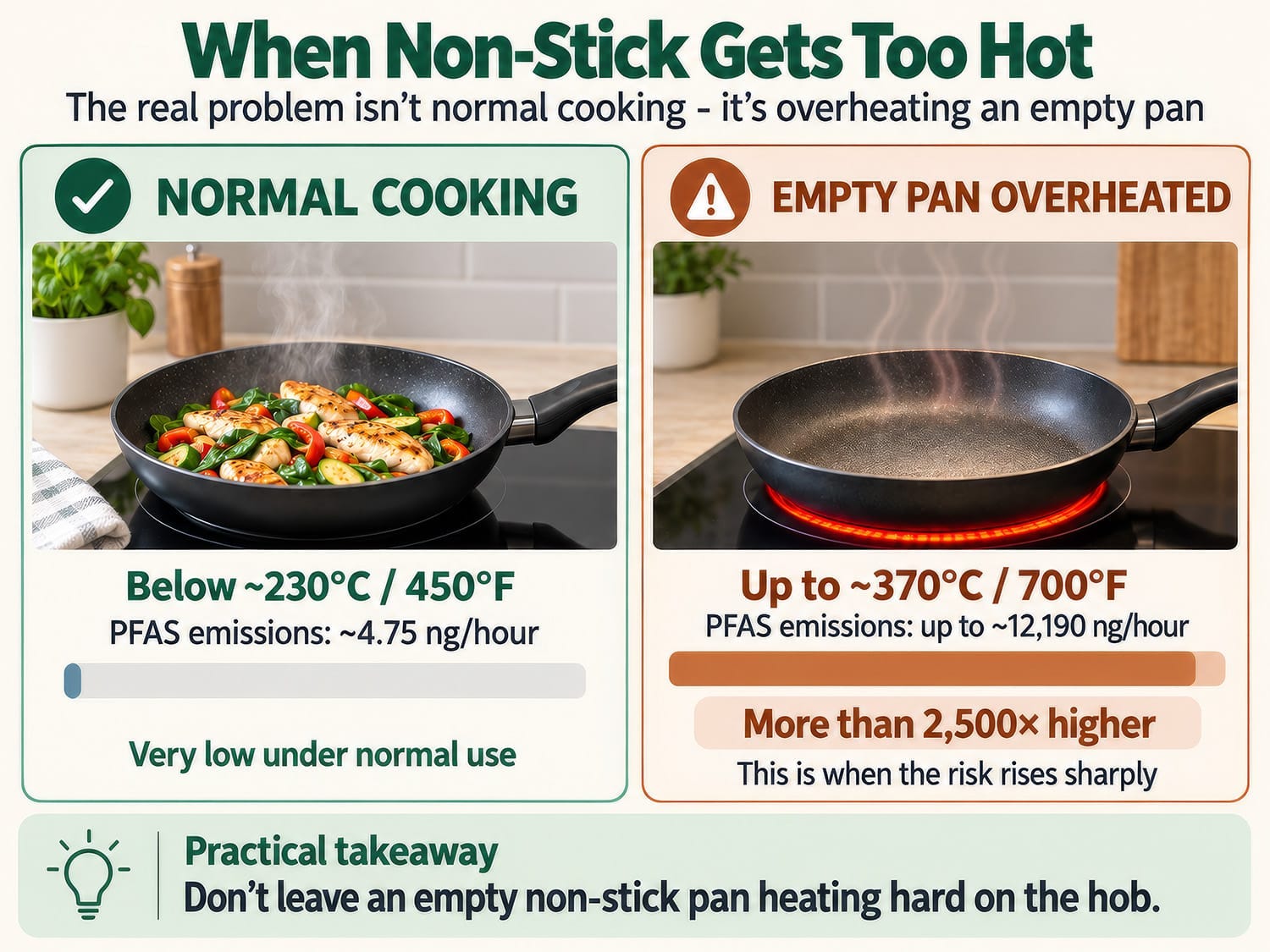
A pan containing food is very unlikely to reach 370°C. An empty pan forgotten over a fierce burner can.
The German Federal Institute for Risk Assessment reaches much the same conclusion: properly used PTFE cookware isn’t expected to cause adverse health effects; the meaningful hazard arises when empty cookware is strongly heated to around 360°C or above.
At those temperatures, the fumes can cause polymer fume fever: fever, chills, headache, muscle and joint pains and general malaise beginning several hours after exposure. Overheated non-stick cookware is one recognised cause.
You can preheat a non-stick pan moderately, but don’t leave it empty on high heat long enough to get screaming hot.
The “millions of particles” story
You may remember headlines in 2022 claiming that damaged Teflon pans could release thousands or even millions of micro- and nanoparticles.
The study didn’t actually show that millions of particles were ending up in anyone’s food.
That study was designed to develop a method for detecting coating abrasion. The researchers removed non-stick surfaces from their pans, then deliberately attacked them with steel wool and barbecue clamps before examining the results under a scanning electron microscope.
They didn’t actually cook any meals, and most of the particles they identified were still attached to the coating or to a utensil. That’s a long way from showing what happens when you sauté potatoes for dinner.
A 2024 study using more realistic food-preparation activities did find particles coming from plastic utensils, containers and non-stick coatings. But the researchers estimated that all the plastic/non-stick cookware studied, including chopping boards, might contribute around 2,400-5,000 particles a year to home-cooked food. It still represents some exposure, but on a very different scale from the headlines suggesting millions of particles in every meal.
You might reasonably argue that any non-stick particles we swallow are irrelevant anyway, since the material is famously inert: it shouldn’t react with anything on its way through the system. But recent cell-culture work complicates that assumption.
Spanish researchers found that PTFE nanoparticles could get inside cells, where they disturbed cellular structure, damaged mitochondria, triggered inflammation, caused oxidative stress and damaged DNA. The particles didn’t kill the cells, but that’s still a concerning set of effects.
This is laboratory cell-culture evidence, not clinical evidence. It can’t tell us the dose that reaches human tissues during ordinary cooking, and it doesn’t demonstrate that using an intact pan causes harm. But it does weaken the blanket assumption of biological inertness, and it strengthens the case for replacing pans whose coatings are substantially scratched, blistering, flaking or peeling, rather than continuing to cook on them.
There’s no perfectly inert pan
Media coverage leaves the impression that non-stick is uniquely suspect and everything else is clean.
But, of course, nothing is ever that simple.
US researchers found small amounts of titanium, silicon and aluminium migrating from ceramic coatings, with more released after aggressive scouring.
Korean researchers tested 88 kitchen items made from stainless steel, aluminium alloys, copper alloys and cast iron and found small amounts of metals migrating into food, particularly under acidic conditions or with abrasive scrubbing.
In most studies, the amounts released under ordinary use are too small to be expected to cause harm. Stainless steel, ceramic, cast iron, aluminium and copper all interact with food to some degree. Every material comes with its own small set of trade-offs.
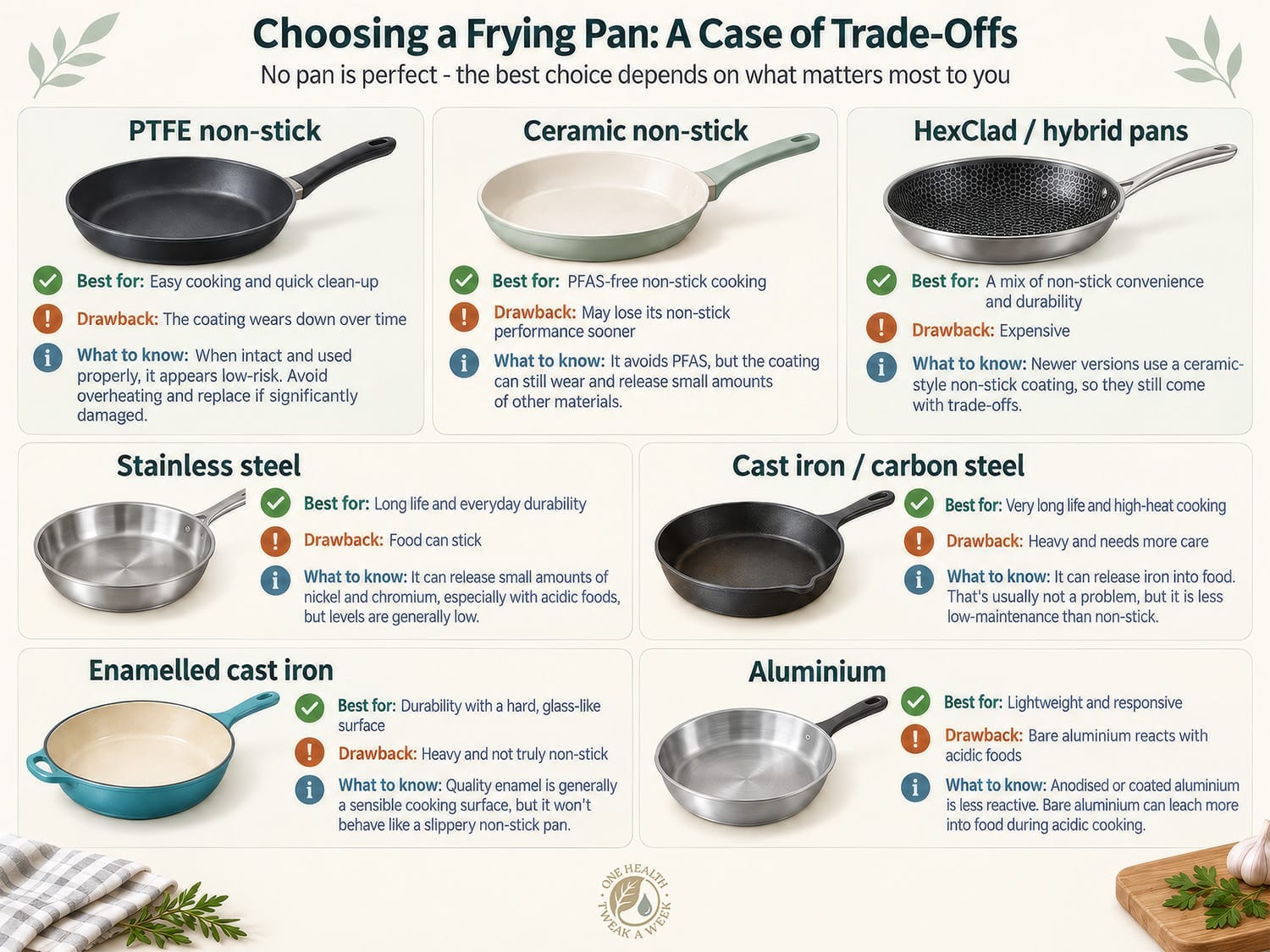
Each material brings a different compromise:
PTFE non-stick: Effortless food release; coating eventually wears; risk from overheating or damaged coatings.
Ceramic non-stick: PFAS-free; may lose non-stick properties sooner; coating constituents can migrate under abrasion.
Stainless steel: Very durable, dishwasher-safe; food sticks more easily; small nickel and chromium release, especially with acidic foods.
Cast iron and carbon steel: Extremely durable; heavy, requires seasoning; transfers iron to food (generally harmless unless you have an iron overload disease like haemochromatosis).
Enamelled cast iron: Durable glass-like enamel surface; heavy, not truly non-stick; very little concern with quality enamel.
Aluminium: Lightweight, responsive to heat; bare metal reacts with acids; aluminium leaching possible from uncoated pans.
Lined copper: Excellent heat control; expensive; minimal concern while the stainless lining is intact. Unlined pans can leach harmful amounts of copper.
For most of us, the nuisance factor matters too. I don’t think maintaining a frying pan should become a hobby unless you want it to. Some people genuinely enjoy seasoning cast iron. I’m happy for them, but that’s not me.
Product quality matters too.
Aggressive testing of 35 cookware samples in Turkey detected PFAS in six and aniline-related chemicals, which are presumed carcinogens, in all of them. They also found small amounts of arsenic, cadmium, chromium and nickel migrating from stainless-steel cookware into food, particularly under acidic conditions and after scrubbing with abrasives like steel wool.
That testing was harsher than normal household use, but it’s a reason to buy from reputable suppliers rather than simply going for the cheapest pan available, which might be made from non-food-safe recycled metal.
I should stress that this isn’t intended as a definitive guide to buying frying pans. I’m looking at them primarily through the lens of health risk and everyday practicality.
I know a number of professional chefs read the newsletter, and I’d love to hear your perspective: what do you actually use in your own kitchen, and what would you recommend to someone who wants a durable, practical pan without turning its care and maintenance into a hobby?
The same principles apply to kitchen appliances with non-stick coatings: air fryers, rice cookers, waffle irons, sandwich makers and electric grills. None of them come close to the 360°C / 700°F temperatures at which coatings start to break down during normal use, and the same care rules apply.
And, just so you know, oven linings are usually ceramic, so no PTFE coatings to worry about there, so at least the oven can come off the suspect list. Though new ovens do give off chemical residues from the manufacturing process, as you’ll know from that ‘new oven’ smell.
What about non-stick baking trays?
There’s one finding I want to circle back to. In the German study, the frying pans performed well, but some of the non-stick-coated baking trays and mats released small PFAS when heated to 250°C (480°F). None were detected when the same samples were heated a second and third time, suggesting these were residues left over from manufacture rather than the coating steadily breaking down.
For ordinary baking, that’s fairly reassuring. Most of us cook well below 250°C, and PTFE doesn’t begin to seriously break down until considerably higher temperatures.
I’d be more cautious if you use a non-stick baking sheet for very high-temperature cooking, such as pizza with the oven turned up as far as it will go. Check the manufacturer’s maximum temperature, and personally I’d use an uncoated metal tray, pizza stone or steel for that job. As with a frying pan, replace coated bakeware once the surface is badly scratched, peeling or flaking.
For now, I wouldn’t rush off to buy silicone baking sheets or cake tins. These come with their own worrying findings, and deserve an article of their own.
The bigger picture
There’s a risk here of focusing so closely on the pan that we overlook what frying itself puts into the kitchen air.
British researchers measured the volatile organic compounds released while shallow-frying flatbread, frying spices and making a chicken curry. Concentrations of acetaldehyde and acrolein, both linked to lung irritation and cancer, ran two to ten times higher than recommended limits for safe indoor air.
We’ve spent a lot of time worrying about nanograms of chemicals coming off the pan. Meanwhile, frying itself fills the kitchen air with a much larger mixture of irritant, pro-inflammatory and cancer-causing chemicals, such as acetaldehyde and acrolein. In experimental kitchens, some of these have reached several times recommended indoor-air limits.
In a factory or professional kitchen, you’d be expected to control fumes at those levels to protect workers. At home, many of us fry dinner blissfully unaware, while the extractor fan sits unused.
What this means for your health
So what does this add up to for you?
PFAS really are harmful, but the evidence doesn’t support the idea that routine cooking in PTFE-coated non-stick pans is a significant source of harmful PFAS exposure.
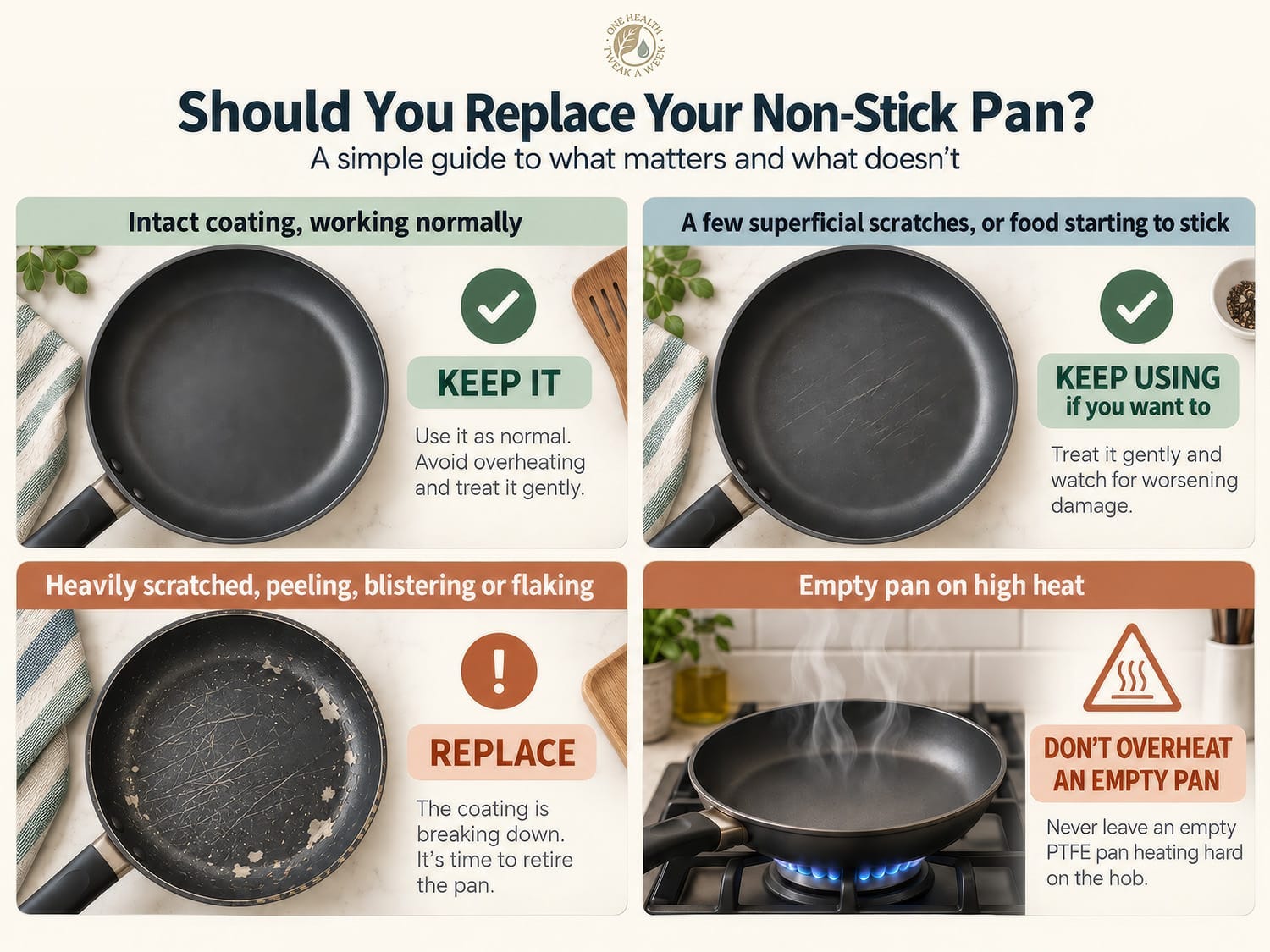
The risk picture changes in a few specific, avoidable situations: severely overheating an empty pan, continuing to cook with a pan whose coating is substantially damaged, or buying poor-quality cookware of uncertain provenance. Those are definitely worth avoiding.
Every material we looked at comes with its own small exposure issues, alongside practical strengths and weaknesses. Changing pans means choosing a different set of trade-offs.
And perhaps more importantly, frying itself carries real risks. Heating food and oil to high temperatures produces harmful chemicals, whatever pan you use. If you’re concerned about your long-term health, fry infrequently, and always have the extractor on when you do.
As always, your responses are anonymous, but they really help me tailor future content to what’s most helpful to you. Please take a moment to click a button.
HEALTH TWEAK OF THE WEEK
PFAS - the so-called “forever chemicals” - are a genuine health concern, and reducing unnecessary exposure makes sense. But for most of us, a sound non-stick frying pan used properly is unlikely to be an important source. The bigger cookware risks are much more specific: badly damaged coatings, severe overheating, and poor-quality products.
Take one minute today to check the coated cookware you actually use.
Start with your frying pan, then look at your air-fryer basket, baking trays, and any other regularly used non-stick surfaces.
Keep using them if the coating is intact or only lightly marked.
Replace them if they’re heavily scratched, blistering, peeling or flaking, or if the non-stick surface has clearly started to fail.
Then make three small habits automatic:
Don’t leave an empty non-stick pan sitting over high heat.
Use wooden or other non-abrasive utensils and avoid steel wool or harsh scourers.
Turn on an externally vented extractor whenever you fry, and keep frying as an occasional cooking method rather than an everyday one.
If you buy new coated cookware, choose a reputable manufacturer, wash it before first use, follow its care instructions and ventilate well during the first few uses.
Once you’ve done that, I’d give your cookware rather less mental bandwidth. The evidence doesn’t support treating a sound non-stick pan as a hidden health threat. A quick check, a few sensible habits and replacing coatings when they genuinely deteriorate will take you most of the way.
🎧 Prefer to listen while wondering whether your frying pan is secretly poisoning you?
🎙️ This week’s One Health Tweak a Week podcast takes a close look at non-stick cookware, PFAS and the question most of us actually want answered: is the pan we cook with every day something we need to worry about?
You’ll hear:
Why PFAS really are a health concern, but your frying pan is probably a very small part of the problem
What researchers actually find when they heat modern PTFE non-stick cookware
Why overheating an empty pan changes the picture dramatically
What scratches, peeling and flaking really mean, and when I’d replace a pan
What we know about air fryers, baking trays, rice cookers and other coated appliances
Why switching to ceramic, stainless steel, or cast iron doesn’t make every potential exposure disappear
The simple cookware check and cooking habits that can reduce the risks that are worth worrying about
👉 Good company for your next walk, commute, or while standing in front of the pan cupboard wondering whether that scratch really means it’s time for a new one.

(Episodes are free for now. Paid subscribers support the deeper research - and unlock practical tools to help you improve your health without turning it into a second job.)
🧭 Before you go
💬 Have a look at the cookware you actually use. Are you keeping your non-stick pan, replacing a badly worn one, changing how you heat it, or finally remembering to turn on the extractor?
And if you’ve already moved away from conventional non-stick, I’d be interested to hear what you chose instead and how you’ve found it in everyday use.
📤 Know someone who has been eyeing their frying pan suspiciously after another headline about “forever chemicals”? Forward this to them.
👥 Paid corner - Do the one-minute cookware check from this week’s Health Tweak and tell us what you found. I’m particularly interested in the pans and appliances that turned out to be in much better shape than you feared - and the ones that clearly deserved retirement.

Until next Saturday - check the coating, avoid heating an empty non-stick pan hard, and then give your cookware a little less mental bandwidth.
– Ben
Turns out (as science directs its analytical glare to every aspect of life) that there’s lots of ways to die. The old fashioned stuff like eaten by a bear, accidents, disease, or dying at war are being overshadowed by what we keep finding out from studies.
Well, yeah, everyone dies, but the idea is not doing stuff to hasten it. And you can do everything from eating better protein, fiber, beans, veggies, fruits, getting exercise etc etc is good, but then “feces occurs” and you’re dead at 45 from something else. What are we supposed to do? Not dying turns out to be a lifelong pursuit.
Now it turns out that something as regular and almost impossible to avoid, as sautéing food (never mind in what material pan) releases carcinogens, and roasting anything from coffee to chocolate to toast, meat, veggies is an acrylamide danger. Death lurks.
Nonstick stuff is a convenience. Professional kitchens use it too. But I never did except for my breakfast cooks…frying eggs when you’ve maybe got 5 different pans going; non stick egg pans are useful. Most big boy kitchens have dish and pot stewards, whereas homes are DIY in that regard, thus convenience is a virtue. What part of life’s necessary stuff do we adjust?
A non stick pan that’s used properly is fine, but if we want to educate users about how not to die from using it, then a little warning on the thing’s tag or packaging might tell folks “don’t super heat it”.
I have one nonstick pan at home. It is still basically in good shape, though there are patches that aren’t. I don’t worry, it’s time to replace it, and I will. Everyone needs to know when its useful lifespan has been reached. Toss it as needed.
Most of my pans are either carbon steel or cast iron. These can be non stick if you form a polymerized surface treatment. Its. It is not a hobby to do it, it’s simply respecting your tools. Do it and you’ll never have to toss it. Thus less waste and rubbish. Takes a minute after cleaning it to refresh the polymer. It’s not difficult. My pots are all stainless steel. Even a SS pan can be made non stick. YouTube informs how.
I think folks ought not worry about their pans.
Cooking food, not purchasing premade stuff is probably the best thing someone can do to live longer. And better. But the rush and the stress and everything that makes life faster works against people being able to take more time for themselves. Modern life is worry and stress filled. Cancer is a disease that’s primarily a fact of living long enough to get it. So much of how industry has changed our environment, and all the various chemicals and processes used by it, and what we breathe, drink, and eat can eventually kill you. How to find peace and calm is probably a better time spent than worrying over your non stick. Especially if you’re over 50…it takes time for stuff like this to kill. What me worry?
Use whatever are your pans and pots to make fresh food. Stop buying crap. That’s your best bet for extending your spell here. Cook simply, eat better, live longer, and then die. I’m sorry if that’s glib; it’s really just natural.
I don’t like Lodge brand cast iron bc it has a coarse grain surface. There are better brands. A pan that has undergone a polishing of the surface is better and easier for making it non stick. Or, just hire a pot washer and don’t worry about sticking stuff crusting on as you cook. Everyone it seems wants to be chef. Somehow that got to be cool. Well, you need staff. :)
Ben, the detail that deserves the widest circulation is the 2,500 fold jump in emissions from an empty pan left on high heat. That turns a vague chemical fear into one specific habit anyone can fix tonight. The frying fumes section is the part most readers will not expect, because acrolein and acetaldehyde in kitchen air are a far better documented exposure than anything coming off an intact coating. An extractor that vents outside does more for the lungs than a new set of pans.
DRrTom Kane