If Sugar Is Bad, How Can Fruit Be So Good for You?
Whole fruit is sweet, but it doesn’t behave like sugary drinks, juice or desserts - and normal daily portions are linked with better health, not harm.
For years, I was an optimistic fruit buyer but a reluctant fruit eater. A handsome fruit bowl sat on the kitchen counter: apples polished, bananas curved just so, a few satsumas adding a flash of orange.
It looked great. Very aspirational. A still life with good intentions. But by Friday, much of it was still there, slowly composting in plain sight.
But everything changed after I read the Harvard healthy-ageing study.
In a study tracking more than 100,000 Americans over decades, researchers asked a simple question: which foods best predicted reaching 70 without major chronic disease, severe cognitive decline, or significant physical impairment? The answer wasn’t leafy greens, legumes, or some expensive ‘superfood’. It was fruit.
That finding turned my fruit bowl from a decoration into a vital part of my daily routine.
But when I polled readers of an earlier issue, almost half weren’t eating enough fruit to get the full benefits, and one of the most common reasons was concern about sugar: if sugar is bad for us, and fructose supposedly worse, how can eating more fruit be good advice?
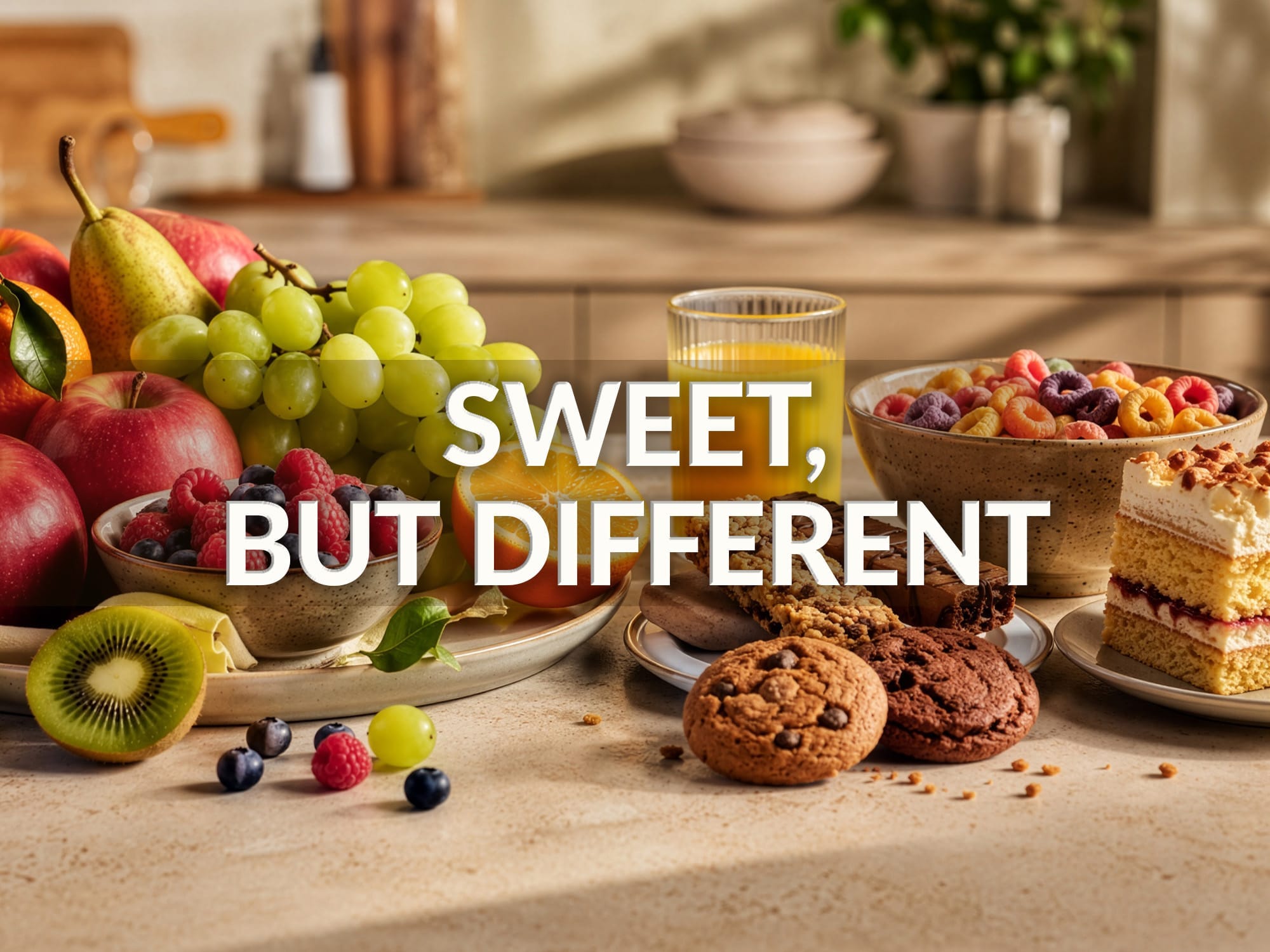
It’s a fair question. But ‘contains sugar’ is not the same as ‘behaves like sugar’. The problem with much modern sugar is that its sweetness is stripped of structure: concentrated, liquefied, rapidly consumed, and easy to overdo. Whole fruit gives you sweetness inside a slower, fibre-rich, water-rich plant food.
Let’s have a proper look, because I don’t want sugar anxiety coming between you and the health benefits of eating more fruit.
What you may be missing if sugar anxiety keeps fruit off the menu
Let’s put the stakes on the table first.
In that Harvard study, following over 100,000 Americans for decades, eating around 200g of fruit a day, roughly two handfuls, was associated with a 15% lower risk of dying prematurely from any cause, and a 20% lower risk of coronary heart disease or stroke.
Fruit wasn’t just ‘quite good’. It was the single strongest dietary predictor of healthy ageing.

That finding sits within a broader evidence base.
A 2017 meta-analysis of 95 prospective studies confirmed that fruit consumption is strongly associated with lower all-cause mortality and lower stroke risk. In a study of over 126,000 US adults followed for 8 to 14 years, those eating the most fruit had a 20% lower risk of developing coronary heart disease compared to those eating the least.
Now, these are observational studies, which means fruit eaters may differ from non-fruit eaters in other ways. But the consistency of the signal, across multiple studies, outcomes, and decades, makes ‘avoid fruit because of sugar’ a hard position to defend. If fruit were quietly poisoning your metabolism, this is not the pattern you’d expect to see.
The diabetes evidence breaks the ‘fruit = sugar = diabetes’ story
If fruit sugar behaved like the sugar in fizzy drinks, you’d expect more fruit to mean more diabetes. The data show the opposite.
In a meta-analysis of 20 studies involving more than 1.5 million people, those eating around 200g/7oz of fruit a day had an 8–12% lower risk of developing type 2 diabetes compared to those who ate little or none. Above 200–300g per day the benefit begins to taper, but even at half a kilo of fruit daily, diabetes risk remains lower than for non-fruit eaters.

That graph is worth reflecting on for a moment. The sweet food so many people fear is actually linked with the lowest diabetes risk at the very intake level linked with the greatest overall health benefits.
If whole fruit behaved like fizzy drinks, sweets, cakes, or sweetened coffees, you wouldn’t expect the lowest type 2 diabetes risk to sit around 200g/7oz of fruit a day.
What about people who already have diabetes?
A meta-analysis of 19 studies found that fruit consumption modestly lowered fasting blood sugar in people with diabetes, although it didn’t significantly affect HbA1c. And a 2025 review found that people with diabetes who ate the most fruit had an 18% lower risk of dying from any cause.
You’re not going to get that result from drinking cola.
These studies don’t prove that fruit treats diabetes. Other factors may come into play, and individual responses vary. But they do suggest that treating whole fruit like sweets or fizzy drinks is not supported by the evidence.
Whole fruit behaves differently because structure matters
The problem with modern sugar is that it’s usually sweetness stripped of structure: concentrated, liquefied, rapidly consumed, and easy to overdo. Whole fruit gives you sweetness in a slower, fibre-rich, water-rich, nutrient-rich package.
Why does that matter?
Because an orange is not a round soft drink. A bowl of berries is not a small cake wearing a halo.
Chewing and volume. Whole fruit takes time to eat. It fills your stomach. It makes you feel full before you’ve consumed much energy.
Intact plant cells. Fruit sugar is trapped inside cell walls, slowing its release into the bloodstream. You don’t get the spike you’d get from, say, cake or a glass of juice.
Fibre and water. These reduce energy density and slow gastric emptying.
Microbiome support. Gut bacteria ferment fruit fibre into short-chain fatty acids, which may improve insulin sensitivity and reduce inflammation.
Polyphenols and micronutrients. Polyphenols act as antioxidants and can reduce inflammation.
The weight of evidence is fully consistent with this. In the Nurses’ Health Study, women who increased their fruit and vegetable intake the most were 24% less likely to develop obesity. A separate analysis found that those eating more fruit had lower body fat and a slimmer waist.
With free sugar, weight gain is a consistent concern. With whole fruit, the pattern usually points the other way.
Fructose panic: HFCS is the wrong lesson to apply to apples
Here’s where the fear often starts. Largely due to generous US subsidies, sweetened drinks are mostly sweetened with high-fructose corn syrup (HFCS). Multiple studies link consumption of sugar-sweetened drinks to weight gain, type 2 diabetes, cardiovascular disease, high blood pressure, liver disease, and some cancers.
People have reasonably concluded that fructose must be especially harmful. And since fructose is the most common sugar in many fruits, that fear gets transferred to the fruit bowl.
But there are two problems with that logic.
First, multiple studies have found no material difference in metabolic effects between HFCS and ordinary table sugar (sucrose) at comparable doses. There’s nothing uniquely toxic about fructose as a molecule. The problems come from consuming excess free sugars, in whatever form, especially in liquid form.
Second, the dose and delivery are completely different. A large soft drink can deliver 40–65g of free sugar in less time than it takes to find your keys, with no fibre, no chewing, no effect on your appetite, and often on top of your usual calorie intake.
Two handfuls of whole fruit deliver much less sugar, slowly, inside a food that fills you up.
In one small but interesting trial, overweight participants were assigned either to a low-fructose diet or to a moderately high-fructose diet where all the fructose came from whole fruit. Both groups ate fewer calories overall and lost weight. But the whole-fruit group lost 4.2kg over six weeks, compared with 2.8kg in the low-fructose group. Fructose delivered inside intact fruit didn’t hinder weight loss in this trial: it appeared to help it.
This is one short-duration study, so we shouldn’t take this to mean fructose is the newest weight-loss strategy. But it reinforces the broader pattern: fructose in a soft drink and fructose in an orange are the same molecule, but they can have very different effects.
It reinforces the message: the greatest health benefits come from cutting back on free and added sugar while hitting daily whole fruit targets.
Whole fruit is the target; juice and many smoothies are not equivalent
It’s important to note that when I say “eat more fruit,” I mean whole fruit: apples, oranges, berries, pears, peaches, grapes, kiwi, melon, and similar. I don’t mean a large glass of orange juice or a bottle of commercial smoothie.
Why? Because juicing removes or bypasses much of what makes whole fruit different: the chewing, the intact cells, the fullness, the slower intake.
In a Peruvian study of almost 100,000 adults, whole fruit was associated with a lower BMI, fruit salad had no significant effect on it, and fruit juice was associated with a higher BMI. The more you break up the fruit, the faster the sugar hits the bloodstream and the less full you feel. It’s like the difference between a slow burn and a flare.
Smoothies sit somewhere between whole fruit and juice. A homemade smoothie built around whole fruit, yoghurt, and a handful of nuts is probably reasonable. A commercial smoothie consisting mostly of fruit juice and fruit purées is, for practical purposes, juice-like in its effects.
The simple test: if you can drink it quickly, you don’t need to chew it, and it’s mostly juice or purée, it’s more like a canned sweet drink than a piece of fruit. Don’t be misled by health-halo branding.
What this means for your health
If the health benefits of fruit sound compelling, but part of you still thinks, “Yes, but what about all that sugar?”, you’re exactly the person this issue is for.
That concern is understandable. We’ve spent years hearing that sugar is harmful, and that fructose may be especially problematic. But the evidence doesn’t support carrying that fear over to normal portions of whole fruit.
Apples, oranges, berries, pears, peaches, grapes, and similar fruits are not behaving in your body like fizzy drinks, fruit juice, sweetened coffees, cakes, biscuits, sweets, or desserts.
You can enjoy about two handfuls of whole fruit a day, get the health benefits repeatedly linked with that intake, and stop worrying that fruit is secretly undermining your health because it tastes sweet.
The mistake is treating fruit as “sugar with vitamins.” It isn’t. It’s an intact plant food that happens to taste sweet, and that difference is the whole point.
If someone came to mind while you were reading this, please forward it to them. These tweaks may be small, but practised consistently they can genuinely change long-term health. A useful nudge at the right moment can make all the difference.
HEALTH TWEAK OF THE WEEK
A lot of sensible people are eating less fruit than the evidence suggests they should, not because they dislike fruit, but because they’re worried about sugar.
That worry makes sense if we’re talking about fizzy drinks, fruit juice, cakes, biscuits, sweets, and sweetened coffees. But whole fruit is different: its sugar comes packaged inside an intact, fibre-rich, water-rich plant food that slows you down, fills you up, and behaves very differently from liquid or refined sugar.
Around 200g/7oz/two handfuls of whole fruit a day is the intake repeatedly linked with better long-term health: a 15% lower risk of dying prematurely from any cause, a 20% lower risk of coronary heart disease and stroke, and an 8–12% lower risk of type 2 diabetes. In the Harvard healthy-ageing study, fruit was the single strongest dietary predictor of reaching 70 in good health.
So this week’s tweak is simple: don’t let sugar anxiety push whole fruit off your plate.
1. Eat two handfuls of whole fruit daily. For the next 14 days, aim for around 200g/7oz of whole fruit each day, ideally from at least two or three different fruits. Berries, apples, oranges, pears, peaches, grapes, kiwi, melon, and similar all count.
2. Replace one less healthy sweet option with fruit. Use fruit instead of juice, biscuits, sweets, dessert, or a sugary drink where you can. Berries with yoghurt, an apple after lunch, citrus after dinner, grapes instead of sweets: simple swaps that move sweetness back into a healthier package.
3. Keep fruit intact where possible. Choose fruit you chew. Treat juice and most commercial smoothies as sweet drinks rather than fruit equivalents. If it’s liquid, mostly juice or purée, and you finish it in two minutes, it’s not giving you the benefits whole fruit gives you.
If you have diabetes, you still need to think about portion size, timing, medication, and your own glucose responses. But the evidence does not support treating normal portions of whole fruit like Coke or sweets. Whole fruit belongs in the “worth including thoughtfully” category, not the “avoid because it tastes sweet” category. But everyone’s diabetes is different, so talk to your doctor or dietician before making changes.
You don’t have to choose between enjoying sweet fruit and looking after your long-term health. Two handfuls a day is not an indulgence to justify. It’s one of the rare health upgrades that feels like adding pleasure, not removing it.
🎧 Prefer to listen while raiding the fruit bowl?
🎙️ This week’s One Health Tweak a Week podcast is about why whole fruit isn’t sugar in disguise.
You’ll hear:
Why “contains sugar” is not the same as “behaves like sugar”
How around 200g of whole fruit a day fits with better long-term health, including lower risks of type 2 diabetes and premature death
Why fears about fructose and high-fructose corn syrup shouldn’t be carried over to apples, oranges, berries, pears, and grapes
Why juice and many commercial smoothies sit in a very different category from fruit you chew
👉 Ideal for your next walk, commute, or while deciding whether tonight’s “something sweet” is going to come from a bowl, a wrapper, or a glass.
(Episodes are free for now. Paid subscribers support the deeper research - and the practical tools I’m building to help you act on what you learn, not just collect another interesting health fact.)
🧭 Before you go
💬 Do you hold back from eating fruit because of sugar or fructose?
Or are you already firmly in the ‘fruit bowl needs restocking twice a week’ camp?
📤 Know someone who avoids bananas because they’re ‘too sugary’ but drinks juice, smoothies, or sweetened coffees without a second thought? Send this their way.
👥 Paid corner - Want help making fruit work with your blood sugar, waistline, snack habits, or evening sweet tooth? Drop me a note in our private chat, and we’ll map out a few realistic swaps.
Until next Saturday - may your fruit bowl become less decorative and more useful. 🍎
– Ben
If you missed earlier articles on the fruit series, you can find them here:


Ben, I love the graphics you produce that simply, and effectively, communicate the key points. Our fruit bowl (and freezer) have always had "gravitational pull" (as you phrased it) for my wife and I. Every week we buy apples, bananas, mangoes (when in season here), mandarin and navel oranges, organic blueberries and strawberries and sometimes kiwi, pineapple, mamay or something else. Fruitaholics Anonymous is alive and well.
This is a great summary, Ben. It took me a while to dissuade my daughter from "juicing."