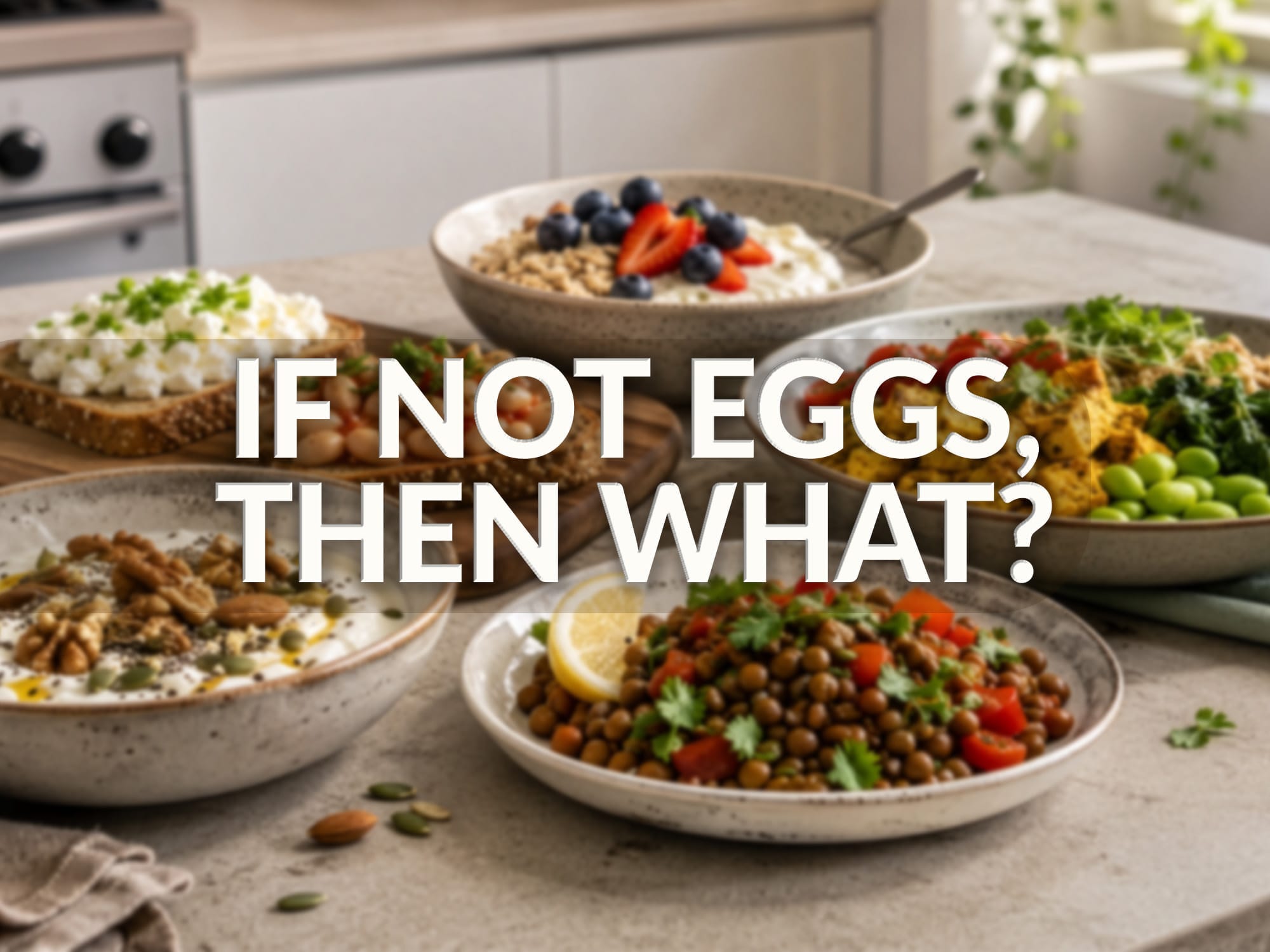
Could Everyday Eggs Be Crowding Out Foods Linked to Longer Life?
The health effect of eating fewer eggs depends on what takes their place - and some replacements offer far more than others.
I’ve been feeling a little guilty since the last egg issue (and not just because I accidentally sent the newsletter on Thursday instead of Saturday!)
In that issue, I laid out the evidence linking regular whole-egg consumption to a higher risk of premature death. For those of us eating a typical Western diet, each additional half egg per day was associated with a 7% higher risk. The data were clear enough that I couldn’t soften them, and I don’t think you should ignore them either.
But eggs aren’t just a line on a nutrition spreadsheet. They’re warm, satisfying, endlessly adaptable, and one of the quickest meals you can put together.
They’re also a reliable way to boost protein, something many of us are concerned about.
Asking you to eat fewer eggs without showing you what could fill the space on the plate didn’t feel terribly helpful. But then I only had five minutes of your time. Now I have five more!
So, what should you eat instead?
The good news is that the answer isn’t just “something less harmful.” Replacing eggs with the right foods is associated with additional meaningful reductions in the risk of premature death, cardiovascular disease and type 2 diabetes.
A bowl of almonds might contain the same amount of protein, but it doesn’t feel much like an omelette. A better way of thinking about swaps is to replace the function the egg-based meal was serving: the speed, the warmth, the protein, the satisfaction. And once you start thinking about it that way, the options open up considerably.
The lowest-friction switch: fewer yolks, more whites
If you’re not ready to abandon egg-based meals entirely, you don’t have to.
Eggs are effectively two different foods sharing the same shell. The yolk carries the cholesterol and most of the fat, while the white is mostly protein and water.
In a study of more than 520,000 Americans aged 50–71, followed for 15–16 years, researchers estimated that replacing half a whole egg per day with egg whites was associated with a 6% lower risk of premature death. That’s compared with a 7% higher risk for each additional half whole egg consumed per day.
What’s really eye-catching is that those who ate only egg whites had a 7% lower mortality risk than people who didn’t eat eggs at all. In other words, egg whites are associated with benefits of their own.
The pattern held broadly across disease categories. In almost every outcome the researchers examined, whole eggs were associated with higher risk and egg whites with lower risk.
You can see that in the graph below, where anything above the line represents an increased risk, while anything below it signifies reduced risk.

One egg white provides about 3.6g of complete, highly absorbable protein (and 0.35g of leucine, for protein experts who know enough to care about leucine). So a meal built around one whole egg with two or three additional whites preserves much of the warmth, flavour and convenience of the original dish, with similar protein and much less cholesterol.
It’s important to say these are observational associations in an older American population eating largely Western diets. They don’t prove that egg whites caused the lower risks, but the contrast is striking enough to make egg whites a very reasonable bridge for anyone who enjoys egg-based meals.
The strongest signals: nuts, legumes, whole grains and fish
If you’re happy to move beyond egg-based meals entirely, the data suggest some replacements are substantially better than others.
From that same study of more than 520,000 adults, the estimated reductions in premature death from replacing just half an egg per day with other foods were:
Egg whites: 6% lower
Dairy products: 7% lower
Poultry: 8% lower
Fish: 9% lower
Legumes: 10% lower
Nuts: 13% lower
A separate meta-analysis of 24 prospective studies provides further insights, this time looking at what happened when an entire daily egg was replaced. Replacing one egg per day with nuts was associated with:
15% lower premature deaths from any cause
17% lower risk of cardiovascular disease
16% lower cardiovascular mortality
18% lower risk of type 2 diabetes
Replacing eggs with legumes was associated with a 10% lower risk of premature death from any cause and a 12% lower cardiovascular disease risk. And replacing eggs with whole grains was associated with a striking 21% lower risk of type 2 diabetes.
A related analysis of more than 215,000 US adults followed for up to 32 years found that replacing one daily egg with yoghurt, whole grains, nuts, milk or cheese was associated with a 9–19% lower risk of type 2 diabetes.

So, this isn’t just damage limitation, since each of these replacements brings something eggs don’t.
For example, nuts and seeds deliver unsaturated fats and fibre, while legumes combine fibre with plant protein. Whole grains bring fibre and minerals, while oily fish have loads of omega-3 fats. The foods most strongly associated with benefits in the substitution data are precisely the ones that fill nutritional gaps an egg-centred meal wasn’t addressing.
Don’t read these percentages as a precise league table. The broad direction is consistent, but the exact ranking of, say, fish versus poultry depends on the study.
Not all swaps are good swaps
The health effect of eating fewer eggs depends entirely on what fills the space.
In a study of more than 215,000 US adults followed for up to 32 years, researchers estimated that replacing one egg per day with processed meat was associated with a 15% higher risk of cardiovascular disease. Swapping to red meat was associated with a 10% higher risk. Swapping to full-fat milk was linked to an 11% higher risk.
By contrast, replacing eggs with fish, poultry, legumes, nuts, whole grains or reduced-fat dairy was not associated with any increase in cardiovascular risk.
So a sausage isn’t a health upgrade from an egg. And just because poultry does well isn’t an excuse to resort to chicken nuggets. Processed poultry still belongs to the processed-meat conversation.
Also, lower-fat and full-fat dairy aren’t interchangeable here. The benefits seen with dairy came only from the reduced-fat versions.
Protein adds up across the meal
One concern I hear often is, “If I eat fewer eggs, where will I get my protein?”
If eggs have become one of your reliable ways to reach a protein target, losing them may feel like solving one nutritional problem only to create another.
One large whole egg provides about 6.24g of protein. That’s a useful amount, but it doesn’t need to come from a single replacement food. Protein accumulates across the meal.
It’s not that hard to replace the protein from an egg. Roughly 6g of protein comes from any one of these:
28g/1oz chicken breast (uncooked weight)
31g/1.1oz salmon
71g/2.5oz Greek yoghurt
54g/1.9oz cottage cheese
52g/1.8oz edamame
29g/1oz almonds
46g/1.6oz rolled oats
89g/3.1oz canned chickpeas
1 slice wholegrain bread
Rather than think about one-for-one swaps, think about the meal as a whole. It then becomes much easier to see how you replace an egg’s protein.
Good combinations might be:
A bowl of Greek yoghurt with nuts and seeds
Oats with yogurt and berries
Beans or cottage cheese on wholegrain toast
Tofu with edamame and vegetables, or
Beans or lentils with whole grains
For a selection of high-protein breakfast and brunch recipes, have a look at one of my earlier articles.
What this means for your health
Seeing that rather stark statistic, which says that, on average, for someone eating a Western diet, each additional half-egg daily increases the risk of premature death by 7%, provides a pretty strong incentive to eat fewer eggs.
Rather than just looking at a list of protein-rich foods and wondering what to swap, first consider what the egg was doing for you.
Was it providing speed? Warmth? Something savoury and satisfying at the end of a long day? The replacement should match the function, not just the nutrient profile.
Perhaps the easiest option is to preserve your egg-based meals by using fewer yolks and more whites: one whole egg with two or three additional whites gives you more protein than two whole eggs, at a fraction of the cholesterol.
The second option, and the one that’s associated with the greater additional health benefits, is to bring in foods you may currently eat too little of: nuts, legumes, whole grains, fish, lower-fat dairy, fruit and vegetables.
Fewer whole eggs doesn’t have to mean no whole eggs. For me, two yolks a week feels like a sensible maximum. As we discussed last week, eggs are very context-dependent.
HEALTH TWEAK OF THE WEEK
Replacing whole eggs with egg whites, nuts, legumes, fish, whole grains or lower-fat dairy is associated with lower risks of premature death, cardiovascular disease and type 2 diabetes.
The benefits come not just from removing the yolk, but from adding foods that bring fibre, unsaturated fats, omega-3 fats and plant protein. But avoid replacing eggs with processed meat, red meat or full-fat dairy, which are associated with higher cardiovascular risk.
1. Preserve the egg meal with fewer yolks. Use one whole egg with 2–3 additional whites for an omelette or scramble. Add spinach and lower-fat cream cheese, or salmon and grilled peppers, to turn it into a substantial breakfast, lunch or light evening meal. The whites restore volume and protein without adding another yolk.
2. Match the replacement to what you need.
Quick and familiar: nut butter on wholegrain toast.
Cool and protein-rich: Greek yoghurt with nuts, seeds and berries.
Warm breakfast: oats with nuts, seeds or yoghurt.
Warm and savoury: tofu scramble with vegetables.
Substantial lunch or supper: beans or lentils with whole grains.
Minimal prep: cottage cheese on wholegrain toast.
Fish option: sardines, tuna or salmon with whole grains and vegetables.
3. Let the whole meal do the protein work. You don’t need one ingredient to replace all the protein from an egg. Combine Greek yoghurt with nuts and seeds; oats with yoghurt; beans or lentils with whole grains; or one whole egg with extra whites. Favour nuts, legumes, whole grains, fish and lower-fat dairy over processed meat, red meat or full-fat dairy.
The useful part of this change is how much it can add to the rest of the meal. A few extra whites keep familiar egg dishes on the table, while nuts, legumes, whole grains, fish and yoghurt bring in fibre, better fats and more variety across the week. You still get something quick, satisfying and rich in protein, but the meal now carries a little more nutritional weight.
🎧 Prefer to listen while whipping up an egg white omelette?
🎙️ This week’s One Health Tweak a Week podcast looks at what to eat when you’re cutting back on whole eggs.
You’ll hear:
Why using fewer yolks and more egg whites is the simplest way to keep familiar egg-based meals
Which replacements are linked to lower risks of premature death, cardiovascular disease and type 2 diabetes
Why nuts, legumes, whole grains, fish and lower-fat dairy tend to come out well in substitution studies
Why swapping eggs for processed meat, red meat or full-fat dairy may be a step in the wrong direction
How to build quick, satisfying meals that still provide plenty of protein
👉 Ideal for your next walk, commute, or while looking into the fridge and discovering that “eat fewer eggs” was the easy part of the advice.
(Episodes are free for now. Paid subscribers support the deeper research, and the practical tools I’m building to help you act on what you learn, rather than simply collect another interesting health fact.)
🧭 Before you go
💬 Which egg-based meal would be hardest for you to replace: breakfast, lunch or a quick evening meal?
And what would you genuinely look forward to eating instead?
📤 Know someone who relies on eggs for a quick meal or for protein? Send this their way.
👥 Paid corner - Trying to work out how fewer eggs would fit with your protein needs, cholesterol results or usual meals? Drop me a note in our private chat, and we can think through some practical replacements that would suit the way you actually eat.
Until next Saturday, may your breakfasts remain satisfying, and your fridge contain at least one genuinely useful alternative.
– Ben
If you missed the previous egg issue, you can find it here:


I usually avoid eggs when I can. I don't think I'm as risk but from a sustainability point it seems right to me. Hummus and avocados are my favorite replacements, somehow hitting the spot. A breakfast burrito with tofu scratches my egg itch and garbanzo bean flour for a quiche also has been a good replacement. I appreciate this article because it's so tangible.
Ben, I am not sure I am buying this egg data. For example eating another egg increases heart risk by 7%. I am assuming this is relative risk reduction. If so then absolute risk reduction (one’s individual risk) is far less, perhaps <1%. And this also ignores how the eggs were prepared ( soft, medium or hard boiled probably healthier than fried). And what were there served with? Was it bacon and hollandaise sauce or a slice of wholegrain toast with a tiny bit of butter? You get the idea.