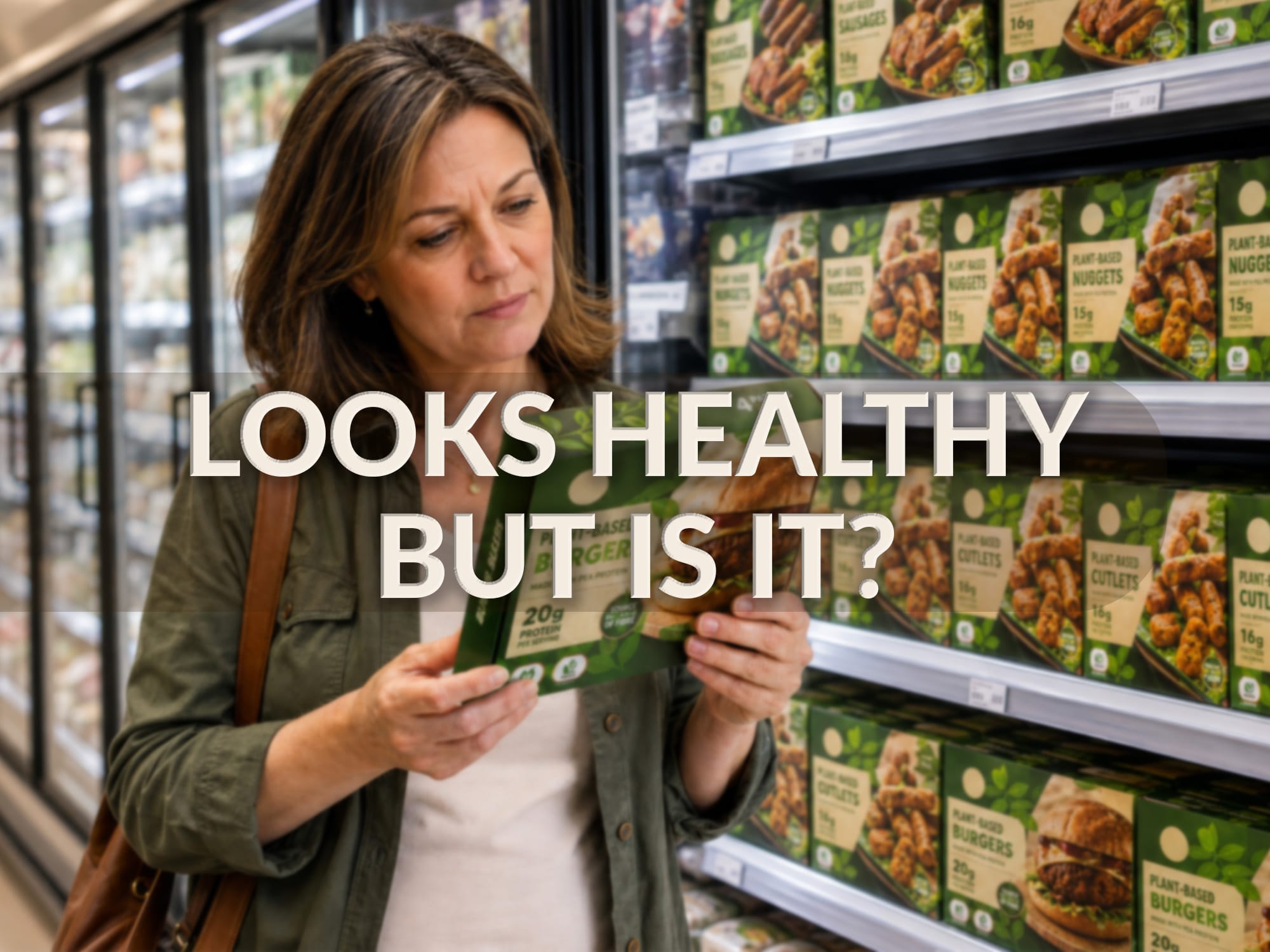
Could Plant-Based Meat Be the Healthier Choice?
Today’s meat-free burgers, mince and nuggets are more convincing than ever. But does the health case match the marketing?
I remember Linda McCartney’s frozen veggie sausages arriving in the supermarket freezer aisle sometime in the early 1990s. They felt like the future: principled, ethically sound, faintly revolutionary. Then you ate one.
The future, it turned out, tasted like salty mush.
Three decades on, the category has changed beyond recognition. Today’s plant-based meats are engineered to mimic the look, chew, sizzle, and even the bleed of real meat.
The global market was worth an estimated $10.4 billion in 2025 and is projected to reach $30.4 billion by 2032. Celebrity investors have piled in: Leonardo DiCaprio, Jay-Z, Beyoncé, Kim Kardashian, Snoop Dogg.
This is no longer a niche for committed vegetarians. It’s a mainstream bet.
But here’s the question that matters most to your health: has the science improved as much as the imitation?
When the packaging says “plant-based,” is that a health claim, or just a description of the raw materials? Could eating plant-based meats improve your long-term health
Let’s look at what the evidence shows.
These aren’t plants in a different shape
First, a category distinction that often gets side-stepped.
Tofu, tempeh, lentils, beans, textured soy and pea protein: these are minimally processed plant proteins. They’ve been eaten for centuries, have strong nutritional profiles, and have well-supported health credentials.
Plant-based meat alternatives are a different product entirely.
Burgers, sausages, mince, meatballs, nuggets: they’re designed to replicate the full sensory experience of meat, and doing that requires serious food engineering. One look at the ingredient panels tells you everything you need to know.

These are ultra-processed foods. Not all of them are nutritionally identical, and some are better than others, but the category sits firmly in UPF territory.
That doesn’t automatically make them harmful. But it does mean we should hold them to the same scrutiny we’d give any other ultra-processed product, rather than treating them as health foods simply because the word “plant” is on the box.
Short-term trials show a plausible benefit
When researchers test what happens when people swap real meat for plant-based meat over a few weeks, the results are generally encouraging.
The best overall summary comes from 7 randomised trials involving 369 adults. Across these studies, people who replaced meat with plant-based meat for up to 8 weeks saw, on average, a 12% fall in LDL (’bad’) cholesterol and a modest 1% drop in body weight.
That’s a useful signal. LDL is one of the blood fats most closely linked to cardiovascular risk. So if a food swap reliably lowers LDL, we should pay attention.
One trial helps explain what may be going on. Researchers asked 36 healthy adults to eat at least 2 portions a day of either real meat or plant-based meat for 8 weeks, then switch to the other version. During the plant-based phase, people ate less saturated fat and more fibre. Their LDL cholesterol was 9% lower, and they lost about 1kg (2.2 lb) on average.
That makes nutritional sense. Many plant-based meat products contain less saturated fat than the meat products they’re replacing, and some contain more fibre. Less saturated fat plus more fibre is a perfectly understandable recipe for lower LDL cholesterol.
It’s worth saying that, like many studies on plant-based meats, this study was sponsored by a food manufacturer, though the analysis plan was pre-registered and the statistical analyses were handled independently.
A smaller study comparing red meat with mycoprotein, better known as Quorn, found a similar LDL cholesterol reduction over 2 weeks, along with small improvements in waist size and blood pressure. Again, useful, but small and short-term.
Why the improvement? Probably nothing magical about “plant meat” as a concept. It’s simpler than that: many of these products contain less saturated fat and more fibre than their animal equivalents. Swap one for the other, and your LDL tends to drift in the right direction.
But the signal isn’t settled
Not all trials agree. An 8-week study of 89 adults comparing plant-based meats with their real-meat equivalents found no significant effects on LDL or other cardiometabolic markers. Product composition, baseline diet, and study design all likely matter.
So the short-term picture is: probably some benefit for LDL cholesterol, probably modest, and probably driven by the nutrient profile of the swap rather than any inherent property of plant-based meat.
However, while changes in surrogate markers like LDL cholesterol and body weight are useful signals, they aren’t proof of long-term benefit. For that, we need longer-term evidence. And the longer-term evidence tells a more complicated story.
Long-term evidence favours whole plants, not plant-based UPFs
The most relevant long-term data comes from the UK Biobank: over 118,000 British adults aged 40–69, followed for 9 years.
The findings split cleanly along the processing line:
Each 10% increase in plant-sourced non-UPF food (i.e. whole plant foods) was associated with a 7% lower risk of cardiovascular disease and a 13% lower risk of premature death from any cause.
Each 10% increase in plant-based UPF food was associated with a 5% higher risk of cardiovascular disease and a 12% higher risk of premature death from any cause.
The researchers estimated that switching from plant-based UPFs to whole plant foods could mean a 7% reduction in cardiovascular disease and a 15% lower all-cause mortality. Same plants, different processing, very different outcomes.

While this sounds concerning, there’s an important caveat: in this study, plant-based meat alternatives accounted for just 0.2% of participants’ daily energy intake. That’s vanishingly small. It means any effect of these foods could be greatly diluted by everything else in the diet.
We should be cautious about reading too much into it, but the direction of travel is consistent with the wider UPF evidence: more processing = more risk.
A separate analysis from the EPIC study of almost 312,000 Europeans reported that “plant-based alternatives” were associated with a 54% lower risk of type 2 diabetes. That sounds reassuring until you dig in.
The study didn’t define what counted as a “plant-based alternative,” and the same analysis found sweets and desserts linked to an 11% lower risk of diabetes, which is hard to take at face value. I don’t find that result convincing.
The real comparator matters
Here’s a point that often gets lost in the marketing.
Plant-based meats almost always compete with processed meats: bacon, sausages, burgers, nuggets. And processed meats set a very low bar. The International Agency for Research on Cancer estimates that each additional 50g of processed meat per day is associated with an 18% higher risk of bowel cancer.
So when a plant-based sausage looks “healthier” than a pork sausage, that may well be true. But “better than processed meat” is a bit like finishing above last place.
If you’re interested in long-term health, which I’m pretty sure you are, then you’re hoping to be leading the pack, not just avoiding last place!
What this means for your health
“Plant-based” has become a health halo, but it covers an enormous range.
A bowl of lentils is plant-based. So is a box of ultra-processed nuggets made from methylcellulose, pea protein isolate, and a dozen other ingredients you’d never find in a kitchen cupboard.
If you’re currently eating processed meat regularly, swapping some of it for plant-based equivalents may modestly improve your LDL cholesterol and could be a small step in the right direction.
But if the choice is between a plant-based sausage and a plate of beans, lentils, tofu, fish, or poultry, the whole or minimally processed option is almost certainly the better bet.
The practical decision rule: think of plant-based meats as an occasional bridge away from processed meat, not a destination. And don’t confuse them with the genuinely health-supporting category of whole plant foods.
As always, your responses are anonymous, but they really help me tailor future content to what’s most helpful to you. Please take a moment to click a button.
HEALTH TWEAK OF THE WEEK
Plant-based meats may wear a health halo, but make no mistake: they are ultra-processed foods that sit in the same manufacturing territory as the processed meats they mimic.
Short-term trials suggest they may modestly lower LDL cholesterol when they replace real meat, but longer-term evidence favours whole plant foods over plant-based UPFs.
At best, they’re a less-bad substitute for some processed meats, and that’s a low bar.
1. Classify the swap before you make it. Before reaching for a plant-based burger or sausage, ask one question: “What is this replacing?”
If it’s displacing bacon, pork sausages, or processed nuggets, it’s probably a modest upgrade.
If it’s replacing beans, lentils, tofu, tempeh, fish, poultry, or any minimally processed meal, it’s likely a downgrade. The direction of the swap matters more than the label on the packet.
2. Use plant-based meats as occasional bridge foods, not staples. They’re useful for barbecues, family meals where someone won’t eat beans, quick weeknight dinners, or easing a transition away from processed meat. That’s fine.
But treat them as the convenience food they are, not as a health upgrade you can eat freely. A few times a month is very different from a few times a week.
3. Build your regular protein habit around whole and minimally processed foods. The everyday base should be beans, lentils, chickpeas, tofu, tempeh, nuts, whole grains, fish, and poultry.
These foods bring fibre, micronutrients, and a nutritional depth that plant-based meats can’t match, and you won’t need a food-science degree to read the label.
If plant-based meat helps you eat fewer sausages, burgers or nuggets, that’s a step worth taking.
The next step is the one that matters more: making the regular diet less processed, more varied, and built around foods your grandmother would recognise.
🎧 Prefer to listen while grilling something that looks suspiciously like meat but isn’t?
🎙️ This week’s One Health Tweak a Week podcast is about plant-based meats, ultra-processing, and why eating plant-based meat isn’t the same as eating plants.
You’ll hear:
Why tofu, tempeh, beans and lentils are not the same category as plant-based burgers, sausages, mince and nuggets
What short-term trials suggest about LDL cholesterol, fibre, saturated fat and weight
Why the long-term health evidence is much stronger for whole plant foods than for plant-based ultra-processed foods
How to decide whether a plant-based meat swap is a useful step away from processed meat, or just a different kind of convenience food
👉 Ideal for your next walk, commute, or while standing in the supermarket quietly wondering what methylcellulose is doing in your burger.
(Episodes are free for now. Paid subscribers support the deeper research - and the practical tools I’m building to help you act on what you learn, not just collect another interesting health fact.)
🧭 Before you go
💬 Do plant-based meats turn up in your week: burgers, sausages, mince, nuggets, or not really?
And when they do, are they replacing processed meat, or replacing something simpler?
📤 Know someone who assumes “plant-based” automatically means healthier, or someone trying to cut down on meat without living on lentils? Send this their way.
👥 Paid corner - Want help working out which swaps are actually worth making? Drop me a note in our private chat, and we’ll sort your regular meals into three buckets: useful swaps, convenience compromises, and better everyday defaults.
Until next Saturday - may your burgers be properly classified, your lentils get the respect they deserve, and your ingredient panels be shorter than your insurance policy’s terms and conditions.
– Ben


What are the studies on plant based meats in animal studies? It’s harder to make sense in human studies. People studies are harder to control and design.
I am more a believer in mice. They are more trustworthy than people.
For a time I was eating a plant based sausage in the AM. I hadn’t really looked at the ingredients but once I did I stopped and never went back. I wasn’t even eating it to avoid sausage or whatever - it was simply more convenient.
Most often hear plant based meat touted as an alternative for real meat. Ie steaks, pork chops, lamb. Eat plant based meat they say: save your body and save the plant. I don’t think I’ve ever heard them described as an alternative to sausage etc. I’ll take my ribeye any day of the week (though usually only occasionally) over the UPF plant based meat.